Are you looking for ways to improve your blog? Want to know how to be more creative with your writing?
According to Expert Editor you need to drink more!
They share the science behind writing whilst drunk and then editing whilst sober in this infographic.
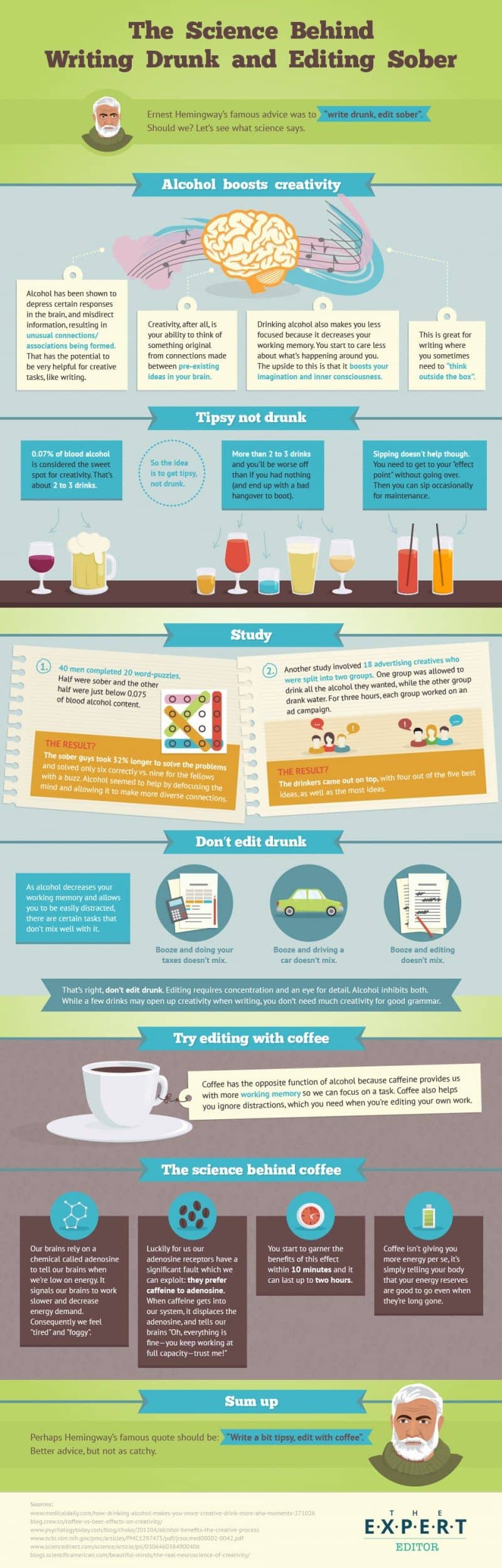
Ernest Hemingway is often credited with the advice, “Write drunk, edit sober.” While there’s no evidence he actually said this, the phrase has taken on a life of its own in creative circles. It suggests that the best writing happens when you let go of inhibitions and allow creativity to flow, while the best editing requires a sober, meticulous approach.
But does this advice hold any merit? And more importantly, can applying this mindset improve your blog? In this guide, we’ll explore the science behind this concept, how it applies to blogging, and how you can implement it to create compelling content that engages readers.
The Philosophy of “Write Drunk, Edit Sober”
At its core, this phrase isn’t really about drinking alcohol. Instead, it’s about embracing two distinct mindsets in the writing process:
- Unfiltered Creativity (Writing Drunk) – The drafting stage should be free-flowing, uninhibited, and imaginative. This is where you let ideas pour out without self-censorship.
- Meticulous Refinement (Editing Sober) – The editing phase is where you refine, structure, and polish your work. It’s about fixing mistakes, improving clarity, and ensuring coherence.
By separating these two phases, you avoid self-editing while writing—one of the biggest creativity killers. Let’s break this down further.
The Science Behind Writing Drunk (Figuratively Speaking)
Even without alcohol, the idea of “writing drunk” is backed by cognitive science. Creativity thrives when our brains are in a relaxed, unrestricted state. Here’s why:
Loosening Mental Filters
Alcohol is known to lower inhibitions, which is why people often say things they normally wouldn’t after a few drinks. While you don’t need to consume alcohol to write, adopting a “drunken” mindset—one free from self-judgment—helps ideas flow without fear of imperfection.
A study published in Consciousness and Cognition found that people with mild intoxication (a blood alcohol content of 0.075%) performed better in creative problem-solving tasks than sober individuals. This suggests that slight mental disinhibition can improve creative thinking.
Allowing Divergent Thinking
When you overanalyze your writing while drafting, you limit creative connections. Creativity thrives in a state called divergent thinking—the ability to generate multiple ideas from a single concept. This is why ideas often strike when you’re relaxed, like in the shower or just before sleep.
To mimic this effect, try:
- Freewriting without stopping
- Brainstorming without rejecting ideas
- Writing without rereading every sentence
Fostering “Flow”
Flow is a mental state where you’re fully immersed in an activity, losing track of time and distractions. Many writers describe their best work happening in a flow state. Writing freely—without worrying about typos, grammar, or sentence structure—helps achieve this.
How to Apply the “Write Drunk” Method to Blogging
While we’re not suggesting you pour yourself a glass of whiskey before every writing session, adopting the “drunk” mindset can significantly improve your blog content. Here’s how:
Silence Your Inner Critic
One of the biggest barriers to effective blogging is self-doubt. If you constantly second-guess your ideas, you’ll never get past the first sentence. Instead of worrying about whether your opening line is perfect, just start writing.
Try this exercise:
- Set a timer for 10 minutes.
- Write about your topic without stopping.
- Don’t edit or delete anything.
- Review what you wrote after the timer ends.
You’ll be surprised at how much raw material you generate.
Embrace Imperfection
Many bloggers struggle with perfectionism, rewriting sentences over and over before they’ve even finished a draft. Instead, adopt the mindset that your first draft is supposed to be messy. Editing comes later.
Write as You Speak
A great blog should feel conversational. Writing in a relaxed, natural tone—almost like talking to a friend—makes content more engaging. Don’t overthink phrasing or try to sound overly sophisticated. Just get the words down.
Experiment with Ideas
Some of the best blog posts come from spontaneous ideas. Instead of overanalyzing whether an idea is good enough, write it down first and evaluate later. Blogging should be fun and exploratory, not rigid and stressful.
The Science Behind Editing Sober
Now that you have a rough draft, it’s time to switch gears. Editing requires a completely different set of cognitive skills—ones rooted in logic, precision, and structure.
Engaging Analytical Thinking
Unlike the creative process, which relies on fluid and free-form thinking, editing demands critical analysis. This involves assessing readability, coherence, grammar, and tone. Studies on cognitive function show that analytical thinking and creativity use different neural pathways, which is why trying to edit while writing disrupts the creative process.
Improving Clarity and Conciseness
The editing phase is where you refine your message. This means:
- Cutting unnecessary words
- Reordering sentences for better flow
- Ensuring your key points are clear and direct
Fixing Mistakes
Even the best writers make errors. Common issues in blog drafts include:
- Grammar and spelling mistakes
- Redundant phrases
- Poorly structured sentences
This is why editing should always be done separately from writing—your brain needs time to reset before you can catch mistakes.
How to Edit Your Blog Like a Pro (While Sober)
Editing is where your blog post transforms from raw material into polished content. Here’s how to do it effectively:
Take a Break First
Never edit immediately after writing. Your brain is too familiar with the text, making it harder to spot errors. Wait a few hours or even a day before revisiting your draft.
Read Your Blog Out Loud
This helps identify awkward phrasing, run-on sentences, and missing words. If a sentence sounds unnatural when spoken, it probably needs revision.
Focus on Structure First, Details Second
Editing isn’t just about fixing typos. First, ensure your post has a clear introduction, body, and conclusion. Then, refine individual sentences and grammar.
Use Editing Tools
While human review is essential, tools like Grammarly, Hemingway Editor, and ProWritingAid can catch errors and suggest improvements.
Cut the Fluff
Blog readers appreciate clarity. Remove redundant words and tighten your writing. Example:
- Wordy: “In order to improve your writing, you need to make sure that you eliminate unnecessary words.”
- Concise: “To improve your writing, eliminate unnecessary words.”
Optimize for Readability
Good blog posts are skimmable. Use:
- Short paragraphs
- Bullet points
- Subheadings
- Bold text for key points
Check for SEO Best Practices
If your blog is for an audience beyond just yourself, ensure it’s optimized for search engines:
- Use relevant keywords naturally
- Write a compelling meta description
- Include internal and external links
- Format with headers (H1, H2, H3)
Finding the Balance: Creativity & Precision
Great blogging is about balancing creativity with precision. You need both unfiltered creativity and meticulous editing to produce compelling content. Here’s a simple workflow:
- Brainstorm & Freewrite → Get your ideas down without judgment.
- Take a Break → Step away to refresh your mind.
- Edit for Structure → Ensure logical flow and clarity.
- Edit for Grammar & Style → Fix typos and refine sentences.
- Final Review → Read aloud or use tools to catch overlooked issues.
Final Thoughts
The “Write Drunk, Edit Sober” approach isn’t about alcohol—it’s about understanding how creativity and analysis work best at different stages of writing. If you struggle with overthinking your blog posts or getting stuck on perfection, embracing this method can improve your writing process, reduce stress, and make blogging more enjoyable.
So next time you sit down to write, remember:
- Let creativity flow without judgment (write drunk).
- Refine and polish later with a critical eye (edit sober).
By following this principle, you’ll create more engaging, well-crafted, and effective blog content—without the headache of trying to do everything at once.
Now, grab your metaphorical drink, start writing, and refine your masterpiece later!

Author:
Mark Ford

The Complete Content Mix: What Every Business Should Be Publishing
Are you struggling to decide what types of content your business should be publishing to attract more traffic and engagement? Want to learn how to build the perfect content mix that keeps your audience interested and your brand growing? […]