In today’s digital age, where online presence is crucial for businesses of all sizes, inbound marketing has emerged as a powerful strategy to attract and engage potential customers.
Unlike traditional outbound marketing, which interrupts audiences with advertisements, inbound marketing focuses on creating valuable content and experiences that draw people in naturally.
In this blog post, we’ll explore the basics of inbound marketing and provide you with five essential steps to increase website traffic and conversions.
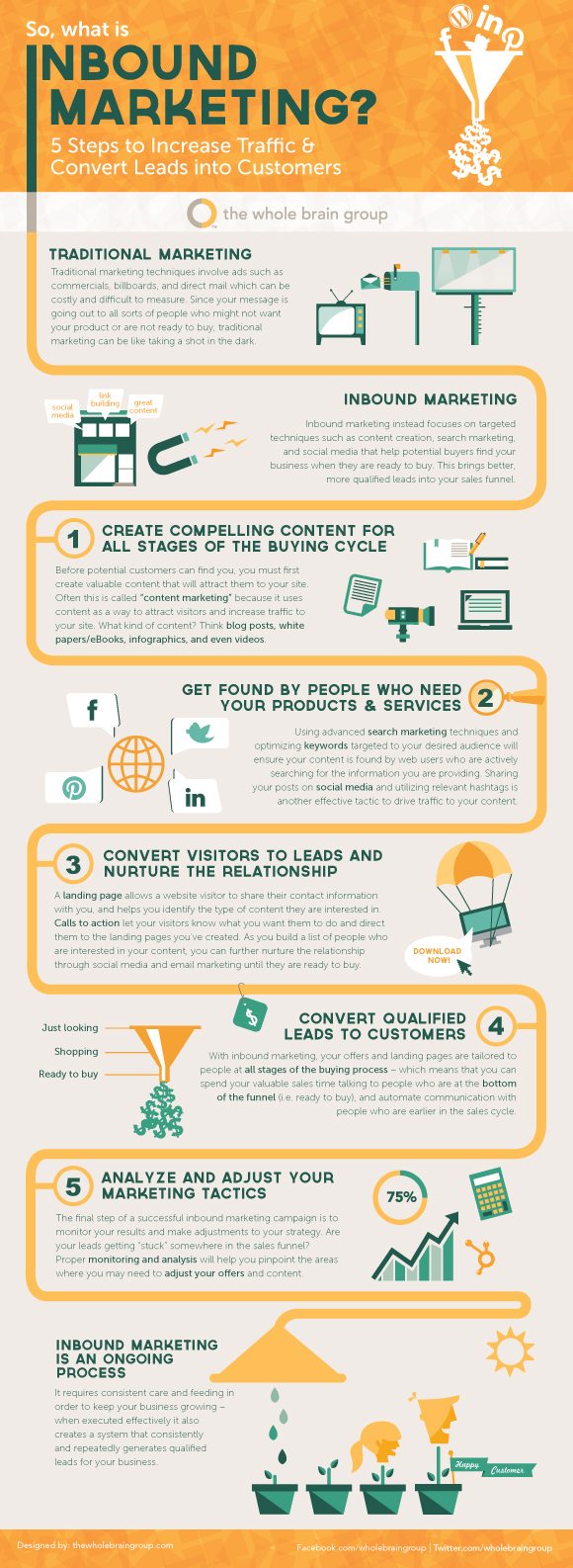
Infographic from The Whole Brain Group.
1. Understand Inbound Marketing
Before diving into the steps of inbound marketing, it’s essential to have a clear understanding of what it entails. Inbound marketing is a customer-centric approach that aims to attract, engage, and delight your target audience. It is built on the premise of providing value to potential customers and establishing your brand as a trusted authority in your industry.
Key Principles of Inbound Marketing:
a. Content Creation: Content is at the heart of inbound marketing. It involves creating high-quality, relevant content that addresses the needs and interests of your target audience. This content can take various forms, including blog posts, videos, infographics, eBooks, and more.
b. SEO (Search Engine Optimization): To ensure your content reaches your target audience, it’s crucial to optimize it for search engines. SEO involves optimizing your website and content to rank higher in search engine results pages (SERPs), making it easier for users to find you.
c. Social Media Engagement: Social media platforms provide an excellent opportunity to connect with your audience. Sharing your content and engaging with your followers on platforms like Facebook, Twitter, and Instagram can help you build a loyal community.
d. Email Marketing: Email marketing allows you to nurture leads and maintain ongoing communication with your audience. It’s an effective way to deliver personalized content and promotions directly to your subscribers.
e. Conversion Optimization: Converting website visitors into leads and customers is a critical aspect of inbound marketing. This involves creating compelling calls to action (CTAs), landing pages, and forms to capture visitor information.
f. Analytics and Data Analysis: Inbound marketing is data-driven. Analyzing metrics and user behavior helps you refine your strategy and make informed decisions to improve results continually.
2. Identify Your Target Audience
To effectively implement inbound marketing, you must have a deep understanding of your target audience. This involves creating detailed buyer personas – semi-fictional representations of your ideal customers. By knowing your audience’s pain points, goals, interests, and demographics, you can tailor your content and marketing efforts to resonate with them.
Steps to Identify Your Target Audience:
a. Research Existing Customers: Start by analyzing data on your existing customers. What are their common characteristics? What problems do your products or services solve for them?
b. Conduct Surveys and Interviews: Reach out to your current customers or conduct surveys to gather insights directly from them. Ask about their preferences, challenges, and motivations.
c. Analyze Competitors: Study your competitors’ customer base and marketing strategies. What type of audience are they targeting, and how are they reaching them?
d. Use Analytics Tools: Tools like Google Analytics can provide valuable information about the demographics and interests of your website visitors.
e. Build Detailed Buyer Personas: Create well-defined buyer personas that include information such as age, gender, job title, pain points, goals, preferred communication channels, and more. Having these personas will guide your content creation and marketing efforts.
3. Create Valuable and Relevant Content
Content is the cornerstone of inbound marketing. To attract and engage your target audience, you need to consistently produce valuable and relevant content that addresses their needs and interests. Here are some key content types to consider:
Blog Posts:
Regularly publish blog posts that provide educational and informative content related to your industry. Use keyword research to target topics that your audience is actively searching for.
Videos:
Video content has gained significant popularity. Create explainer videos, product demonstrations, how-to guides, and vlogs to connect with your audience visually.
Infographics:
Infographics are visually appealing and can simplify complex information. Use them to convey data, statistics, or step-by-step guides.
eBooks and Whitepapers:
In-depth content like eBooks and whitepapers can be used as lead magnets. Offer them as downloadable resources in exchange for visitor contact information.
Podcasts:
If your audience prefers audio content, consider starting a podcast. Invite industry experts for interviews and discuss relevant topics.
Social Media Posts:
Share bite-sized content on your social media platforms to engage your audience and drive traffic to your website.
Email Newsletters:
Keep your subscribers informed about your latest content, promotions, and news through email newsletters.
Remember, quality matters more than quantity. Consistently producing high-quality content will establish your brand as a trusted source of information and increase your chances of ranking well in search engines.
4. Optimize for Search Engines (SEO)
Having great content won’t be effective if your target audience can’t find it. Search engine optimization (SEO) is the practice of optimizing your website and content to rank higher in search engine results pages (SERPs). Here are some SEO basics to consider:
Keyword Research:
Identify relevant keywords and phrases that your audience is searching for. Use tools like Google Keyword Planner or SEMrush to discover keywords with high search volume and low competition.
On-Page SEO:
Optimize your website’s on-page elements, including title tags, meta descriptions, header tags (H1, H2, H3), and URL structures. Ensure that your content is easily readable and logically organized.
Content Quality:
Produce high-quality, well-researched content that provides real value to your audience. Google rewards content that satisfies user intent.
Backlinks:
Build a network of quality backlinks from reputable websites. Backlinks signal to search engines that your content is authoritative and trustworthy.
Mobile-Friendliness:
Ensure that your website is mobile-responsive, as Google considers mobile-friendliness when ranking websites.
Page Speed:
Optimize your website’s loading speed. Slow-loading pages can lead to a higher bounce rate and lower search engine rankings.
Regular Updates:
Frequently update your content to keep it fresh and relevant. Google tends to favor recently updated content.
5. Engage on Social Media
Social media platforms provide a direct line of communication with your audience. They allow you to share your content, engage in conversations, and build a community around your brand. Here are some tips for effective social media engagement:
Choose the Right Platforms:
Identify which social media platforms are most relevant to your audience. Not all platforms are equally effective for all businesses.
Consistent Posting:
Maintain a consistent posting schedule to keep your audience engaged. Use social media management tools to schedule posts in advance.
Engage with Your Audience:
Respond to comments, messages, and mentions promptly. Engage in conversations and build relationships with your followers.
Use Visual Content:
Visual content, such as images and videos, tends to perform well on social media. Use eye-catching visuals to accompany your posts.
Leverage Hashtags:
Use relevant hashtags to increase the visibility of your posts. Research popular industry-related hashtags and incorporate them into your content.
Run Paid Ads:
Consider running targeted paid advertising campaigns on social media platforms to reach a broader audience.
Monitor Analytics:
Use social media analytics tools to track the performance of your posts and campaigns. Adjust your strategy based on the data to improve results.
Conclusion
Inbound marketing is a powerful approach to increase website traffic and conversions by attracting and engaging your target audience naturally. By understanding your audience, creating valuable content, optimizing for search engines, and engaging on social media, you can build a strong online presence and drive sustainable growth for your business. Remember that inbound marketing is an ongoing process that requires consistent effort and adaptation to stay relevant and effective in the ever-changing digital landscape. Start implementing these five steps today to unlock the full potential of inbound marketing for your business.

Author:
Mark Ford

Mastering the Art of the Landing Page: Design, Copy, and Conversion in Harmony
Are you trying to design a landing page that not only looks great but actually converts visitors into customers? Want to learn how to balance design, copy, and strategy to create landing pages that work in perfect harmony? […]