
Are you worried that spelling or grammar errors might be damaging your website’s credibility? Want to learn the most common writing mistakes that could be turning visitors away from your site?
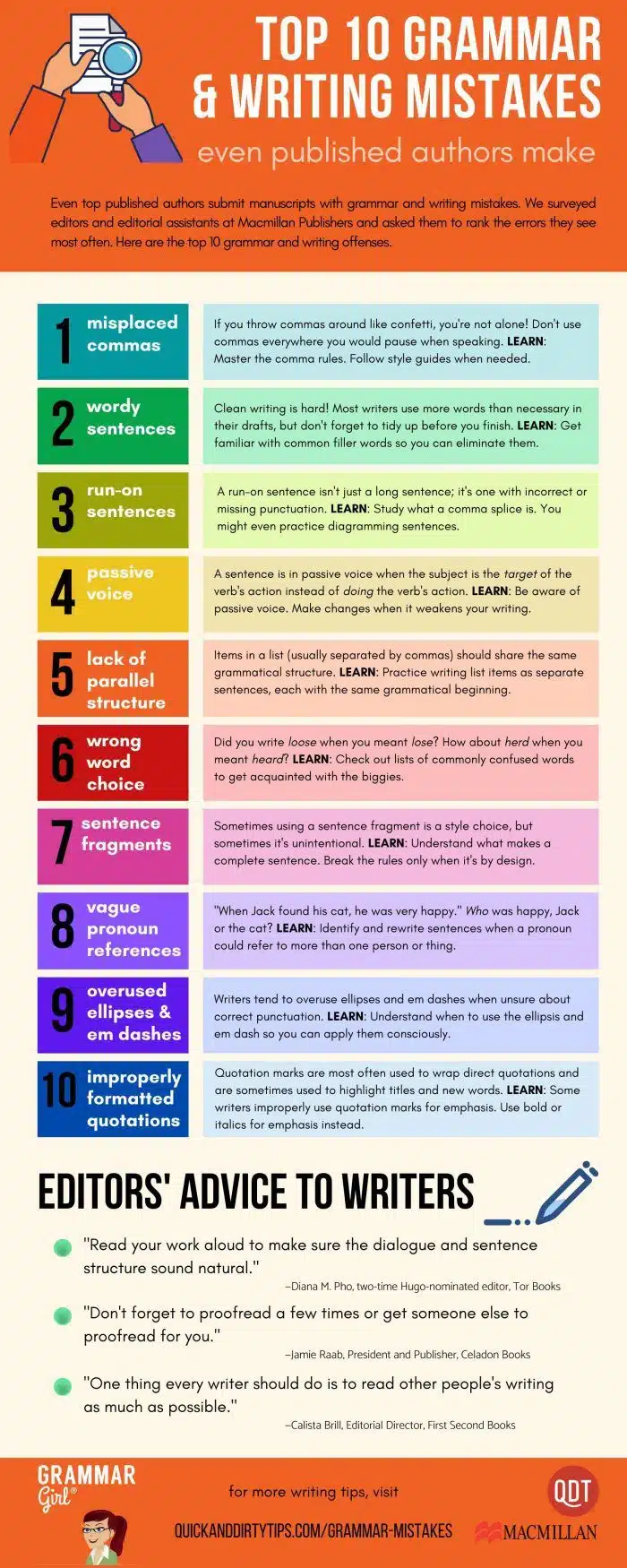
You’ll find some copywriting basics in this infographic.
Here’s a summary of what’s covered:
- Misplaced Commas
- Wordy Sentences
- Run-On Sentences
- Passive Voice
- Lack of Parallel Structure
- Wrong Word Choice
- Sentence Fragments
- Vague Pronoun References
- Overused Ellipses & Em Dashes
- Improperly Formatted Quotations
Check out the post below for more.
Your website is often the first impression people get of your business. But even the best design can’t save you from poor writing. Typos, unclear sentences, and sloppy grammar damage your credibility and make users click away.
In this post, we’ll explore ten common writing mistakes that could be hiding on your website—and how to fix them fast.
Misplaced Commas
Commas may be small, but they carry a lot of weight in how your content reads. Misplacing them can confuse your message or interrupt the natural flow of your writing. Many website owners add commas wherever they pause when speaking, which doesn’t always work in text. Learning correct comma use can instantly make your content clearer.
- Read your sentences out loud and only place commas where they make grammatical sense, not just where you pause.
- Use style guides like the Oxford or AP guide for consistency in punctuation.
- Avoid comma splices—don’t link two full sentences with just a comma.
- If in doubt, simplify the sentence to avoid unnecessary commas altogether.
Wordy Sentences
Website visitors are scanning for information, not settling in for a novel. Long-winded sentences filled with unnecessary words slow readers down and weaken your message. Clean, concise writing is easier to read and makes your brand sound more professional. Trimming the fat can do wonders for your user experience.
- Identify and remove filler words like “really,” “very,” “just,” and “that.”
- Replace lengthy phrases with simpler alternatives—e.g. “due to the fact that” becomes “because.”
- Break complex sentences into two shorter, clearer ones.
- Review your content regularly and edit ruthlessly for clarity and brevity.
Run-On Sentences
Run-on sentences don’t just ramble—they confuse. When two or more independent clauses are jammed together without proper punctuation or connectors, it creates a jumbled mess. On websites, this often looks like rushed content that wasn’t proofread. Clear sentence structure helps your message land with impact.
- Use punctuation like full stops or semicolons to separate complete thoughts.
- Watch out for comma splices—using a comma where a full stop or conjunction is needed.
- Don’t be afraid of short sentences; they’re powerful and easy to follow.
- Review content with fresh eyes or read aloud to spot where breaks are needed.
Passive Voice
Passive voice isn’t technically wrong, but it can make your writing feel vague or detached. In website content, where action and clarity matter, passive voice often falls flat. Instead, active voice makes your copy more direct and engaging. Knowing when to avoid the passive voice gives your content more energy.
- Turn “The service was provided by our team” into “Our team provided the service.”
- Use active verbs to clarify who’s doing what in each sentence.
- Reserve passive voice only when the subject is unknown or irrelevant.
- Check for forms of “to be” followed by a past participle as a passive voice clue.
Lack of Parallel Structure
Parallel structure means that items in a list or sentence follow the same grammatical form. When this isn’t followed, your writing sounds awkward and uneven. Website copy often uses lists to communicate key features or benefits—so making sure those lists are consistent is essential. Good structure equals better readability.
- Ensure bullet points or list items follow the same verb or noun form.
- If one list item starts with a verb, they all should (e.g. “Save time, Boost productivity, Cut costs”).
- Use the same sentence patterns in grouped phrases for better rhythm.
- Read list items aloud to check if they sound balanced and cohesive.
Wrong Word Choice
Nothing damages credibility faster than using the wrong word. Confusing “your” and “you’re” or “loose” and “lose” instantly raises red flags for readers. These small mistakes make your site feel unprofessional and careless. Getting your word choices right builds trust and authority in your content.
- Review commonly confused words and keep a reference list on hand.
- Don’t rely solely on spellcheck—context matters more than spelling.
- Ask someone else to proofread, especially if you’re unsure about certain terms.
- Use tools like Grammarly or Hemingway to catch usage issues.
Sentence Fragments
A sentence fragment is an incomplete thought. It may be missing a subject or verb—or both. While fragments can work stylistically, especially in marketing copy, they often look like errors when not used deliberately. Consistently using full sentences gives your website a more polished tone.
- Make sure each sentence contains at least one subject and one verb.
- Avoid fragments unless used intentionally for emphasis or effect.
- Combine fragments with nearby sentences to create full thoughts.
- Review headings, taglines, and CTAs to ensure clarity and completeness.
Vague Pronoun References
Clarity is king on a website. If it’s not clear who or what your pronouns refer to, readers will get lost. Vague pronoun use forces people to re-read, which ruins flow and increases bounce rates. Always make sure it’s obvious who “he,” “she,” “they,” or “it” is referring to.
- Replace pronouns with the actual noun when multiple subjects are present.
- Avoid using “this” or “that” alone; specify what you’re referring to (e.g. “this strategy”).
- Read your sentences from a visitor’s point of view—would it make sense to someone new?
- Use names or titles in key places like product descriptions and testimonials.
Overused Ellipses & Em Dashes
Ellipses and em dashes are often used when writers aren’t sure how to end a sentence or want to create drama. But overuse leads to messy, unclear writing. On websites, this can distract from your message or dilute your authority. Use these tools sparingly and purposefully.
- Use ellipses to indicate omissions or pauses, not as a filler.
- Use em dashes to add emphasis or interrupt a sentence—but don’t overdo it.
- Avoid stringing together multiple ellipses or dashes in a single section.
- Replace dramatic punctuation with simpler, clearer phrasing where possible.
Improperly Formatted Quotations
Quotation marks are often misused on websites—not just in writing speech, but for emphasis. Using quotes for emphasis instead of proper formatting like italics or bold creates confusion. Get your quotation usage right to maintain a professional, trustworthy tone.
- Use quotation marks only for direct speech or quoted material.
- Avoid using quotation marks for emphasis—use bold or italics instead.
- Follow standard punctuation rules when placing commas or periods near quotes.
- Keep quote formatting consistent across your website.
Conclusion
Writing mistakes on your website might seem small, but they can have a big impact on how users perceive your brand. From misplaced commas to vague pronouns and passive voice, these issues can make your content confusing, untrustworthy, or unengaging.
The good news? They’re all fixable. By learning to spot and correct these errors, you can strengthen your message, build credibility, and keep visitors coming back. Good writing is good business—so give your content the attention it deserves.

Author:
Mark Ford