Are you using link building tactics as part of your SEO strategy? Do you know what makes a high quality link that can help boost your site?
Link building (or link earning as we like to call it) should form a large part of your SEO strategy, it’s one of the biggest factors Google looks at when deciding where to rank a site. Not all links are created equal though, some can do more harm than good.
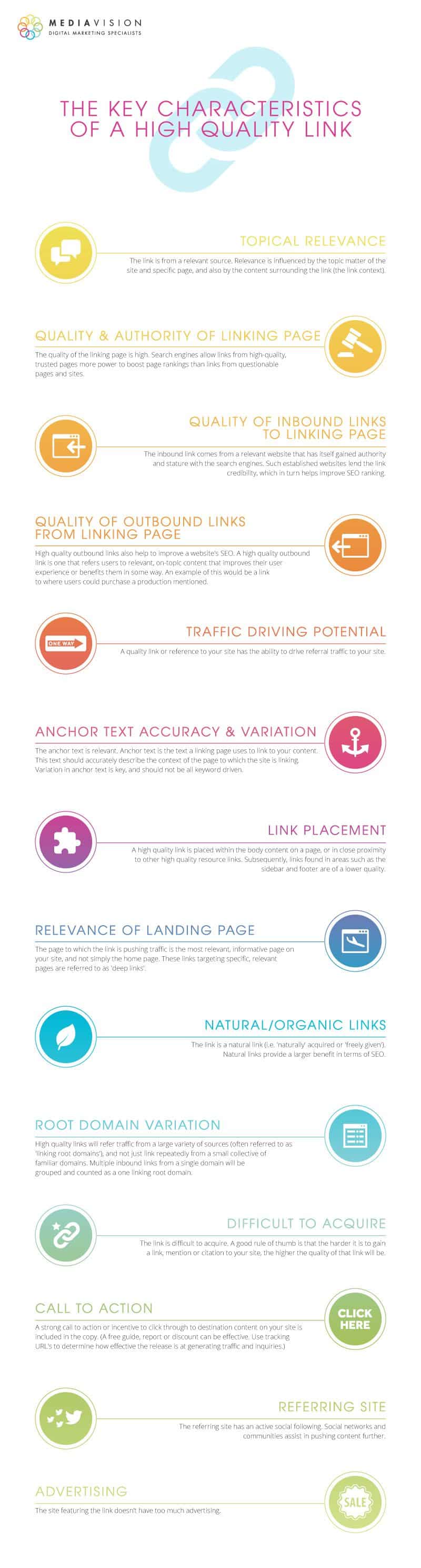
For some guidance on the characteristics of a high quality link take a look at the infographic below from Media Vision.
In the ever-evolving world of SEO (Search Engine Optimization), link building remains a fundamental strategy for improving a website’s search engine rankings. While the algorithms and techniques have evolved over the years, one thing remains constant: the importance of high-quality links.
High-quality links not only enhance a website’s authority and trustworthiness in the eyes of search engines but also drive targeted traffic. However, not all links are created equal. To achieve success in link building, it’s crucial to understand what makes a link high-quality. In this blog post, we’ll delve into 14 characteristics of a high-quality link and provide actionable insights to help you build an effective link building strategy.
1. Relevance
The first and foremost characteristic of a high-quality link is relevance. When a link comes from a website or webpage that is topically related to your own content, it carries more weight in the eyes of search engines. Relevance is a key factor in determining the value of a link.
For example, if you run a website about gardening, a link from a gardening blog or a horticultural organization’s website will be more valuable than a link from a website about car repair. Search engines use relevance to gauge the authenticity and authority of a link, so always prioritize links from sources that are relevant to your niche.
2. Authority
Authority is another vital characteristic of high-quality links. Links from authoritative websites hold more weight in search engine rankings. Authority can be measured using various metrics, such as Domain Authority (DA) and Page Authority (PA).
Websites with high authority are generally considered experts in their field, and links from these sources indicate that your content is trusted and reliable. Aim to acquire links from websites with established authority to boost your own site’s credibility.
3. Trustworthiness
Closely related to authority is trustworthiness. Links from trustworthy websites are highly valuable. Search engines assess the trustworthiness of a website based on factors like the site’s security, history, and the quality of its content.
Reputable sources, such as government websites, educational institutions, and well-known news outlets, are often seen as trustworthy by search engines. Earning links from these sources can significantly improve your website’s trustworthiness in the eyes of both search engines and users.
4. Editorial Backlinks
Editorial backlinks are links that are naturally placed within the content of a webpage. These links are often seen as more valuable because they are not manipulated or paid for. They are typically earned through the merit of your content and website.
To acquire editorial backlinks, focus on creating high-quality, informative, and shareable content that naturally attracts links from other websites. When your content adds value to the web, other site owners are more likely to link to it.
5. Organic Growth
High-quality links often come from organic growth rather than aggressive link-building tactics. Organic growth means that your link profile is built gradually and naturally over time.
Avoid spammy practices like buying links or participating in link schemes. Instead, concentrate on creating compelling content, engaging with your audience, and promoting your website in a genuine and ethical way. Organic link growth may take longer, but it yields more sustainable and valuable results.
6. Dofollow Links
Dofollow links are links that pass “link juice” or SEO value to the linked page. They are the standard type of link, and they play a significant role in improving your website’s search engine rankings.
While nofollow links have their place (e.g., in user-generated content or as a way to disclose paid relationships), dofollow links are the ones you should primarily seek. They directly contribute to your website’s SEO efforts.
7. Natural Anchor Text
Anchor text is the clickable text in a hyperlink. Natural anchor text is descriptive and relevant to the content it’s linking to. Search engines use anchor text to understand the context of the linked page.
Avoid over-optimized anchor text, which involves using exact-match keywords excessively. Instead, aim for anchor text that flows naturally within the content and provides context to both users and search engines.
8. Social Signals
While social signals themselves are not direct ranking factors, there is a correlation between social engagement and link quality. When content is shared and liked on social media, it can attract more attention and, in turn, more high-quality backlinks.
To leverage social signals, create shareable content and encourage your audience to engage with it on social platforms. The increased visibility can lead to more organic link acquisition.
9. Traffic Generation
High-quality links not only boost your SEO but also drive targeted traffic to your website. Links from authoritative sources with engaged audiences can send valuable visitors your way.
When building links, consider the potential for traffic generation. Seek out websites that have an audience interested in your niche, as these links can deliver both SEO benefits and direct referral traffic.
10. Diversity of Link Sources
A diverse link profile is a sign of a healthy website. Aim to acquire links from a variety of sources, including blogs, news sites, forums, and industry-specific directories.
Diversity in link sources helps to establish your website’s authority and reduces the risk of overreliance on a single source. It also provides a more natural and balanced link profile.
11. Longevity
High-quality links tend to be long-lasting. Unlike low-quality links that may disappear over time, links from reputable websites are likely to stay active for an extended period.
Investing in link building efforts that result in long-term, sustainable links is a wise strategy. It provides ongoing SEO benefits and a stable source of referral traffic.
12. Consistency
Consistency in link building is key to maintaining and improving your website’s rankings over time. It’s important to continuously seek out and acquire high-quality links, rather than pursuing a one-time link-building campaign.
Set aside time each month or quarter to review your link profile and identify opportunities for new, relevant links. Consistent effort will help you stay ahead of competitors and adapt to changes in the SEO landscape.
13. Link Placement
The placement of a link on a webpage can also impact its quality. Links placed within the main content area of a page are typically more valuable than those in sidebars, footers, or less prominent sections.
When earning links, strive to secure placements within the body of relevant content. These in-content links are more likely to be seen, clicked on, and trusted by both users and search engines.
14. Monitoring and Maintenance
Finally, the work doesn’t end once you’ve acquired high-quality links. Regularly monitor your link profile to ensure that links remain active and that there are no issues like broken links or changes in anchor text.
In addition, stay informed about changes in search engine algorithms and SEO best practices. The world of SEO is dynamic, and what works today may not work tomorrow. By staying up to date, you can adapt your link-building strategy to maintain and improve your website’s rankings.
Conclusion
Link building remains a crucial aspect of SEO, and the quality of the links you acquire can make or break your search engine rankings. High-quality links exhibit characteristics such as relevance, authority, trustworthiness, and organic growth. By focusing on these qualities and implementing ethical and sustainable link-building practices, you can enhance your website’s SEO performance and drive targeted traffic.
Remember that link building is a long-term strategy that requires patience and consistent effort. Building a strong link profile takes time, but the rewards in terms of improved search engine rankings and increased visibility are well worth it. So, as you embark on your link-building journey, keep these 14 characteristics of high-quality links in mind and watch your website climb the search engine rankings.

Author:
Mark Ford