Are you ready to take your blog writing from inconsistent drafts to polished, high-performing content? Want to learn a proven step-by-step strategy that helps you write blogs that engage readers and deliver results every time?
You’ll find some content marketing basics in this infographic.
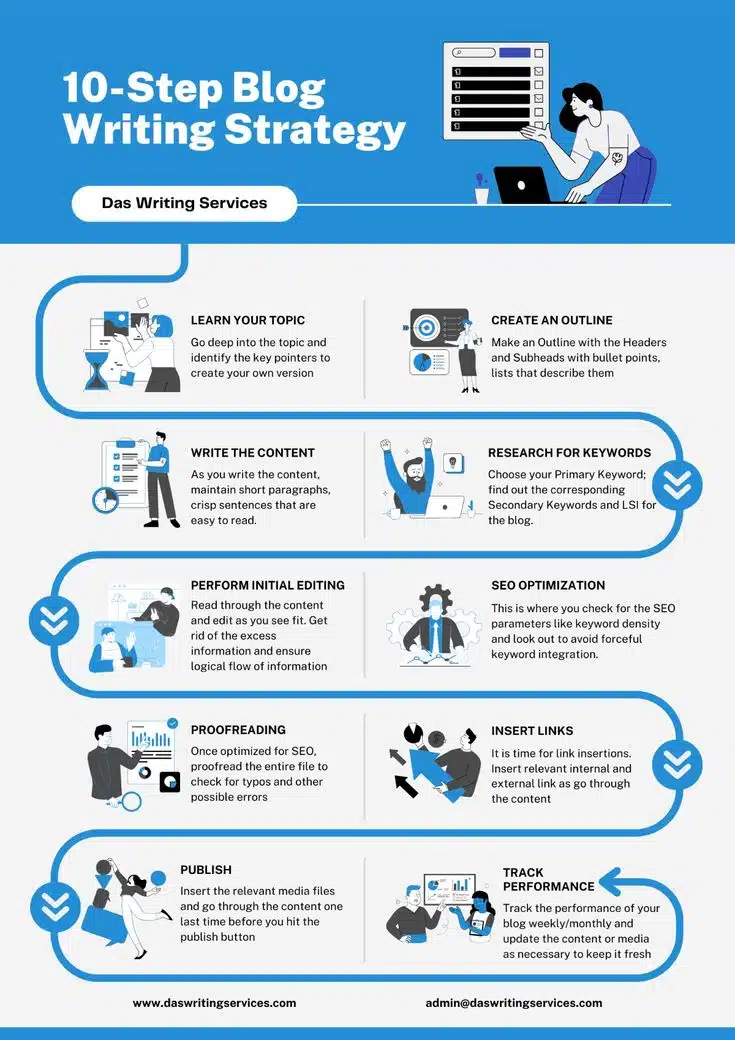
Here’s a summary of what’s covered:
- Learn Your Topic
- Create an Outline
- Write the Content
- Research for Keywords
- Perform Initial Editing
- SEO Optimisation
- Proofreading
- Insert Links
- Publish
- Track Performance
Check out the post below for more.
Writing a blog may seem simple, but crafting one that consistently attracts readers, performs well in search engines, and delivers value takes structure and planning. A clear process helps ensure every blog post you create has purpose, quality, and measurable results.
By following a step-by-step strategy, you can avoid rushed, inconsistent content and instead develop posts that engage and convert. This guide outlines a proven 10-step approach to mastering blog writing for consistent success.
Learn Your Topic
Before you can write a strong blog post, you need to understand your subject thoroughly. Surface-level knowledge isn’t enough if you want to stand out in a crowded digital landscape. Readers trust content that demonstrates authority and depth, and that comes from research and exploration. Taking time to immerse yourself in your topic ensures your blog reflects expertise and builds credibility.
- Research widely using reputable sources such as industry reports, expert blogs, and case studies.
- Note down key statistics, insights, and examples that can enrich your writing.
- Identify gaps in current content where you can add unique value.
- Develop your own perspective rather than simply repeating what others have said.
Create an Outline
A blog without a structure often ends up meandering and difficult to follow. Creating an outline gives you a roadmap that keeps your content focused and coherent. It helps you organise your thoughts, ensures you cover all important points, and makes the writing process much smoother. Outlines also make it easier to maintain consistent formatting across multiple posts.
- Break your content into logical sections with clear headers and subheaders.
- Use bullet points or notes under each section to capture key ideas.
- Ensure the order of sections creates a natural flow of information.
- Allow room for flexibility if new insights emerge while writing.
Write the Content
With your research and outline in place, it’s time to bring your blog to life with words. Writing is where you balance creativity with clarity, aiming to inform, engage, and inspire your readers. Concise sentences and short paragraphs keep your writing accessible and easy to follow. Always write with your audience in mind, tailoring tone and style to match their expectations.
- Start with a strong introduction that hooks readers immediately.
- Keep paragraphs short, ideally no more than three or four sentences.
- Use simple, direct language to make your points clear.
- Balance factual information with storytelling to keep readers engaged.
Research for Keywords
Search engines are a vital traffic source, which is why keyword research plays a central role in blog writing. Keywords help connect your content with the questions and needs of your audience. But effective keyword research goes beyond picking one or two obvious phrases. A well-rounded approach ensures your blog ranks for a range of related searches, giving it greater visibility.
- Choose a primary keyword that captures the main focus of your blog.
- Identify secondary keywords and long-tail phrases to broaden reach.
- Use tools such as Google Keyword Planner or SEMrush to validate your choices.
- Integrate keywords naturally, keeping the reader’s experience the priority.
Perform Initial Editing
After writing, the first draft is rarely perfect. Initial editing helps refine your ideas and strengthen the overall flow of your blog. It’s about stepping back to see whether the content makes sense, whether points are developed properly, and whether anything can be removed or improved. This stage is essential to transform raw writing into polished content.
- Read through the blog once to check for clarity and flow.
- Remove repetition or irrelevant details that add little value.
- Reorganise sections if needed to improve logical progression.
- Tighten sentences to make them sharper and more engaging.
SEO Optimisation
Optimising your blog for search engines ensures it has the best chance of being discovered. However, good SEO is about balance: while you want search engines to understand your content, you also need to prioritise your readers. Keyword stuffing and poor optimisation can drive people away. Effective SEO combines technical awareness with natural, user-friendly writing.
- Check keyword placement in headings, meta descriptions, and body text.
- Ensure keywords are used naturally without forcing them into sentences.
- Add alt text to images for accessibility and SEO benefit.
- Use internal and external links to strengthen relevance and authority.
Proofreading
Even the best content loses credibility if it contains spelling mistakes or grammatical errors. Proofreading ensures your blog is error-free and professional. It’s more than a quick scan—it involves carefully reviewing every detail to ensure accuracy and consistency. Taking this step protects your brand reputation and ensures your content feels polished and trustworthy.
- Read through the entire blog slowly, focusing on detail.
- Use proofreading tools like Grammarly or Hemingway for extra support.
- Check punctuation, grammar, and consistency of style.
- Ask a colleague or editor for a second pair of eyes.
Insert Links
Links are an important part of blog writing, providing context, credibility, and value. Internal links keep readers exploring more of your website, while external links to reputable sources enhance your authority. Including relevant links also supports SEO by showing search engines how your content connects within the wider web. Effective linking strategy builds depth and reliability.
- Add internal links to other relevant blog posts or service pages.
- Use external links to back up data, statistics, or expert opinions.
- Make anchor text descriptive rather than generic, like “click here.”
- Regularly review and update links to avoid broken URLs.
Publish
Publishing is the stage where your blog officially meets the world. It’s important not to rush this moment; a final review can make all the difference. Ensure that formatting looks clean, media is in place, and the post reads smoothly from start to finish. Hitting publish should be the result of careful preparation, not an afterthought.
- Add images, videos, or infographics that support the text.
- Double-check formatting such as headings, spacing, and bullet points.
- Preview the post to see how it appears on desktop and mobile.
- Make sure metadata, title tags, and descriptions are optimised.
Track Performance
A published blog is not the end of the process—it’s the beginning of its life online. Tracking performance helps you understand what works, what doesn’t, and where improvements can be made. By monitoring traffic, engagement, and rankings, you can refine your strategy for future posts. Consistent tracking keeps your content relevant and effective over time.
- Use analytics tools like Google Analytics to track traffic and behaviour.
- Monitor keyword rankings to see how your post performs in search results.
- Assess engagement metrics such as time on page and bounce rate.
- Update content regularly to keep it fresh and competitive.
Conclusion
Mastering blog writing isn’t about luck—it’s about process, discipline, and consistency. By following these 10 steps, you can transform scattered ideas into structured, engaging, and high-performing blog posts.
From researching your topic to tracking performance, each stage plays a vital role in ensuring success. When done correctly, your blog becomes more than just content; it becomes a powerful tool for authority, visibility, and growth.

Author:
Mark Ford