
Are you looking for ways to measure the success of your social strategy? Need to demonstrate a return on investment of your social media marketing campaigns?
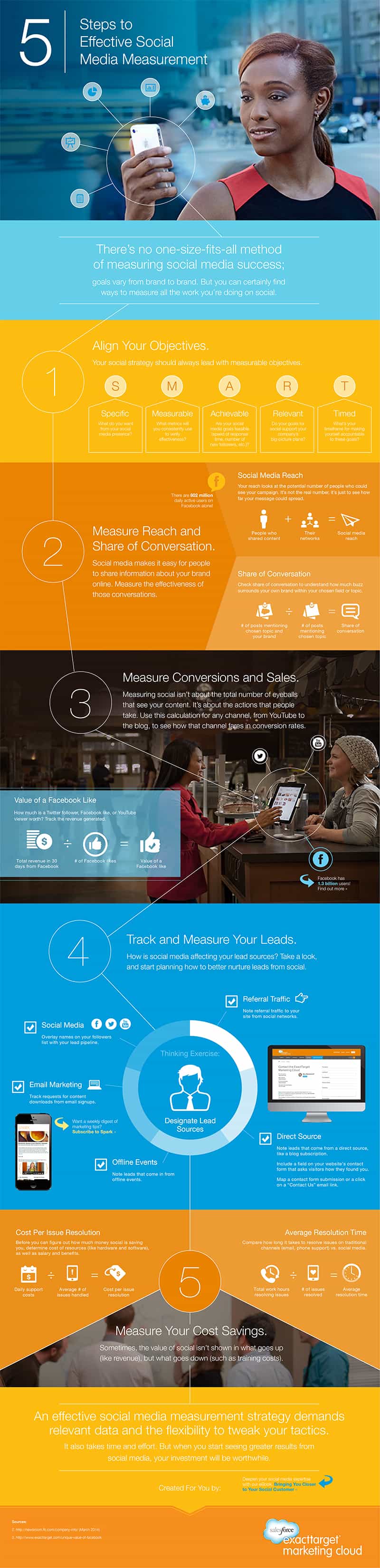
Salesforce share their guide to social media measurement in this infographic.
Here’s a quick summary:
- Align your objectives
- Measure reach and share of conversation
- Measure conversions and sales
- Track and measure your leads
- Measure your cost savings
Check out the infographic for more detail.
Social media marketing is no longer just a trend—it’s a vital part of any business’s digital strategy. With the growing number of platforms, tools, and techniques available to marketers, it’s more important than ever to ensure that your efforts are not only aligned with your business goals but also measurable. Without proper metrics, you can’t understand what’s working or where you need to improve. Measuring the success of your social media marketing efforts is essential for optimizing your strategy, justifying the budget, and proving ROI.
In this blog post, we’ll walk you through five steps to effectively measure your social media marketing strategy. By following these steps, you can gain a clear understanding of your social media performance, and make data-driven decisions to improve your campaigns.
Align Your Objectives
Aligning your social media marketing objectives with your broader business goals is the cornerstone of any effective social media strategy. Without clear alignment, your social media activities can become fragmented, inconsistent, and difficult to measure. By ensuring that your social media objectives directly support your company’s vision and goals, you can create a cohesive strategy that drives real business results.
Why Objective Alignment is Crucial
For small businesses, where resources are often limited, every action must be purposeful. Aligning objectives ensures that the time, energy, and resources you invest into social media are focused on outcomes that will move the needle for your business. Moreover, it allows you to measure success in a meaningful way—beyond vanity metrics like likes and follows—so you can tie social media performance to tangible business results like leads, revenue, or customer retention.
Steps to Align Your Social Media Objectives with Business Goals
- Understand Your Business Objectives Before you can set social media goals, you need to have a clear understanding of your business objectives. Start by asking yourself questions like:
- What are our top priorities for this year or quarter? (e.g., increasing sales, improving brand awareness, entering a new market)
- What are our company’s long-term goals?
- What challenges are we currently facing, and how can social media help overcome them?
For example, if your business goal is to increase sales by 20% in the next quarter, your social media objective should focus on activities that directly contribute to that, such as driving traffic to product pages, running conversion-focused ad campaigns, or generating leads for your sales team.
- Define Specific Social Media Goals Once you have clarity on your business objectives, translate them into specific, actionable social media goals. These goals should directly contribute to achieving your business objectives. It’s important to make these goals SMART: Specific, Measurable, Achievable, Relevant, and Time-bound. Here’s a breakdown of each component:
- Specific: Be as clear as possible about what you want to achieve. Instead of “I want more followers,” aim for something specific like “I want to increase Instagram followers by 10% within the next three months.”
- Measurable: Make sure there are metrics that allow you to track progress. If your goal is to increase engagement, determine which metrics (likes, shares, comments) will be used to measure that.
- Achievable: Set goals that are realistic based on your current resources, audience, and time. While aiming for a massive increase in followers may seem ambitious, it’s more effective to set smaller, incremental goals that you can consistently reach.
- Relevant: Your social media goals should align with your broader business goals. For instance, if brand awareness is a priority for your business, focus on metrics like reach and impressions rather than conversions.
- Time-bound: Set deadlines for achieving your goals. Without a timeframe, it’s difficult to track progress or know when to adjust your strategy. For example, aim to increase website traffic from social media by 15% within six months.
- Prioritize Your Social Media Objectives As a small business, you may not have the resources to focus on multiple social media goals simultaneously. Prioritize the objectives that are most critical to your business. Start by focusing on one or two core goals, such as generating leads or increasing brand awareness, and then gradually expand as you build momentum and resources.
For example, if your primary goal is lead generation, you might prioritize platforms like LinkedIn or Facebook, where you can run targeted lead generation ads or capture leads through gated content. If brand awareness is a bigger priority, platforms like Instagram and TikTok, where visual storytelling can engage a larger audience, may take precedence.
- Match Objectives to the Right Social Platforms Different social media platforms serve different purposes. It’s important to understand where your audience spends their time and what each platform excels at so you can align your objectives accordingly. Here’s a quick rundown of which platforms are best suited for common business goals:
- Facebook: Great for building communities, customer engagement, and running targeted ads for conversions or leads.
- Instagram: Ideal for brand awareness, visual storytelling, and building a loyal, engaged community.
- LinkedIn: Perfect for B2B businesses focused on lead generation, professional networking, and thought leadership.
- Twitter: Effective for real-time conversations, customer service, and brand awareness.
- YouTube: Best for businesses looking to leverage video content for brand education, tutorials, or product demonstrations.
- TikTok: Focused on reaching younger audiences and creating viral, short-form video content for brand awareness.
By aligning your goals with the strengths of each platform, you can maximize the effectiveness of your campaigns. For instance, if lead generation is your priority, LinkedIn’s lead-gen forms or Facebook’s lead ads can be powerful tools. Alternatively, if brand awareness is your focus, Instagram’s visual content and Reels can help you reach a wider audience.
- Set Key Performance Indicators (KPIs) Once your goals are set, it’s crucial to define the KPIs that will help you measure progress. KPIs are the metrics that show how well you’re tracking towards your social media objectives. Different goals will require different KPIs. Here are some examples based on specific objectives:
- Brand Awareness: Reach, impressions, brand mentions, and follower growth.
- Engagement: Likes, shares, comments, engagement rate (interactions as a percentage of followers).
- Lead Generation: Number of leads, form submissions, cost per lead (CPL).
- Conversions: Website traffic, conversion rate, sales attributed to social media, return on ad spend (ROAS).
- Customer Retention: Customer support interactions, positive reviews, repeat purchases from social media-driven traffic.
Your KPIs should be closely tied to your social media goals and should allow you to measure success over time. Use analytics tools like Google Analytics, Facebook Insights, Instagram Insights, or third-party platforms like Hootsuite or Sprout Social to track your KPIs regularly.
- Monitor Progress and Adjust Social media is dynamic, and your business’s needs may shift over time. It’s important to continuously monitor the progress of your social media campaigns and adjust your strategy as necessary. If certain tactics or platforms aren’t performing as expected, don’t be afraid to pivot. For instance, if you set a goal to increase engagement on Instagram but notice that engagement rates are stagnating, you might need to rethink your content strategy or test new content formats, such as Reels or Stories.
Regularly review your KPIs to ensure they’re aligned with your overall objectives, and don’t hesitate to refine your goals if needed. A quarterly or monthly review of your social media performance will help you stay on track and ensure that your efforts are driving meaningful results.
Common Mistakes to Avoid When Aligning Objectives
- Setting Vague Goals: Without clear, measurable objectives, it’s impossible to determine if your social media efforts are successful. Avoid setting goals like “improve social media presence” and instead focus on specific outcomes like “increase website traffic by 20% in six months.”
- Chasing Vanity Metrics: While metrics like follower count and likes can be satisfying, they don’t always indicate success. Make sure your goals are focused on outcomes that impact your business, such as conversions, leads, or customer retention.
- Neglecting Audience Insights: Understanding your audience is critical to aligning your objectives. Without knowing your audience’s demographics, preferences, and behaviors, your objectives may be disconnected from what your target market values.
- Overlooking Competitor Analysis: Studying your competitors’ social media strategies can provide insights into what’s working (or not) in your industry. Use competitor analysis to set benchmarks and inform your own goal-setting process.
By taking the time to align your social media objectives with your business goals, setting measurable targets, and focusing on the right platforms, you can create a social media strategy that drives tangible business results. Whether you’re looking to generate leads, increase brand awareness, or boost sales, the key to success lies in clearly defining what you want to achieve and tracking your progress along the way.
Measure Reach and Share of Conversation
Measuring reach and share of conversation is essential for understanding the effectiveness of your social media marketing strategy. These metrics allow small businesses to gauge their brand’s visibility and how much they are part of relevant online discussions compared to their competitors. By tracking reach and share of conversation, you can gain valuable insights into how well your content resonates with your target audience and how your brand stands in the competitive landscape.
Understanding Reach and Share of Conversation
- Reach refers to the total number of unique users who have seen your content. It’s an important metric because it shows how far your message is spreading across your social media platforms. Increasing reach is key to brand awareness, as the more people who see your content, the greater the potential for engagement, leads, and sales.
- Share of Conversation (SOC) measures the proportion of online discussions about a specific topic that involves your brand, relative to your competitors. It helps you understand how much of the conversation in your industry you are owning. A high share of conversation means that people are talking about your brand more than your competitors, which can indicate strong brand presence and engagement.
Why Measuring Reach and Share of Conversation Matters for Small Businesses
For small businesses, which often have limited resources and need to make every marketing dollar count, reach and share of conversation are critical indicators of success. These metrics not only show how well your content is performing in terms of visibility but also provide context for how your brand compares to competitors in your industry.
A higher reach ensures that more potential customers are seeing your content, which can increase brand awareness and familiarity. On the other hand, share of conversation helps you determine whether your brand is being noticed, discussed, and preferred by your audience over competitors.
Steps to Effectively Measure Reach and Share of Conversation
- Track Your Organic and Paid Reach There are two primary types of reach: organic and paid. Organic reach refers to the number of people who see your content without any paid promotion, while paid reach refers to the number of people who see your content as a result of paid advertising.
- Organic Reach: This is becoming harder to achieve due to the changing algorithms on platforms like Facebook and Instagram, which prioritize content from friends and family over brands. However, it’s still crucial to monitor as it gives you insights into how well your content performs on its own. To improve organic reach, focus on creating engaging, relevant content that encourages shares, likes, and comments, as this will increase your content’s visibility in the algorithm.
- Paid Reach: This is the reach generated from sponsored posts or social media ads. Paid reach allows you to target specific audiences based on demographics, interests, and behaviors, so it’s a powerful tool for extending your content to new potential customers. When running paid campaigns, track the reach of your ads and compare it to the engagement they generate to ensure you’re getting a good return on investment (ROI).
Use native analytics tools like Facebook Insights, Instagram Insights, and Twitter Analytics to measure reach. For example, Facebook Insights will show you how many unique users have seen your posts, both organically and through paid promotion. This helps you understand the balance between your organic and paid reach and which strategies are more effective.
- Analyze Your Social Media Impressions While reach shows how many unique users have seen your content, impressions track how many times your content was displayed. It’s important to monitor impressions alongside reach because it shows the frequency with which your content appears to users. If your impressions are significantly higher than your reach, it indicates that your audience is seeing your content multiple times, which can increase brand recall and familiarity.
For small businesses, impressions are valuable because they show how often your content is being exposed to your audience. Even if a user doesn’t engage with your content the first time they see it, repeated exposure can build recognition and eventually lead to engagement or a purchase.
- Leverage Social Listening Tools for Share of Conversation Measuring share of conversation requires you to go beyond basic metrics and tap into social listening tools. Social listening allows you to track mentions of your brand, competitors, and relevant keywords across social media platforms, blogs, forums, and other online spaces. This gives you a comprehensive view of where and how people are talking about your brand in the context of your industry.
Some useful social listening tools for small businesses include:
-
- Hootsuite: Tracks mentions of your brand across different social platforms, giving you insights into how often your brand is mentioned compared to competitors.
- Sprout Social: Provides detailed reporting on brand mentions and share of conversation, making it easier to track how much of the online discussion your brand commands.
- Brand24: Offers real-time tracking of your brand’s mentions across the web and provides sentiment analysis to understand how people feel about your brand.
When measuring share of conversation, focus on the following:
-
- Brand Mentions: Track how many times your brand is mentioned in social media conversations compared to your competitors.
- Industry Keywords: Monitor key industry terms and see how frequently your brand is associated with those discussions.
- Sentiment Analysis: Analyze the tone of the conversations about your brand. Are people speaking positively, negatively, or neutrally about you? Understanding sentiment can help you improve your brand perception.
Use these insights to assess your brand’s share of voice and adjust your content strategy accordingly. If competitors are dominating the conversation, analyze their tactics to see where you can improve, whether through more engaging content, better customer interaction, or targeted campaigns.
- Monitor Engagement Metrics in Relation to Reach Measuring reach alone is not enough to gauge the success of your social media efforts. You also need to evaluate how your audience is interacting with your content. This includes tracking engagement metrics such as likes, comments, shares, and clicks. High engagement rates alongside a broad reach indicate that your content is not only being seen but also resonating with your audience.
For small businesses, focusing on engagement is crucial because it helps build a community around your brand. Here’s how to measure engagement relative to reach:
-
- Engagement Rate: This is a percentage that shows the level of interaction your audience has with your content. To calculate engagement rate, divide the total number of engagements (likes, shares, comments) by the total reach and multiply by 100. A higher engagement rate indicates that your content is compelling and encouraging interaction.
- Shares and Retweets: These are particularly valuable engagement metrics because they extend your reach to a new audience. When someone shares or retweets your content, it’s exposed to their followers, increasing the chance that more people will see and engage with it.
- Comments: Comments indicate a deeper level of engagement than likes or shares. When users take the time to comment, it shows that your content has sparked a meaningful reaction. Pay attention to the nature of the comments to gauge sentiment and adjust your content strategy if needed.
- Benchmark Your Performance Against Competitors To truly understand your share of conversation, you need to compare your performance to that of your competitors. Use social listening tools to track how much of the conversation your competitors are commanding and what topics they are being associated with. This will help you identify opportunities to differentiate your brand and capture a larger share of voice.
Here’s how to benchmark your performance:
-
- Competitive Analysis: Monitor how often your competitors are mentioned compared to your brand. Tools like Hootsuite and Sprout Social can help you set up competitor tracking, so you can compare your brand mentions, sentiment, and reach against theirs.
- Content Performance: Analyze the type of content your competitors are posting and see how it compares to yours. If they are getting more engagement or a larger share of the conversation, consider adapting your content strategy. For example, if your competitor’s blog posts are getting more traction, you might need to focus on improving your own blog content or adding value through additional formats like infographics or videos.
- Audience Insights: Use insights from social listening tools to learn more about your audience’s preferences, behaviors, and pain points. Understanding what drives conversations in your industry can help you create content that better resonates with your target audience.
- Use Insights to Adjust Your Strategy Measuring reach and share of conversation is only valuable if you use the insights to improve your social media strategy. Regularly review your performance to see if you’re reaching your target audience and engaging them in meaningful conversations. If your reach is stagnating or your share of conversation is declining, it’s time to adjust your strategy.
Some adjustments you can make include:
-
- Refining Your Content: If your content isn’t generating engagement, experiment with new formats (e.g., videos, infographics, user-generated content) to see what resonates with your audience.
- Optimizing Posting Times: Use platform insights to determine when your audience is most active and adjust your posting schedule to maximize reach.
- Engaging with Your Audience: Increase your share of conversation by actively participating in discussions relevant to your industry. Respond to comments, engage in trending topics, and leverage hashtags to increase your visibility.
Common Mistakes to Avoid When Measuring Reach and Share of Conversation
- Focusing Solely on Reach: Reach is an important metric, but it doesn’t tell the whole story. Always evaluate reach in conjunction with engagement and sentiment to get a complete picture of how your content is performing.
- Ignoring Negative Sentiment: If your brand is being mentioned frequently but in a negative light, a high share of conversation can be a double-edged sword. Monitor sentiment carefully and take proactive steps to address any negative feedback.
- Not Benchmarking Against Competitors: Without comparing your share of conversation to competitors, it’s difficult to assess how well you’re performing in your industry. Always track competitor mentions and conversations to see how you stack up.
By measuring reach and share of conversation effectively, small businesses can make informed decisions about their social media strategy, ensuring they stay visible, relevant, and engaging in the competitive digital landscape.
Measure Conversions and Sales
Engagement and reach are important, but at the end of the day, conversions and sales are often the primary goals of most social media campaigns. If you’re not driving tangible results, it’s time to rethink your strategy. Measuring conversions and sales directly links your social media efforts to revenue and helps you prove ROI.
Track Conversions
Conversions can vary depending on your business goals, but they generally refer to actions taken by users after interacting with your social media content. These actions can include:
- Signing up for a newsletter
- Downloading a white paper
- Making a purchase
- Filling out a lead form
Using tools like Google Analytics, you can set up conversion tracking to measure how social media traffic contributes to these desired outcomes. Many platforms, like Facebook and Instagram, offer in-app shopping experiences that allow you to track conversions directly from social media ads or posts.
Measure Social Media’s Impact on Sales
To measure the direct impact of social media on sales, consider using UTM parameters in your social media posts and ads. These are tracking codes added to URLs, allowing you to see exactly where your traffic is coming from and which campaigns are driving the most conversions.
If you’re running paid social media campaigns, platforms like Facebook Ads Manager and Google Analytics can provide in-depth reports on how much revenue your campaigns are generating. For eCommerce brands, tracking the number of sales and the average order value from social media referrals is essential to understanding how well your strategy is performing.
Tip: While direct sales are important, don’t forget to measure other forms of conversion, like email signups or app downloads, which can eventually lead to sales in the future.
Track and Measure Your Leads
Tracking and measuring leads is crucial for small businesses as it helps you evaluate the effectiveness of your social media marketing strategies. Leads are potential customers who have shown interest in your products or services, and understanding where they come from allows you to refine your approach, maximize resources, and increase conversions.
Why It Matters
For small businesses, lead tracking helps in:
- Maximizing marketing ROI: Identifying which social platforms generate the most qualified leads.
- Improving targeting and content strategy: Recognizing which campaigns and posts resonate with your audience.
- Optimizing sales efforts: Prioritizing high-quality leads that are more likely to convert into customers.
Now, let’s explore practical steps for small businesses to effectively track and measure leads.
Steps to Effectively Track and Measure Leads
- Define What Constitutes a Lead for Your Business
The first step is to determine what qualifies as a lead for your business. A lead could be someone who:
- Submits a contact form.
- Signs up for a newsletter.
- Requests a demo.
- Engages meaningfully with your social media posts.
Clearly defining what makes someone a lead helps focus your tracking efforts on those actions that matter most for your business goals.
- Use UTM Parameters to Track Campaign Effectiveness
UTM (Urchin Tracking Module) parameters are bits of text you add to URLs shared on social media. They let you track the source, medium, and campaign that brought a visitor to your site. This information helps you know exactly where your leads are coming from and which specific social media campaigns are driving them.
For instance, if you’re promoting a new product on Instagram, add a UTM-tagged link to your bio or posts, and track clicks in Google Analytics. This way, you can monitor how many leads Instagram is generating compared to other platforms.
- Leverage Social Media Lead Generation Tools
Platforms like Facebook, Instagram, and LinkedIn offer lead generation ads that make it easy for users to submit their contact information without leaving the platform. This reduces friction and increases lead conversion rates.
- Facebook and Instagram Lead Ads: These tools allow users to submit their information directly within an ad.
- LinkedIn Lead Gen Forms: Users can fill out a pre-populated form, making the process seamless.
These tools are great for capturing leads quickly and efficiently, especially for mobile users.
- Optimize Landing Pages for Lead Capture
Whenever you run a social media campaign, direct users to a dedicated landing page designed specifically to convert visitors into leads. The landing page should focus on one clear call-to-action (CTA), like signing up for a newsletter or downloading a guide.
- Simplicity is key: Keep forms short and easy to fill out—ask for only essential information like name and email.
- Mobile optimization: Ensure your landing pages are mobile-friendly, as a significant portion of traffic comes from mobile devices.
- Consistency: The landing page should match the message of the campaign. If a social post promotes a discount, the landing page should prominently feature that offer.
Using tools like HubSpot or Mailchimp, you can build landing pages and link them directly to your email marketing or CRM systems, making it easy to track leads.
- Integrate a CRM to Manage and Track Leads
A Customer Relationship Management (CRM) system is essential for tracking and nurturing leads once they’ve been captured. CRM systems like HubSpot, Zoho, and Salesforce are affordable options for small businesses, offering seamless integration with social media and email marketing platforms.
A CRM lets you:
- Track all lead interactions from initial contact through the sales funnel.
- Segment your leads based on behavior or engagement level.
- Automate follow-ups and lead nurturing processes, ensuring no potential customer is overlooked.
By integrating a CRM with your social media platforms, you can automatically track how leads from specific campaigns progress, allowing you to fine-tune your marketing strategies.
- Measure Lead Quality and Engagement
Not all leads are equal—some are more likely to convert than others. That’s why it’s important to track lead quality in addition to quantity.
Here’s how to monitor lead quality:
- Engagement metrics: Track how leads interact with your brand after their initial contact. Do they open your emails? Visit your website again? Engage with your social posts?
- Conversion rates: Measure how many leads from specific campaigns convert into paying customers. A high number of leads with low conversion rates might indicate that your targeting needs adjustment.
- Lead scoring: Assign scores to leads based on their actions (e.g., downloading a guide, signing up for a webinar). This helps prioritize high-value leads for your sales team.
Monitoring lead quality helps ensure that your marketing efforts are attracting the right audience, allowing you to focus your efforts on nurturing the leads most likely to convert.
- Analyze Data to Improve Lead Generation
Finally, regularly review your data to see which platforms, campaigns, and content types are generating the most valuable leads. Use this data to adjust your social media strategy, focusing on channels that provide the best results.
For instance, if Instagram posts are generating more high-quality leads than Facebook, you might allocate more resources to Instagram in the next campaign.
In Conclusion: Tracking and measuring leads is essential for optimizing your social media marketing strategy. By defining what a lead means for your business, utilizing tools like UTM parameters and lead gen ads, integrating with a CRM, and monitoring both lead quantity and quality, small businesses can turn their social media efforts into measurable, actionable insights. This ensures that your marketing dollars are being spent effectively and that your sales pipeline remains filled with high-potential leads.
Measure Your Cost Savings
Measuring cost savings is an essential aspect of evaluating your social media marketing strategy. For small businesses, effective use of social media can lead to significant savings in marketing expenses while simultaneously boosting reach and engagement. Understanding these savings can provide valuable insights into your overall return on investment (ROI).
Why It Matters
Measuring cost savings helps small businesses:
- Optimize budget allocation: Identify which social media platforms or campaigns provide the best value for money.
- Reduce unnecessary expenses: Streamline processes and eliminate underperforming strategies.
- Enhance profitability: Understand how effective social media marketing can contribute to overall cost efficiency and revenue generation.
Steps to Effectively Measure Cost Savings
- Assess Your Marketing Costs
Start by analyzing your overall marketing expenses, including traditional methods (e.g., print ads, radio spots) and digital marketing efforts. This will give you a baseline to compare against your social media expenditures.
- Break down costs: List all expenses associated with your marketing strategy, including advertising costs, content creation, software tools, and staff time.
- Include indirect costs: Factor in expenses that may not seem directly related to social media, such as training staff to use social media tools or the time spent engaging with followers.
By understanding your total marketing costs, you can better gauge the effectiveness of your social media efforts.
- Calculate Specific Social Media Expenses
Next, pinpoint your social media-specific costs. This includes both paid advertising and organic strategies. Be as detailed as possible.
- Advertising costs: Track spending on social media ads, including costs per click (CPC) or cost per thousand impressions (CPM).
- Content creation: Include expenses related to graphic design, video production, copywriting, and any tools or software used for content creation.
- Management tools: If you use tools like Hootsuite, Buffer, or social media analytics software, include their costs in your calculations.
Understanding the total cost of your social media strategy is essential for accurately measuring savings.
- Monitor Performance Metrics
To measure cost savings effectively, you need to correlate your expenses with the performance of your social media campaigns. Key performance indicators (KPIs) can help you evaluate the effectiveness of your social media marketing relative to the costs incurred.
- Engagement rates: Track likes, shares, comments, and overall interaction with your posts. Higher engagement at a lower cost indicates effective spending.
- Lead generation: Analyze how many leads are generated from your social media efforts relative to the costs associated with those campaigns.
- Conversions: Measure the conversion rate from social media leads into customers. A higher conversion rate can indicate cost savings by generating revenue at a lower expense.
By regularly monitoring these metrics, you can establish a clearer picture of your social media marketing’s cost-effectiveness.
- Compare Against Traditional Marketing Methods
One effective way to measure cost savings is to compare your social media efforts to traditional marketing methods. This analysis can highlight the benefits of a digital-first approach.
- Reach vs. Cost: Calculate how much you would spend on traditional advertising methods (like print or TV) to achieve the same reach and engagement levels you get from social media. Often, social media can provide more reach at a fraction of the cost.
- Time investment: Assess the time spent on social media marketing compared to traditional methods. Social media allows for immediate engagement and feedback, which can save time and resources in the long run.
This comparison helps you quantify the cost savings associated with your social media strategy and justifies the allocation of your marketing budget.
- Calculate Customer Acquisition Cost (CAC)
Customer Acquisition Cost (CAC) is a critical metric for understanding how much it costs to acquire a new customer through your marketing efforts. To calculate CAC through social media:
- Total marketing costs: Divide your total social media marketing expenses (including advertising, content creation, and management costs) by the number of new customers acquired through social media during a specific period.
For example, if you spent $1,000 on social media marketing and acquired 50 new customers, your CAC would be $20.
Tracking CAC helps you understand how efficiently your social media marketing is generating new customers and where you can make adjustments for greater cost savings.
- Evaluate Cost Savings Over Time
Tracking cost savings is not just a one-time effort; it’s essential to evaluate your performance over time. Regularly review your data to identify trends and opportunities for further savings.
- Monthly or quarterly analysis: Set regular intervals to analyze your social media marketing costs versus outcomes. Look for trends in customer acquisition costs, engagement rates, and overall marketing efficiency.
- Benchmark against previous periods: Compare your current performance to previous months or years to identify improvements or areas needing attention.
By continuously evaluating cost savings, you can refine your strategy, optimize spending, and ultimately enhance your social media marketing ROI.
- Utilize Analytics Tools
Leverage analytics tools to gain insights into your social media performance and costs. Many platforms, like Google Analytics and Facebook Insights, provide valuable data to help you measure the effectiveness of your campaigns.
- Track metrics: Use analytics to track performance metrics, including engagement rates, conversions, and lead generation, alongside your costs.
- Automated reporting: Many tools allow you to automate reports, making it easier to analyze your data and identify trends quickly.
Utilizing analytics tools can streamline your efforts and provide you with the insights needed to measure cost savings effectively.
In Conclusion:
Measuring cost savings in social media marketing is essential for small businesses looking to maximize their marketing budget and improve ROI. By assessing your marketing costs, calculating specific social media expenses, monitoring performance metrics, comparing against traditional methods, calculating CAC, evaluating savings over time, and utilizing analytics tools, you can gain valuable insights into your social media strategy’s effectiveness. This ongoing analysis not only helps in justifying your marketing expenditures but also in identifying opportunities for improvement and optimization, ultimately leading to a more successful social media marketing effort.
Conclusion
Effectively measuring your social media marketing strategy isn’t just about tracking vanity metrics like likes and shares. It’s about aligning your objectives with business goals, tracking conversions, understanding the quality of leads, and measuring cost savings. By following these five steps—aligning your objectives, measuring reach and share of conversation, measuring conversions and sales, tracking leads, and measuring cost savings—you can optimize your strategy and make data-driven decisions that lead to long-term success.
In the ever-evolving world of social media marketing, measurement is key to staying ahead of the competition and ensuring that your efforts are not only engaging your audience but also driving real results for your business.

Author:
Mark Ford