What techniques and metrics does your SEO campaign focus on?
If you’re creating content for search engines rather than visitors and only monitoring rankings rather than traffic and business you’re doing SEO the old way. With Google’s constant algorithm updates and the penalties that come with them this is an increasingly risky strategy to continue with.
For some guidance bringing your SEO strategy into the modern times take a look at this infographic from Alan Weiss.
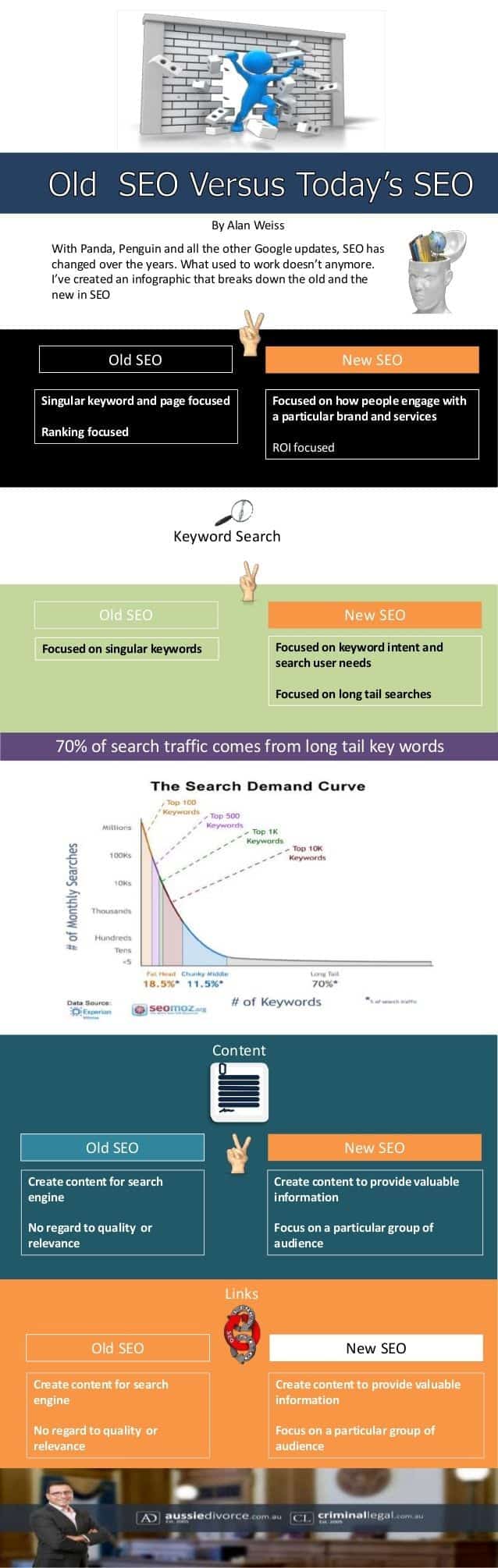
In the fast-paced world of digital marketing, search engine optimization (SEO) is constantly evolving. What worked in the past may no longer be effective today. To succeed in the competitive online landscape, it’s crucial to stay updated on the latest SEO trends and strategies. In this blog post, we will explore seven key differences between old SEO practices and today’s SEO landscape, providing you with insights and actionable tips to help you adapt and thrive in the ever-changing world of search engine optimization.
- Keyword Stuffing vs. User-Centric Content
Old SEO: Keyword Stuffing In the early days of SEO, the focus was primarily on keyword optimization. Websites would cram their content with keywords, often resulting in poor-quality and unreadable text. This practice, known as keyword stuffing, aimed to manipulate search engine rankings by overloading pages with target keywords.
Today’s SEO: User-Centric Content Modern SEO has shifted its focus from keyword density to user-centric content. Search engines like Google have become much more sophisticated in understanding user intent and context. Rather than stuffing keywords, the emphasis is now on creating high-quality, valuable, and engaging content that caters to the needs of the audience. It’s about providing real value, answering user queries, and delivering a positive user experience.
Actionable Tip: Conduct keyword research to understand what your target audience is searching for, and then create informative and engaging content that addresses their needs and concerns naturally.
- Backlink Quantity vs. Quality
Old SEO: Backlink Quantity Backlinks, also known as inbound links, were once the primary metric for search engine rankings. Websites would often prioritize quantity over quality, seeking to acquire as many backlinks as possible, often through spammy or manipulative tactics.
Today’s SEO: Backlink Quality In the present SEO landscape, the quality of backlinks far outweighs the quantity. Search engines have become more sophisticated in evaluating the authority and relevance of the websites linking to yours. High-quality backlinks from reputable sources are now essential for ranking well in search results. Building relationships and earning backlinks through organic and legitimate means is the new norm.
Actionable Tip: Focus on building relationships with industry influencers and authoritative websites. Create exceptional content that naturally attracts backlinks from reputable sources.
- Exact Match Domains vs. Branding
Old SEO: Exact Match Domains In the past, exact match domains (EMDs) were considered a quick way to gain search engine rankings. Websites would use domain names that precisely matched their target keywords. For example, if you wanted to rank for “bestonlinemarketingtips.com,” you would register that domain.
Today’s SEO: Branding Modern SEO prioritizes branding over exact match domains. Search engines have become better at understanding user intent, and they reward websites that establish a strong brand identity. Using a branded domain name and building brand recognition through quality content and user engagement are more effective strategies in today’s SEO landscape.
Actionable Tip: Choose a domain name that reflects your brand identity and is easy for users to remember. Invest in building a strong brand presence both online and offline.
- Thin Content vs. Comprehensive Content
Old SEO: Thin Content In the past, websites would create thin, shallow, and low-quality content to target specific keywords. These pages often lacked depth and provided little value to users. The primary goal was to rank for keywords, even if the content itself was lacking.
Today’s SEO: Comprehensive Content Google’s algorithms now favor comprehensive, in-depth content that thoroughly covers a topic. Longer-form articles, guides, and blog posts that offer valuable insights, analysis, and solutions tend to rank higher. Search engines want to provide users with the most informative and authoritative content available.
Actionable Tip: When creating content, aim to be the best source of information on a topic. Conduct thorough research, provide valuable insights, and create in-depth content that answers all potential user questions.
- Static Optimization vs. Continuous Adaptation
Old SEO: Static Optimization In the past, SEO was often treated as a one-time project. Websites would optimize their pages and then leave them unchanged for an extended period. This static approach no longer aligns with the dynamic nature of search engine algorithms.
Today’s SEO: Continuous Adaptation Modern SEO is an ongoing process that requires continuous adaptation. Search engine algorithms evolve regularly, and user behaviors change. Websites must keep up with these changes, regularly updating and optimizing their content, technical aspects, and strategies.
Actionable Tip: Implement an ongoing SEO strategy that includes regular content updates, technical SEO audits, and staying informed about industry trends and algorithm updates.
- Mobile-Friendly vs. Mobile-First
Old SEO: Mobile-Friendly In the past, having a mobile-friendly website was seen as a bonus. Websites that adapted their design to be responsive on mobile devices were considered ahead of the curve but not necessarily a requirement.
Today’s SEO: Mobile-First Mobile-first indexing is now the standard for search engines. Google primarily uses the mobile version of a website for indexing and ranking. This shift reflects the increasing number of users accessing the internet through mobile devices. Having a mobile-friendly and responsive design is not only essential for SEO but also for user experience.
Actionable Tip: Ensure your website is fully responsive and optimized for mobile devices. Test your site’s performance and usability on various screen sizes to deliver a seamless mobile experience.
- Keyword Density vs. Semantic Search
Old SEO: Keyword Density In the past, SEO professionals often obsessed over keyword density—the percentage of times a keyword appeared in a piece of content. The goal was to achieve a specific keyword density to rank higher in search results.
Today’s SEO: Semantic Search Search engines now employ semantic search, which focuses on understanding the meaning and context of words and phrases. They can identify synonyms, related terms, and user intent. Rather than fixating on keyword density, SEO experts should concentrate on providing contextually relevant and semantically rich content.
Actionable Tip: Expand your vocabulary and use natural language in your content. Focus on creating content that comprehensively covers a topic and includes relevant variations of keywords and phrases.
Conclusion
SEO has come a long way from its early days of keyword stuffing and link manipulation. Today’s SEO landscape demands a user-centric approach, high-quality content, reputable backlinks, and a commitment to ongoing improvement. To succeed in this ever-evolving field, adaptability and a focus on providing value to your audience are key.
As you navigate the differences between old SEO practices and today’s SEO strategies, remember that SEO is not a one-size-fits-all solution. Tailor your approach to your specific industry, target audience, and business goals. By staying informed and embracing these changes, you can achieve higher search engine rankings, increased organic traffic, and long-term success in the digital marketing landscape.

Author:
Mark Ford