Are you considering spending some of your marketing budget on pay per click ads? Want to ensure you don’t waste your money on things when you don’t need to?
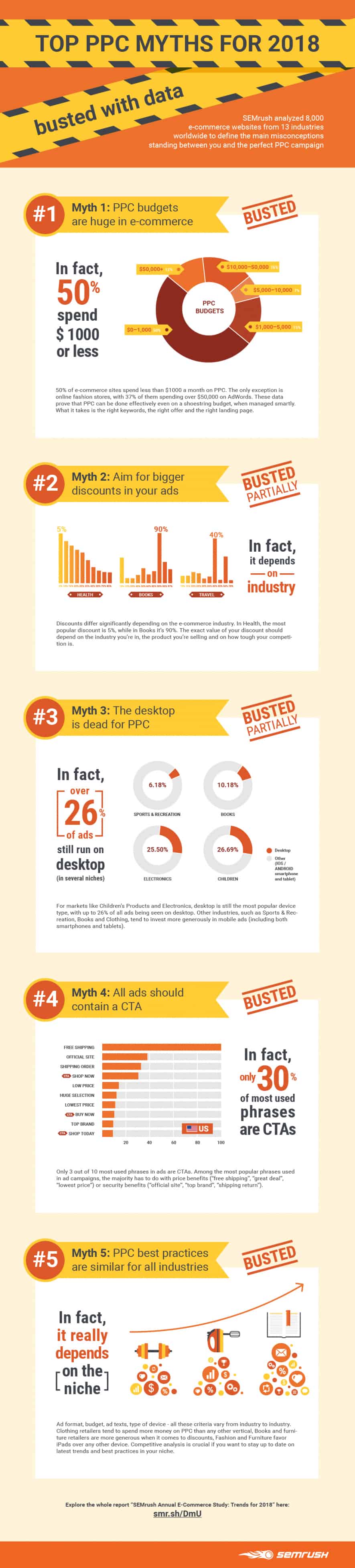
SEMrush share 5 PPC myths to ignore in this infographic.
Here’s a quick summary:
- PPC budgets are huge in Ecommerce
- Aim for bigger discounts in your ads
- The desktop is dead for PPC
- All ads should contain a call to action (CTA)
- PPC best practices are similar for all industries
Check out the infographic for more detail.
In the world of digital marketing, Pay-Per-Click (PPC) advertising is often heralded as a quick and effective way to drive traffic to your site and increase sales. However, like any marketing strategy, PPC is surrounded by myths that can mislead even the savviest marketers. Believing in these myths can lead to wasted budgets, ineffective campaigns, and missed opportunities. In this blog post, we’ll debunk five common PPC myths to help you make the most of your advertising dollars.
PPC Budgets Are Huge in Ecommerce
A pervasive myth in the world of PPC advertising is that you need a colossal budget to be effective, especially in ecommerce. While it’s true that large companies often allocate significant funds to their PPC campaigns, this doesn’t mean smaller businesses can’t compete or see substantial results with more modest budgets.
Myth Debunked:
- Strategic Spending: Success in PPC isn’t solely about the amount of money you spend; it’s about how strategically you spend it. By focusing on high-intent keywords, optimizing ad copy, and continuously refining your targeting, you can achieve a strong return on investment (ROI) even with a smaller budget.
- Niche Markets: Small businesses can often find success by targeting niche markets where competition is less fierce. This allows for lower cost-per-click (CPC) rates and the opportunity to reach highly interested customers without breaking the bank.
- Testing and Optimization: Even with a limited budget, running A/B tests on your ads can help you understand what works best. Incremental improvements can lead to significant gains over time, ensuring your budget is used efficiently.
- Geographic Targeting: Limiting your ad reach to specific geographic areas can also help manage costs while ensuring your ads are seen by a relevant audience. This can be particularly useful for local businesses looking to attract nearby customers.
In-Depth Tips and Guidance for Small Businesses
Navigating the PPC landscape can be daunting for small businesses, but with the right approach, even modest budgets can yield impressive results. Here’s a deeper dive into some actionable tips and strategies:
- Define Clear Goals:
Before diving into PPC, it’s crucial to define what success looks like for your business. Are you looking to drive sales, generate leads, increase brand awareness, or something else? Clear goals will help you create focused campaigns and measure success accurately.
- Keyword Research:
- Long-Tail Keywords: Focus on long-tail keywords that are more specific and less competitive. These keywords often have lower CPCs and attract users with higher purchase intent. For example, instead of bidding on “shoes,” consider “women’s running shoes size 8.”
- Negative Keywords: Use negative keywords to filter out irrelevant traffic and prevent your ads from showing up for searches that won’t convert. This helps in conserving your budget for more relevant clicks.
- Ad Copy and Creative:
- Compelling Ad Copy: Write clear, compelling ad copy that addresses your target audience’s pain points and offers a solution. Highlight unique selling propositions (USPs) to stand out from competitors.
- Ad Extensions: Use ad extensions like sitelinks, callouts, and structured snippets to provide additional information and increase the visibility and effectiveness of your ads.
- Budget Management:
- Daily Budget Caps: Set daily budget caps to control spending and prevent your budget from being exhausted too quickly. This ensures your ads are spread throughout the day and don’t stop showing early.
- Bid Adjustments: Use bid adjustments to allocate your budget more effectively. For example, you can increase bids for devices, locations, or times of day that perform better.
- Geo-Targeting:
- Local Campaigns: If your business serves a specific geographic area, use geo-targeting to show your ads to users within that region. This reduces wasted spend on clicks from users outside your service area.
- Localized Ad Copy: Customize your ad copy to include location-specific keywords and messaging to resonate with local audiences.
- Utilize Remarketing:
Remarketing allows you to target users who have previously visited your website but didn’t convert. These users are already familiar with your brand and more likely to convert on subsequent visits. Use tailored ads to remind them of your products and encourage them to return.
- Monitor and Optimize:
- Regular Analysis: Continuously monitor your campaign performance through analytics platforms. Pay attention to key metrics like click-through rate (CTR), conversion rate, cost per acquisition (CPA), and ROI.
- A/B Testing: Implement A/B testing to compare different versions of your ads, landing pages, and targeting options. Use the insights gained to refine your campaigns and improve performance.
- Adjust Based on Performance: Don’t be afraid to make adjustments based on what’s working and what’s not. This could involve reallocating budget to higher-performing campaigns or pausing underperforming keywords.
- Leverage Automation:
- Smart Bidding: Use Google’s smart bidding strategies, such as Target CPA or Target ROAS, to automate bid adjustments based on the likelihood of conversion.
- Ad Scheduling: Schedule your ads to run during peak times when your target audience is most active. This helps maximize the impact of your budget.
- Focus on High-Quality Landing Pages:
- Relevant Content: Ensure your landing pages are relevant to the ad copy and keywords. A seamless user experience from ad click to landing page increases the chances of conversion.
- Fast Load Times: Optimize your landing pages for fast load times to prevent users from bouncing. A slow-loading page can lead to lost opportunities and wasted ad spend.
- Mobile Optimization: With a significant portion of traffic coming from mobile devices, ensure your landing pages are mobile-friendly and provide a good user experience on all devices.
- Stay Informed and Adapt:
The PPC landscape is constantly evolving, with new features, tools, and trends emerging regularly. Stay informed by following industry blogs, participating in forums, and attending webinars. Adapt your strategies based on the latest best practices and insights.
Case Studies and Examples:
Case Study 1: Local Boutique Store
A small boutique store specializing in handmade jewelry used PPC to drive local traffic. With a limited budget, they focused on geo-targeting and long-tail keywords. By highlighting their unique, handcrafted pieces and offering occasional discounts, they managed to increase both foot traffic and online sales significantly.
Case Study 2: Online Pet Supplies
An online pet supply store wanted to compete with larger brands. They used remarketing and targeted long-tail keywords related to specific pet needs (e.g., “organic dog food for allergies”). By continuously testing ad copy and focusing on unique product benefits, they saw a 30% increase in conversions within six months.
Conclusion:
Small businesses don’t need enormous PPC budgets to succeed in ecommerce. By being strategic, focusing on high-intent keywords, leveraging geo-targeting, and continuously optimizing their campaigns, they can achieve impressive results. Remember, success in PPC is less about the size of your budget and more about how effectively you use it. With careful planning, testing, and adaptation, small businesses can compete with larger brands and drive meaningful growth through PPC advertising.
Aim for Bigger Discounts in Your Ads
Another common belief is that offering bigger discounts in your ads will always lead to higher conversions. The logic seems sound: customers love discounts, so the larger the discount, the more attractive the offer, right? Not necessarily. While discounts can be a powerful tool to attract customers, relying solely on large discounts can undermine your brand value and profit margins. Here’s an in-depth look at how small businesses can use discounts effectively without falling into the trap of excessive discounting.
Myth Debunked:
- Value Perception: Excessive discounts can sometimes devalue your products in the eyes of consumers. If your discounts are too steep, customers might start to question the quality of your products or services.
- Profit Margins: Offering large discounts can erode your profit margins, especially if they become a regular part of your marketing strategy. It’s important to balance the attractiveness of your offers with the financial health of your business.
- Customer Loyalty: Instead of focusing solely on discounts, consider promoting the unique value proposition of your products. Highlight quality, exclusivity, or superior service to create a lasting impression that isn’t solely price-dependent.
- Testing Different Offers: It’s crucial to test different types of offers to see what resonates best with your audience. Sometimes, free shipping, a free gift with purchase, or a smaller percentage discount can be more effective than a large discount.
In-Depth Tips and Guidance for Small Businesses
Offering discounts is a nuanced strategy that requires careful planning and execution. Here are some in-depth tips and guidance on how small businesses can use discounts effectively:
- Understand Your Margins:
Before offering any discount, it’s crucial to understand your profit margins. Calculate how much you can afford to discount while still making a profit. This ensures that your promotions don’t inadvertently harm your bottom line.
- Use Discounts Strategically:
- Limited-Time Offers: Create a sense of urgency with limited-time offers. This can encourage customers to make a purchase decision quickly. For example, “20% off for the next 48 hours” can drive immediate sales without permanently devaluing your products.
- Seasonal Discounts: Align discounts with seasonal events or holidays. This not only capitalizes on increased consumer spending during these times but also associates your brand with festive or seasonal goodwill.
- Offer Other Types of Promotions:
- Free Shipping: Free shipping is a highly attractive offer that can sometimes be more appealing than a percentage discount. Many customers perceive shipping costs as an extra burden, so eliminating this can increase conversions.
- Buy One, Get One (BOGO): BOGO deals can encourage customers to buy more, which helps clear inventory and increase average order value. For example, “Buy one, get one 50% off” can be more effective than a straight 25% discount.
- Bundling Products: Offer discounts on bundled products. This not only increases the perceived value but also helps move inventory that might not sell as quickly on its own.
- Personalize Discounts:
- Loyalty Programs: Create a loyalty program that offers discounts to repeat customers. This not only incentivizes repeat purchases but also helps build a long-term relationship with your customers.
- Abandoned Cart Discounts: Use retargeting to offer discounts to customers who have abandoned their shopping carts. This can help recover potentially lost sales by giving customers an extra nudge to complete their purchase.
- Highlight Unique Value Propositions:
- Quality and Exclusivity: Emphasize the quality and exclusivity of your products. Instead of focusing solely on price, highlight what makes your product unique, such as superior materials, craftsmanship, or limited editions.
- Customer Reviews: Use customer reviews and testimonials to build trust and highlight the value of your products. This can reassure potential buyers and make them feel more confident in their purchase, even without a large discount.
- Test and Optimize:
- A/B Testing: Conduct A/B tests to compare different types of discounts and offers. This can help you identify which promotions resonate best with your audience and drive the highest conversions.
- Analyze Data: Use analytics to track the performance of your discount campaigns. Monitor metrics such as conversion rates, average order value, and customer acquisition cost to determine the effectiveness of your discounts.
- Promote Discounts Effectively:
- Clear Messaging: Ensure your discount offers are clearly communicated in your ads. Use bold headlines and concise messaging to make the discount stand out.
- Multiple Channels: Promote your discounts across multiple channels, including social media, email marketing, and your website. This ensures maximum visibility and reach for your promotions.
- Be Mindful of Frequency:
- Avoid Over-Discounting: Offering discounts too frequently can train customers to expect them and wait for sales rather than buying at full price. Maintain a balance by offering discounts strategically rather than constantly.
- Seasonal and Occasional Sales: Limit large discounts to special occasions, such as holiday sales, end-of-season clearances, or anniversary events. This keeps the excitement and urgency around your sales high.
Case Studies and Examples:
Case Study 1: Boutique Clothing Store
A small boutique clothing store decided to use discounts strategically rather than constantly offering large markdowns. They introduced a loyalty program where repeat customers received a 10% discount on their third purchase. Additionally, they offered free shipping on orders over a certain amount and occasional seasonal sales with 20% off select items. These strategies helped maintain their profit margins while increasing customer loyalty and average order value.
Case Study 2: Online Home Décor Shop
An online home décor shop used A/B testing to determine the most effective discount strategy. They tested a 20% discount against a “buy one, get one 50% off” offer. The BOGO offer performed significantly better, increasing both sales and average order value. They also implemented abandoned cart discounts, offering a 15% discount to users who didn’t complete their purchase, which helped recover lost sales and improve overall conversion rates.
Conclusion:
Discounts can be a powerful tool in your marketing arsenal, but they need to be used strategically to avoid devaluing your products and eroding profit margins. Small businesses can effectively use discounts by understanding their margins, using various types of promotions, personalizing offers, highlighting unique value propositions, testing and optimizing their campaigns, and promoting discounts effectively.
By debunking the myth that bigger discounts always lead to higher conversions and implementing these in-depth tips and guidance, small businesses can attract and retain customers, increase sales, and maintain healthy profit margins. Remember, the key is to strike a balance between offering attractive deals and preserving the perceived value and profitability of your products.
The Desktop is Dead for PPC
With the rise of mobile devices, many marketers have shifted their focus exclusively to mobile platforms, believing the desktop is no longer relevant for PPC advertising. However, dismissing desktop advertising entirely can be a costly mistake. In reality, desktop remains a vital component of a comprehensive PPC strategy, offering unique advantages that can significantly contribute to the success of your campaigns.
Myth Debunked:
- Diverse User Behavior: While mobile usage has indeed increased, many users still rely on desktops for more in-depth research and purchasing decisions, especially in B2B markets. Ignoring desktop users means potentially missing out on high-intent buyers.
- Higher Conversion Rates: In many cases, desktop users exhibit higher conversion rates compared to mobile users. This can be due to the ease of navigation, larger screen sizes, and the ability to easily complete detailed forms or make complex purchases.
- Cross-Device Journeys: Consumers often use multiple devices throughout their buying journey. They might discover your product on mobile but complete the purchase on a desktop. Ensuring a seamless experience across all devices is crucial for capturing these conversions.
- Tailored Strategies: Developing tailored strategies for both desktop and mobile can enhance your PPC campaign’s effectiveness. This includes creating device-specific ad copy, optimizing landing pages for each device, and using analytics to understand device-specific performance.
In-Depth Tips and Guidance for Small Businesses
Understanding the continued importance of desktop PPC can help small businesses maximize their advertising efforts. Here are some in-depth tips and guidance for leveraging desktop PPC effectively:
- Analyze Your Audience Behavior:
- Device Usage Data: Use analytics tools like Google Analytics to understand how your audience interacts with your site across different devices. Look at metrics such as session duration, pages per session, and conversion rates for desktop versus mobile users.
- Segment Your Campaigns: Segment your PPC campaigns by device to tailor your strategies accordingly. This allows you to allocate budgets, bids, and ad copy specific to desktop and mobile users.
- Optimize for Desktop Conversions:
- Landing Page Design: Ensure your landing pages are optimized for desktop users. This means using a clean layout, intuitive navigation, and clear call-to-action buttons that are easy to find and click.
- Fast Load Times: Desktop users expect fast-loading pages. Optimize images, use caching, and leverage content delivery networks (CDNs) to reduce load times and prevent potential customers from bouncing.
- Tailor Ad Copy and Creative:
- Desktop-Specific Messaging: Create ad copy that speaks directly to desktop users. Highlight features that are easier to explore on a larger screen, such as detailed product comparisons, in-depth reviews, and high-resolution images.
- Visuals and Formats: Use visuals and ad formats that are more engaging on desktop. For instance, larger images, video ads, and interactive elements can be more effectively displayed and interacted with on a desktop.
- Consider the Customer Journey:
- Cross-Device Attribution: Use cross-device attribution models to understand how users interact with your ads across different devices. This helps you allocate credit accurately and optimize your campaigns for the entire customer journey.
- Seamless Experience: Ensure a seamless experience from ad click to conversion, regardless of the device. This might involve designing responsive websites and maintaining consistent messaging and visuals across all devices.
- Leverage Remarketing:
- Desktop Remarketing Campaigns: Create remarketing campaigns specifically targeting desktop users who have previously visited your site but didn’t convert. Use tailored ads to remind them of your products and encourage them to return and complete their purchase.
- Cross-Device Remarketing: Implement cross-device remarketing to reach users across all their devices. For example, if a user visits your site on their mobile but doesn’t convert, you can target them with ads on their desktop later.
- Budget Allocation and Bidding Strategies:
- Device-Specific Bids: Adjust your bids based on device performance. If desktop users have a higher conversion rate, consider increasing your bids for desktop traffic to capture more high-intent users.
- Budget Distribution: Allocate your PPC budget based on device performance data. Ensure that desktop campaigns receive adequate funding to capitalize on their potential for higher conversions.
- Monitor and Optimize:
- Performance Tracking: Regularly monitor the performance of your desktop PPC campaigns. Track key metrics such as CTR, conversion rate, CPA, and ROI to gauge effectiveness and identify areas for improvement.
- Continuous Optimization: Continuously optimize your campaigns based on performance data. This could involve tweaking ad copy, adjusting bids, refining targeting, and testing new strategies.
Case Studies and Examples:
Case Study 1: B2B Software Company
A B2B software company noticed that while mobile traffic was increasing, most conversions were happening on desktop. By analyzing their audience data, they found that business professionals preferred to research and make purchasing decisions on desktop during working hours. The company tailored their PPC strategy by creating detailed, informative landing pages optimized for desktop and running remarketing campaigns targeting desktop users. As a result, their conversion rate increased by 25%, and their cost per acquisition (CPA) decreased by 15%.
Case Study 2: Online Education Platform
An online education platform used device-specific PPC campaigns to target potential students. They created separate campaigns for desktop and mobile users, with desktop ads highlighting detailed course information, student testimonials, and high-quality video previews. They also optimized their landing pages for desktop, ensuring easy navigation and access to in-depth content. This approach led to a 30% increase in enrollments from desktop users and a significant boost in overall campaign performance.
Conclusion:
The myth that the desktop is dead for PPC is far from the truth. While mobile devices are crucial, desktop remains a vital part of the digital landscape, offering unique advantages in terms of user behavior, conversion rates, and the customer journey. By recognizing the importance of desktop PPC and implementing tailored strategies, small businesses can effectively reach and convert high-intent users.
- Analyze Your Audience Behavior: Understand how your audience interacts with your site across different devices and tailor your campaigns accordingly.
- Optimize for Desktop Conversions: Ensure your landing pages are optimized for desktop, with fast load times and intuitive navigation.
- Tailor Ad Copy and Creative: Create ad copy and visuals that engage desktop users and highlight features easier to explore on a larger screen.
- Consider the Customer Journey: Use cross-device attribution and ensure a seamless experience from ad click to conversion.
- Leverage Remarketing: Create desktop-specific and cross-device remarketing campaigns to recapture potential customers.
- Budget Allocation and Bidding Strategies: Adjust your bids and allocate your budget based on device performance data.
- Monitor and Optimize: Regularly track performance and continuously optimize your campaigns for better results.
By following these in-depth tips and guidance, small businesses can maximize the effectiveness of their PPC campaigns and drive meaningful results across all devices, including desktop.
All Ads Should Contain a Call to Action (CTA)
The call to action (CTA) is a fundamental element of any marketing campaign, encouraging users to take the desired next step. However, the belief that every single PPC ad must contain a CTA can lead to missed opportunities for more nuanced messaging. While CTAs are indeed powerful tools, there are situations where different approaches may be more effective.
Myth Debunked:
- Brand Awareness: Not all PPC campaigns are designed to drive immediate actions. Brand awareness campaigns, for example, aim to familiarize users with your brand without necessarily prompting an immediate click or conversion. In these cases, a CTA might not be necessary.
- User Experience: Overloading users with CTAs can sometimes be overwhelming or off-putting. In certain contexts, providing valuable information or creating an emotional connection can be more effective than a direct call to action.
- Educational Content: For complex products or services, users might need more information before they’re ready to take action. Ads that focus on educating the audience or highlighting key benefits can be a critical step in the conversion funnel.
- Variety in Messaging: Varying your ad messaging can prevent ad fatigue and keep your audience engaged. While CTAs are important, mixing in different types of content can lead to a more well-rounded and effective PPC strategy.
In-Depth Tips and Guidance for Small Businesses
Understanding the role and application of CTAs in PPC ads is crucial for small businesses. Here are some in-depth tips and guidance on how to effectively use CTAs while also exploring other valuable approaches:
- Understand the Campaign Objective:
Before deciding on the inclusion and type of CTA, clearly define your campaign objective. Is the goal to drive sales, generate leads, build brand awareness, or educate your audience? Your objective will determine whether a direct CTA is necessary or if a more subtle approach is appropriate.
- Different Types of CTAs:
- Direct CTAs: These prompt immediate actions such as “Buy Now,” “Sign Up Today,” or “Get a Free Quote.” They are suitable for campaigns focused on conversions.
- Soft CTAs: These encourage engagement without demanding immediate action, such as “Learn More,” “Discover Our Story,” or “See How It Works.” They are ideal for brand awareness or educational campaigns.
- Emotional CTAs: These connect with the audience on an emotional level, such as “Join Our Community,” “Experience the Difference,” or “Transform Your Home.” They are effective for building brand loyalty and long-term engagement.
- Match the CTA to the Customer Journey:
- Awareness Stage: Use soft or emotional CTAs to introduce your brand and provide valuable information. Examples include “Learn More About Our Mission” or “Discover Our Unique Features.”
- Consideration Stage: Combine soft CTAs with some direct CTAs to guide users towards further engagement. Examples include “Read Customer Reviews” or “See Our Product in Action.”
- Decision Stage: Employ strong, direct CTAs to drive conversions. Examples include “Buy Now,” “Get a Free Trial,” or “Download Now.”
- Crafting Effective CTAs:
- Be Clear and Specific: Ensure your CTA clearly communicates what action you want the user to take. Avoid vague or ambiguous language.
- Create Urgency: Encourage immediate action by adding a sense of urgency, such as “Limited Time Offer” or “Only a Few Left.”
- Highlight Benefits: Make the value of taking action clear. For example, “Save 20% Today” or “Get Your Free eBook.”
- Use Action-Oriented Language: Use strong verbs that prompt action, such as “Discover,” “Join,” “Start,” “Explore,” or “Claim.”
- Incorporating Non-CTA Focused Ads:
- Educational Content: Create ads that provide valuable information about your product or industry. Use headlines that pique curiosity or highlight benefits without a direct CTA. For example, “How Our Product Can Improve Your Life” or “The Benefits of Using Our Service.”
- Storytelling: Use ads to tell your brand’s story or share customer success stories. This helps build an emotional connection and trust with your audience. Example headlines include “Our Journey to Sustainability” or “Customer Spotlight: How We Helped John Achieve His Goals.”
- Visual Appeal: Sometimes, visually appealing ads with striking images or videos can capture attention and convey your message effectively without a CTA. These ads can create a lasting impression and drive organic engagement.
- Testing and Optimization:
- A/B Testing: Continuously test different types of CTAs and non-CTA-focused ads to see what resonates best with your audience. Experiment with wording, placement, and design elements.
- Performance Tracking: Use analytics to track the performance of your CTAs and other ad elements. Monitor metrics such as click-through rates (CTR), conversion rates, and engagement levels to determine effectiveness.
- Iterate Based on Data: Use the insights gained from testing and tracking to refine your ads. Remove or adjust underperforming elements and build on successful strategies.
- Leveraging Multiple Channels:
- Social Media: Use social media platforms to run ads that focus on engagement and community building. Soft CTAs or non-CTA-focused ads can work well here, encouraging users to like, share, or comment.
- Email Marketing: Combine direct and soft CTAs in your email campaigns. For example, an email might start with a soft CTA like “Discover Our Latest Blog Post” and end with a direct CTA like “Shop Now and Save 10%.”
- Content Marketing: Use content marketing to provide valuable information and build trust. Include soft CTAs within your content to guide readers towards further engagement, such as “Learn More About Our Services” or “Download Our Free Guide.”
Case Studies and Examples:
Case Study 1: Eco-Friendly Product Line
An eco-friendly product company aimed to build brand awareness and educate their audience about the benefits of sustainable products. They created PPC ads with soft CTAs such as “Discover Our Eco-Friendly Solutions” and “Learn How to Reduce Your Carbon Footprint.” These ads directed users to informative blog posts and videos. As a result, they saw a significant increase in website traffic and engagement, laying the groundwork for future conversion-focused campaigns.
Case Study 2: Online Course Provider
An online course provider used a mix of direct and soft CTAs in their PPC campaigns. For new visitors, they ran ads with soft CTAs like “Explore Our Courses” and “See What Our Students Say.” For retargeting campaigns, they used direct CTAs such as “Enroll Now and Save 20%” and “Start Your Free Trial.” This approach helped them guide potential students through the customer journey, ultimately increasing enrollments and reducing acquisition costs.
Conclusion:
CTAs are a crucial element of PPC ads, but not every ad needs a direct call to action. By understanding your campaign objectives, customer journey stages, and the types of CTAs that resonate with your audience, you can create a balanced and effective PPC strategy. Incorporate soft CTAs, educational content, and storytelling to build brand awareness and trust, while using direct CTAs to drive conversions when appropriate.
- Understand the Campaign Objective: Define whether your goal is to drive sales, generate leads, build brand awareness, or educate your audience.
- Different Types of CTAs: Use direct, soft, and emotional CTAs based on your campaign goals and audience needs.
- Match the CTA to the Customer Journey: Tailor your CTAs to the different stages of the customer journey.
- Crafting Effective CTAs: Ensure your CTAs are clear, specific, create urgency, highlight benefits, and use action-oriented language.
- Incorporating Non-CTA Focused Ads: Use educational content, storytelling, and visual appeal to engage your audience without always relying on direct CTAs.
- Testing and Optimization: Continuously test and optimize your CTAs and ad elements based on performance data.
- Leveraging Multiple Channels: Utilize social media, email marketing, and content marketing to diversify your approach.
By following these in-depth tips and guidance, small businesses can effectively use CTAs and alternative strategies to engage their audience, build brand loyalty, and drive meaningful results through PPC advertising.
PPC Best Practices Are Similar for All Industries
A one-size-fits-all approach to PPC advertising is another myth that can lead to suboptimal results. Different industries have unique audiences, competitive landscapes, and purchasing behaviors, which require tailored PPC strategies. Assuming that PPC best practices are the same across all industries can result in ineffective campaigns and wasted budgets. Instead, small businesses should focus on customizing their PPC strategies to align with the specific needs and characteristics of their industry.
Myth Debunked:
- Industry-Specific Keywords: The keywords that drive success in one industry might not be effective in another. Conduct thorough keyword research tailored to your industry to ensure you’re targeting terms that resonate with your audience.
- Ad Copy and Creative: Different industries often require different tones, messaging, and creative elements. For example, B2B companies might focus on detailed, professional language, while B2C companies might use more casual, engaging copy.
- Customer Journeys: The customer journey can vary significantly between industries. Understanding how your target audience moves from awareness to consideration to purchase is crucial for designing effective PPC campaigns.
- Competitive Landscape: The level of competition and the strategies used by competitors can differ widely between industries. Regularly analyzing your competitors’ PPC efforts can provide insights into what works and what doesn’t in your specific market.
- Regulatory Considerations: Some industries, like healthcare or finance, have strict regulations governing advertising practices. Ensure your PPC campaigns comply with any industry-specific regulations to avoid penalties and protect your brand’s reputation.
In-Depth Tips and Guidance for Small Businesses
To maximize the effectiveness of your PPC campaigns, it’s essential to recognize and adapt to the unique characteristics of your industry. Here are some in-depth tips and guidance on how to tailor your PPC strategy for different industries:
- Conduct Industry-Specific Keyword Research:
- Identify Niche Keywords: Focus on long-tail keywords that are specific to your industry and have lower competition. These keywords often attract high-intent users who are more likely to convert.
- Use Industry Jargon: Incorporate industry-specific terms and jargon into your keyword strategy to attract a more relevant audience. This helps filter out irrelevant traffic and improves the quality of leads.
- Monitor Trends: Keep an eye on industry trends and emerging keywords. Use tools like Google Trends and industry-specific publications to stay updated and adjust your keyword strategy accordingly.
- Craft Tailored Ad Copy and Creative:
- Understand Your Audience: Develop a deep understanding of your target audience’s preferences, pain points, and motivations. Use this knowledge to create ad copy that resonates with them.
- Different Tones and Styles: Adapt the tone and style of your ad copy to match your industry. For example, a law firm might use a formal, authoritative tone, while an online fashion retailer might opt for a fun, trendy style.
- Highlight Unique Selling Propositions (USPs): Emphasize the unique features and benefits of your products or services that set you apart from competitors. Clearly communicate why customers should choose you over others.
- Customize the Customer Journey:
- Map the Customer Journey: Understand the typical buying process in your industry. Identify the key touchpoints and stages where customers interact with your brand, from awareness to consideration to purchase.
- Tailored Landing Pages: Create landing pages that are specifically designed for each stage of the customer journey. Provide relevant information and CTAs that guide users smoothly through the funnel.
- Nurture Leads: For industries with longer sales cycles, implement lead nurturing strategies. Use remarketing ads and email campaigns to keep potential customers engaged and move them closer to conversion.
- Analyze the Competitive Landscape:
- Competitor Research: Regularly analyze your competitors’ PPC campaigns to identify their strengths and weaknesses. Use tools like SEMrush, SpyFu, and Ahrefs to gain insights into their keyword strategies, ad copy, and landing pages.
- Differentiate Your Ads: Use the insights from competitor research to differentiate your ads. Highlight your unique value propositions and offer something that your competitors don’t.
- Adjust Bids and Budgets: Monitor the competitive landscape to adjust your bids and budgets accordingly. In highly competitive industries, you might need to allocate more budget to stay visible, while in less competitive markets, you can optimize for cost efficiency.
- Comply with Industry Regulations:
- Understand Regulations: Familiarize yourself with the advertising regulations specific to your industry. This is particularly important for industries like healthcare, finance, and legal services, where compliance is crucial.
- Ad Approval Processes: Ensure your ads comply with platform policies and industry regulations to avoid disapproval or penalties. Work closely with legal and compliance teams if necessary.
- Transparent Messaging: Use clear and transparent messaging in your ads to build trust with your audience and comply with regulatory requirements. Avoid misleading claims or exaggerated promises.
Case Studies and Examples:
Case Study 1: Healthcare Services
A small healthcare provider wanted to attract new patients through PPC advertising. They focused on long-tail keywords like “pediatrician near me” and “urgent care for flu symptoms.” Their ad copy highlighted their expertise, compassionate care, and convenient location. By creating tailored landing pages with clear information about services and easy appointment scheduling, they saw a significant increase in new patient inquiries.
Case Study 2: E-commerce Fashion Retailer
An online fashion retailer used industry-specific trends and seasonal keywords to drive traffic to their site. Their ad copy was fun and engaging, with a focus on the latest fashion trends and exclusive collections. They used high-quality images and videos to showcase their products. By offering personalized recommendations and using remarketing ads to target previous visitors, they increased their conversion rate and average order value.
Conclusion:
PPC best practices are not one-size-fits-all. Different industries require tailored strategies to effectively reach and convert their target audiences. By understanding the unique characteristics of your industry and customizing your PPC campaigns accordingly, you can achieve better results and maximize your return on investment.
- Conduct Industry-Specific Keyword Research: Focus on niche keywords, use industry jargon, and monitor trends to attract high-intent users.
- Craft Tailored Ad Copy and Creative: Understand your audience, use different tones and styles, and highlight your unique selling propositions.
- Customize the Customer Journey: Map the customer journey, create tailored landing pages, and implement lead nurturing strategies.
- Analyze the Competitive Landscape: Conduct competitor research, differentiate your ads, and adjust bids and budgets based on competition.
- Comply with Industry Regulations: Understand and adhere to industry-specific regulations, ensure ad approval, and use transparent messaging.
By following these in-depth tips and guidance, small businesses can create effective PPC campaigns that resonate with their target audience, stand out in their industry, and drive meaningful results.
Conclusion
PPC advertising is a powerful tool, but it’s essential to approach it with a clear understanding of the myths and misconceptions that can lead to wasted money and effort. By debunking these five myths, you can create more effective, efficient, and impactful PPC campaigns.
- PPC Budgets Are Huge in Ecommerce: Success doesn’t require a massive budget; strategic spending and niche targeting can yield excellent results.
- Aim for Bigger Discounts in Your Ads: While discounts are attractive, focusing solely on them can harm your brand’s value perception and profit margins. Consider other value propositions.
- The Desktop is Dead for PPC: Desktop remains a vital part of the digital landscape, often driving higher conversion rates and serving as a key point in cross-device journeys.
- All Ads Should Contain a Call to Action (CTA): While CTAs are important, not every ad needs one. Consider the campaign’s goal and the user’s journey.
- PPC Best Practices Are Similar for All Industries: Tailor your PPC strategy to your industry’s unique characteristics for optimal results.
By dispelling these myths and adopting a nuanced, informed approach to PPC advertising, you can maximize your ROI and drive meaningful results for your business.

Author:
Mark Ford