So, you’re trying to learn SEO and improve your website’s ranking on Google, but you’re reading conflicting advice about the processes you should follow?
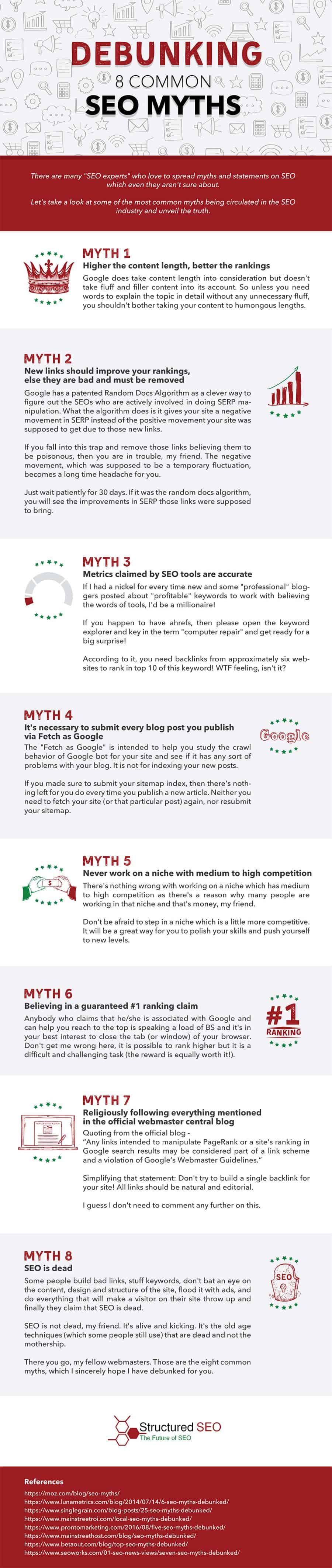
Structured SEO share their explanation for some of the most common SEO myths in this infographic.
Here’s a quick summary:
- Higher the content-length, better the rankings
- New links should improve your rankings, else they are bad and must be removed
- Metrics claimed by SEO tools are accurate / trustworthy
- It’s necessary to submit every blog post you publish via fetch as google in search console
- Never work on a niche with medium to high competition
- Believing in a guaranteed #1 ranking claim
- Religiously following everything mentioned in the official webmaster central blog
- SEO is dead
Check out the infographic for more detail.
Search Engine Optimization (SEO) is a crucial aspect of digital marketing, yet it is often misunderstood. This confusion is partly due to the numerous myths that have developed around the subject. Whether you are a novice or a seasoned professional, falling for these misconceptions can hinder your SEO efforts. Let’s debunk eight common myths about SEO.
Higher the Content-Length, Better the Rankings
One of the most pervasive myths in the SEO world is that longer content automatically translates to higher rankings. The logic seems simple: more content equals more keywords and thus, better search engine visibility. However, this is not entirely accurate.
While comprehensive content can provide value and cover a topic in depth, the focus should always be on quality over quantity. Search engines, particularly Google, prioritize content that meets the searcher’s intent. If a 500-word article delivers precise, valuable information, it can outrank a 2000-word piece filled with fluff.
Moreover, longer content can sometimes suffer from issues like keyword stuffing and redundancy, which can negatively impact rankings. Instead of fixating on word count, aim to create well-researched, insightful content that addresses the needs and questions of your audience.
In-Depth Tips and Guidance for Small Businesses
For small businesses, creating content that ranks well involves a strategic approach. Here are some in-depth tips and guidance to help you navigate this aspect of SEO effectively:
Focus on User Intent
Understanding and addressing user intent is the cornerstone of effective content creation. Google aims to provide search results that best match the intent behind a user’s query. Here’s how you can align your content with user intent:
- Keyword Research: Use tools like Google Keyword Planner, Ahrefs, or SEMrush to identify keywords relevant to your business. Look beyond just high search volume and consider the intent behind those searches.
- Content Mapping: Map out content types that match different stages of the buyer’s journey – awareness, consideration, and decision. For example, a detailed guide or tutorial can help those in the awareness stage, while product comparisons or case studies can assist those closer to making a purchase.
Prioritize Quality Over Quantity
Creating long-form content doesn’t mean filling space with irrelevant information. Quality should always take precedence. Here are some strategies to ensure your content remains high-quality:
- In-Depth Research: Provide well-researched information. Citing authoritative sources and including data, statistics, and case studies can add credibility to your content.
- Clear Structure: Organize your content with clear headings, subheadings, and bullet points. This not only improves readability but also helps search engines understand the structure of your content.
- Engaging Writing Style: Write in a way that is engaging and easy to understand. Avoid jargon unless your audience is familiar with it, and break up long paragraphs to keep readers interested.
Use Visuals and Multimedia
Enhancing your content with visuals and multimedia can significantly improve user engagement and satisfaction:
- Images and Infographics: Use high-quality images, infographics, and charts to illustrate your points. Visuals can make complex information more digestible and engaging.
- Videos: Embedding videos can be a great way to complement your written content. Tutorials, explainer videos, and product demos can provide additional value to your audience.
- Interactive Elements: Incorporate interactive elements like quizzes, calculators, or polls to engage users and encourage them to spend more time on your page.
Regularly Update Your Content
Search engines favor fresh content. Regularly updating your content can help maintain its relevance and improve its ranking potential:
- Content Audits: Periodically review your existing content to identify opportunities for updates. Add new information, update statistics, and remove outdated references.
- Repurpose Content: Turn old blog posts into different formats, such as videos, infographics, or podcasts. This not only refreshes the content but also reaches a broader audience.
Optimize for On-Page SEO
On-page SEO involves optimizing individual pages to improve their search engine rankings. Here are some key aspects to focus on:
- Title Tags and Meta Descriptions: Ensure your title tags and meta descriptions are compelling and include relevant keywords. These elements are crucial for both search engines and users.
- Header Tags: Use header tags (H1, H2, H3, etc.) to structure your content. This helps search engines understand the hierarchy and main topics of your content.
- Internal and External Links: Include internal links to other relevant pages on your site and external links to authoritative sources. This can improve your content’s credibility and help search engines understand its context.
- Image Optimization: Optimize images by using descriptive file names and alt text. This can improve your content’s accessibility and help search engines index your images properly.
Leverage Long-Tail Keywords
Long-tail keywords are specific, less competitive phrases that can drive targeted traffic to your site. For small businesses, targeting long-tail keywords can be a more effective strategy than competing for highly competitive short-tail keywords:
- Specificity: Long-tail keywords are more specific and often indicate a higher intent to purchase. For example, “buy organic honey online” is more targeted than “buy honey.”
- Lower Competition: These keywords typically have lower competition, making it easier for your content to rank higher in search results.
- Content Ideas: Use tools like Answer the Public or Google’s “People also ask” feature to find long-tail keyword ideas. Create content that addresses these specific queries in detail.
Engage with Your Audience
Engagement metrics, such as time on page, bounce rate, and social shares, can impact your content’s ranking. Here’s how to foster engagement:
- Encourage Comments and Feedback: Invite readers to leave comments and feedback. Responding to comments can build a sense of community and keep users engaged.
- Share on Social Media: Promote your content on social media platforms to reach a broader audience. Engaging with your followers and encouraging them to share your content can drive more traffic and signals to search engines that your content is valuable.
- Email Newsletters: Use email newsletters to share your latest content with your subscribers. This can drive repeat traffic and keep your audience engaged with your brand.
Measure and Analyze Performance
Regularly measuring and analyzing the performance of your content is essential for continuous improvement:
- Analytics Tools: Use tools like Google Analytics and Google Search Console to track metrics such as organic traffic, bounce rate, and average time on page.
- A/B Testing: Experiment with different content formats, headlines, and calls to action to see what resonates best with your audience.
- User Feedback: Gather feedback directly from your users through surveys or feedback forms to understand their preferences and pain points.
Conclusion
While the myth that longer content automatically results in better rankings persists, it’s crucial for small businesses to focus on creating high-quality, user-focused content. By understanding user intent, prioritizing quality, leveraging multimedia, optimizing for on-page SEO, targeting long-tail keywords, engaging with your audience, and continuously analyzing performance, you can effectively enhance your content’s visibility and impact.
Remember, the goal of SEO is not just to rank higher but to provide real value to your audience. By debunking this myth and implementing these strategies, small businesses can achieve sustainable growth and a robust online presence.
New Links Should Improve Your Rankings, Else They Are Bad and Must Be Removed
Backlinks are an essential part of SEO, acting as endorsements of your site’s credibility. However, the notion that all new links will boost your rankings or that links not immediately affecting your rankings are harmful is misleading.
SEO is a long-term strategy, and the impact of new backlinks may not be immediate. The quality and relevance of the link are far more critical than the mere existence of a link. High-quality backlinks from authoritative sites in your niche are beneficial, whereas links from low-quality or irrelevant sites can be detrimental.
It’s also essential to consider the context in which these links appear. If they seem manipulative or are from spammy sources, they can harm your site’s reputation. Regularly audit your backlinks but understand that not seeing an instant boost in rankings doesn’t necessarily mean the links are bad.
In-Depth Tips and Guidance for Small Businesses
For small businesses, building a strong backlink profile requires a strategic approach. Here are some detailed tips and guidance to help you manage and optimize your backlinks effectively:
Focus on Quality Over Quantity
When it comes to backlinks, quality always trumps quantity. A few high-quality backlinks can have a more significant impact than numerous low-quality ones. Here’s how to ensure you are getting quality backlinks:
- Relevance: Aim for links from websites that are relevant to your industry. A backlink from a site within your niche is more valuable than one from an unrelated source.
- Authority: Seek links from authoritative sites. Use tools like Moz’s Domain Authority (DA) or Ahrefs’ Domain Rating (DR) to assess the authority of potential linking sites. Higher authority sites provide more valuable backlinks.
- Content Context: Ensure that the backlinks are placed within relevant content. Links embedded naturally within the content of a related article are more beneficial than those in unrelated or off-topic pieces.
Build Relationships
Building genuine relationships with other businesses, bloggers, and influencers in your industry can naturally lead to high-quality backlinks. Here’s how to go about it:
- Networking: Attend industry conferences, webinars, and local business events to meet potential link partners.
- Outreach: Reach out to bloggers, journalists, and influencers in your niche. Share your content with them if it’s relevant and valuable to their audience.
- Guest Blogging: Offer to write guest posts for reputable sites in your industry. This not only provides a backlink but also positions you as an authority in your field.
Create Link-Worthy Content
Creating high-quality, valuable content increases the chances of earning backlinks naturally. Here are some content types that tend to attract links:
- In-Depth Guides and Tutorials: Comprehensive guides that provide detailed information on a specific topic can be highly link-worthy.
- Infographics: Visually appealing and informative infographics are often shared and linked to by other websites.
- Original Research and Data: Publishing original research, studies, or data can attract backlinks from others who cite your work as a source.
- Case Studies: Detailed case studies showcasing successful implementations or results can be valuable resources for others in your industry.
Monitor and Audit Your Backlink Profile
Regularly monitoring and auditing your backlink profile helps ensure its health and effectiveness. Here’s how you can do it:
- Use SEO Tools: Tools like Ahrefs, SEMrush, and Moz can help you track your backlinks, identify new links, and monitor their quality.
- Identify Harmful Links: Look for backlinks from spammy, low-quality, or irrelevant sites. These can harm your SEO and may need to be disavowed using Google Search Console’s disavow tool.
- Analyze Link Context: Assess the context in which your backlinks appear. Ensure they are embedded naturally within relevant content and not placed in manipulative or spammy ways.
Disavow Toxic Backlinks
If you identify toxic or harmful backlinks during your audit, it’s essential to disavow them to protect your site’s ranking. Here’s how to handle toxic backlinks:
- Identify Toxic Links: Use tools like Ahrefs or SEMrush to identify backlinks that may be harmful. Look for links from spammy sites, irrelevant sources, or those with low domain authority.
- Compile a Disavow File: Create a list of URLs or domains that you want to disavow. Ensure that you are thorough and accurate in your selection to avoid disavowing beneficial links by mistake.
- Submit to Google: Use the Google Search Console disavow tool to submit your disavow file. This tells Google to ignore those links when assessing your site’s backlink profile.
Patience and Long-Term Perspective
Backlink building is a long-term strategy, and the benefits may not be immediately apparent. Here’s how to maintain a long-term perspective:
- Consistent Effort: Continuously work on building high-quality backlinks. Consistency over time is key to a strong backlink profile.
- Avoid Shortcuts: Steer clear of black-hat SEO tactics like buying links or participating in link schemes. These can result in severe penalties from search engines.
- Track Progress: Use tools and analytics to track your backlink progress over time. Monitor improvements in your rankings, traffic, and overall site authority.
Leverage Local SEO
For small businesses, local SEO can be a goldmine for quality backlinks. Here’s how to leverage local SEO for backlink building:
- Local Directories: Ensure your business is listed in reputable local directories such as Yelp, Google My Business, and local Chamber of Commerce websites.
- Local Partnerships: Partner with other local businesses for cross-promotional opportunities and backlinks.
- Local News and Media: Reach out to local news outlets and media for coverage. Local press can provide authoritative backlinks and boost your visibility.
Engage in Online Communities
Participating in online communities and forums related to your industry can help build your backlink profile. Here’s how:
- Industry Forums: Join forums and discussion boards where your target audience and industry peers are active. Provide valuable insights and link back to your content when relevant.
- Social Media: Engage with your audience on social media platforms. Sharing your content on social media can lead to natural backlinks as people share and reference your content.
- Q&A Platforms: Participate in Q&A platforms like Quora or Reddit. Answer questions related to your industry and include links to your content where appropriate.
Conclusion
The myth that new links must immediately improve your rankings or be deemed bad is misleading. Building a robust and effective backlink profile requires a focus on quality, relevance, and long-term strategy. By prioritizing high-quality links, fostering relationships, creating link-worthy content, and regularly auditing your backlink profile, small businesses can enhance their SEO efforts and achieve sustainable growth.
Remember, backlinks are just one component of a comprehensive SEO strategy. Consistent, high-quality content creation, technical SEO, and user experience optimization are also crucial for long-term success in search engine rankings. By debunking this myth and implementing these strategies, small businesses can build a strong online presence and drive meaningful results.
Metrics Claimed by SEO Tools Are Accurate / Trustworthy
SEO tools like Ahrefs, SEMrush, and Moz provide valuable insights into various aspects of your SEO performance, such as keyword rankings, backlink profiles, and site audits. However, it’s a mistake to take the metrics from these tools at face value.
These tools use their algorithms and data sources, which means their metrics are estimates and not absolute truths. For instance, keyword difficulty scores can vary significantly between tools, and none of them can replicate Google’s exact ranking algorithm.
Use SEO tools as guides to inform your strategy, but don’t rely on them entirely. Cross-reference data from multiple sources and use your analytics to get a comprehensive view of your SEO health. Remember, these tools are aids, not definitive authorities.
In-Depth Tips and Guidance for Small Businesses
For small businesses, navigating the world of SEO tools and their metrics can be challenging. Here are some detailed tips and guidance to help you make the most of these tools without falling into the trap of over-reliance.
Understand the Limitations of SEO Tools
SEO tools are invaluable for gathering data, but it’s essential to understand their limitations:
- Algorithm Differences: Each tool uses its proprietary algorithms to calculate metrics such as domain authority, keyword difficulty, and traffic estimates. These algorithms can vary significantly, leading to different results across tools.
- Data Sources: SEO tools collect data from various sources, including their crawlers, third-party data providers, and public databases. The accuracy of their data depends on the comprehensiveness and recency of these sources.
- Estimates, Not Absolutes: Metrics provided by SEO tools should be viewed as estimates. For example, traffic estimates are based on sample data and projections, not exact figures. Treat these metrics as indicators rather than definitive measures.
Cross-Reference Data from Multiple Tools
To get a more accurate picture of your SEO performance, cross-reference data from multiple tools:
- Use Multiple Tools: Utilize different SEO tools to gather data on keyword rankings, backlinks, and site audits. Comparing data from tools like Ahrefs, SEMrush, and Moz can provide a broader perspective.
- Identify Consistencies: Look for consistent patterns and trends across different tools. If multiple tools show similar data, it’s more likely to be reliable.
- Understand Variations: Be aware of the differences in how each tool calculates its metrics. This understanding can help you interpret the data more accurately.
Focus on Trends Over Absolute Numbers
Instead of fixating on absolute numbers, pay attention to trends and changes over time:
- Monitor Trends: Track how your key metrics evolve. For example, rather than focusing solely on your current keyword rankings, monitor how they change month over month.
- Set Benchmarks: Establish benchmarks based on your initial data and track progress against these benchmarks. This approach helps you understand whether your SEO efforts are moving in the right direction.
- Analyze Patterns: Look for patterns in your data. For instance, a sudden drop in traffic might correlate with a specific event, such as a Google algorithm update or a technical issue on your site.
Use Tools for Specific Insights
Different SEO tools excel in different areas. Use each tool for its strengths:
- Ahrefs for Backlinks: Ahrefs is known for its comprehensive backlink database. Use it to monitor your backlink profile, identify new backlinks, and analyze your competitors’ backlinks.
- SEMrush for Competitive Analysis: SEMrush offers robust features for competitive analysis, including keyword gaps, traffic analysis, and competitor benchmarking. Use it to identify opportunities and understand your competitive landscape.
- Moz for Domain Authority: Moz provides insights into domain authority and page authority. Use these metrics to gauge the relative strength of your site and compare it to your competitors.
Verify Data with Google Analytics and Search Console
Google Analytics and Google Search Console provide direct data from Google, making them essential for verifying the accuracy of your SEO tool metrics:
- Google Analytics: Use Google Analytics to track your site’s traffic, user behavior, and conversions. This tool provides accurate data on how users interact with your site, helping you validate traffic estimates from other SEO tools.
- Google Search Console: Use Google Search Console to monitor your site’s presence in Google search results. It provides data on impressions, clicks, average position, and crawl errors, offering a direct line of sight into your SEO performance.
- Cross-Check Metrics: Compare the data from Google Analytics and Search Console with the estimates from your SEO tools. Significant discrepancies might indicate areas where the SEO tools’ data is less reliable.
Interpret Keyword Metrics Wisely
Keyword metrics like search volume and keyword difficulty can vary across tools. Here’s how to interpret them effectively:
- Search Volume Variations: Understand that search volume estimates are based on historical data and can fluctuate. Use them as a general guide rather than an exact measure of keyword demand.
- Keyword Difficulty: Different tools use different criteria to calculate keyword difficulty. Use this metric as a relative measure to compare the competitiveness of keywords within the same tool rather than between tools.
- Long-Tail Keywords: Don’t ignore long-tail keywords with lower search volumes. They often have less competition and can drive highly targeted traffic.
Regularly Audit Your Site with Multiple Tools
Conduct regular site audits using multiple SEO tools to get a comprehensive view of your site’s health:
- Technical SEO Audits: Use tools like Screaming Frog, SEMrush, and Ahrefs to conduct technical SEO audits. These audits can help identify issues such as broken links, duplicate content, and crawl errors.
- Content Audits: Use content audit features in tools like SEMrush and Ahrefs to evaluate the performance of your content. Identify underperforming pages and opportunities for content optimization.
- Backlink Audits: Regularly audit your backlink profile using Ahrefs and Moz to identify toxic backlinks and monitor the quality of your inbound links.
Use Custom Reports and Dashboards
Creating custom reports and dashboards can help you track the metrics that matter most to your business:
- Google Data Studio: Use Google Data Studio to create custom dashboards that pull data from multiple sources, including Google Analytics, Search Console, and your preferred SEO tools. This integration allows you to visualize your data in one place.
- Custom Metrics: Focus on metrics that align with your business goals. For example, track metrics related to lead generation, e-commerce sales, or local SEO performance.
- Regular Reporting: Schedule regular reports to monitor your SEO performance over time. Regular reporting helps you stay on top of trends and make informed decisions.
Educate Yourself Continuously
SEO is a dynamic field with constantly evolving best practices and algorithm updates. Stay informed and continuously educate yourself:
- Industry Blogs and Forums: Follow reputable SEO blogs and forums, such as Moz Blog, Search Engine Journal, and Google’s Webmaster Central Blog, to stay updated on the latest trends and insights.
- Webinars and Conferences: Attend SEO webinars and conferences to learn from industry experts and network with peers.
- Online Courses: Enroll in online courses from platforms like Coursera, Udemy, or HubSpot Academy to deepen your understanding of SEO principles and advanced techniques.
Conclusion
While SEO tools provide invaluable insights, it’s crucial to recognize their limitations and use their metrics as guides rather than absolute truths. By cross-referencing data from multiple tools, focusing on trends, leveraging each tool’s strengths, verifying data with Google Analytics and Search Console, interpreting keyword metrics wisely, conducting regular audits, creating custom reports, and continuously educating yourself, small businesses can effectively navigate the complexities of SEO and make informed decisions to enhance their online presence.
Remember, SEO is both an art and a science. The tools and metrics are there to assist you, but critical thinking, adaptability, and a strategic approach are key to achieving long-term success. By debunking the myth of relying solely on SEO tool metrics and implementing these strategies, small businesses can build a robust and effective SEO strategy.
It’s Necessary to Submit Every Blog Post You Publish via Fetch as Google in Search Console
Google Search Console’s “Fetch as Google” feature allows you to manually submit URLs for crawling. While this can be useful for urgent content updates, it’s a myth that you need to use this feature for every blog post to ensure indexing.
Google’s bots are quite efficient at discovering new content, especially if your site is regularly updated and has a solid internal linking structure. Submitting every post manually is not only unnecessary but can also become cumbersome.
In-Depth Tips and Guidance for Small Businesses
For small businesses, efficient indexing of blog posts is crucial for visibility and search engine rankings. Here’s a comprehensive guide on how to manage this process effectively without over-relying on the “Fetch as Google” feature.
Understanding How Google Crawls Your Site
Google uses automated bots, known as spiders or crawlers, to discover and index new content on the web. Understanding how these bots work can help you optimize your site for efficient crawling and indexing:
- Crawl Budget: Google allocates a specific crawl budget to each site, which determines how many pages its bots will crawl and index within a given timeframe. Factors influencing your crawl budget include the size of your site, the speed at which you update content, and the overall site quality.
- Internal Linking: A well-structured internal linking strategy helps crawlers navigate your site efficiently. Links from older, high-ranking pages to new blog posts can facilitate quicker discovery and indexing.
- Sitemaps: XML sitemaps provide search engines with a roadmap of your site’s structure and all its pages. Regularly updating your sitemap ensures that Google is aware of new and updated content.
Best Practices for Ensuring Efficient Indexing
Instead of relying on manual submission, follow these best practices to ensure that your new blog posts are indexed efficiently:
Create and Maintain a Robust Sitemap
- XML Sitemap: Ensure your XML sitemap is comprehensive and up-to-date. Tools like Yoast SEO for WordPress automatically generate and update sitemaps for you.
- Submit Sitemap in Search Console: Submit your sitemap to Google Search Console. This helps Google understand the structure of your site and the location of all your content.
- Regular Updates: Whenever you publish new content, ensure your sitemap is updated accordingly. This can often be automated with most CMS platforms.
Optimize Internal Linking Structure
- Contextual Links: Include links to new blog posts within your existing content. Contextual links, or links embedded naturally within the content, help Google discover new pages more quickly.
- Recent Posts Widget: Implement a recent posts widget in your sidebar or footer to showcase your latest content across your site.
- Content Hubs: Create hub pages that link to multiple related blog posts. This not only helps with SEO but also improves user navigation.
Leverage Social Media and External Links
- Social Sharing: Share your new blog posts on social media platforms like Facebook, Twitter, LinkedIn, and Instagram. Social signals can help search engines discover your new content.
- External Backlinks: Encourage other websites to link to your new content. Backlinks from authoritative sites can significantly boost the visibility and indexing speed of your new blog posts.
Use Ping Services
Ping services notify search engines about new content on your site. When you publish a new blog post, these services send out pings to inform search engines that your site has been updated.
- Ping Services: Use tools like Ping-o-Matic or services integrated within your CMS to automatically notify search engines when you publish new content.
Optimize Your Website for Crawl Efficiency
- Site Speed: Ensure your site loads quickly. Faster sites are crawled more efficiently. Use tools like Google PageSpeed Insights to identify and fix speed issues.
- Mobile-Friendly Design: Google uses mobile-first indexing, meaning it predominantly uses the mobile version of the content for indexing and ranking. Ensure your site is mobile-friendly.
- Fix Crawl Errors: Regularly check for and fix crawl errors in Google Search Console. Addressing issues like broken links, 404 errors, and server errors can improve crawl efficiency.
Regularly Monitor Indexing Status
Use Google Search Console to monitor the indexing status of your site and individual pages:
- Coverage Report: The Coverage report in Google Search Console shows which pages have been indexed, which have errors, and which are excluded. Regularly review this report to identify and address any issues.
- URL Inspection Tool: Use the URL Inspection tool to check the status of individual URLs. This tool provides information on how Google views your page, including indexing status and any detected issues.
When to Use Fetch as Google
While it’s not necessary to use “Fetch as Google” for every new post, there are specific situations where this tool can be beneficial:
- Urgent Updates: If you’ve made critical updates to a page, such as correcting misinformation, updating time-sensitive content, or fixing a major SEO issue, using “Fetch as Google” can expedite the indexing process.
- New Site Launch or Major Redesign: When launching a new site or after a significant redesign, use “Fetch as Google” to ensure Google quickly indexes the new or updated structure.
- Resolving Indexing Issues: If you notice that a new post hasn’t been indexed after a reasonable period, using “Fetch as Google” can help troubleshoot and resolve the issue.
Educate Your Team
Ensure your team understands the basics of how Google indexes content and the importance of following best practices. Provide training on:
- Content Optimization: Teach your team how to optimize content for SEO, including the use of internal links, meta tags, and proper formatting.
- SEO Tools: Familiarize your team with tools like Google Search Console, Yoast SEO, and analytics platforms. Understanding how to use these tools can help them identify and fix indexing issues.
Conclusion
While the “Fetch as Google” feature in Google Search Console can be useful in specific situations, it’s a myth that you need to manually submit every new blog post for indexing. By understanding how Google’s crawlers work and implementing best practices such as maintaining a robust sitemap, optimizing your internal linking structure, leveraging social media and external links, and monitoring your site’s indexing status, small businesses can ensure their content is indexed efficiently and effectively.
Adopting these strategies will not only improve the discoverability and ranking of your new blog posts but also enhance the overall SEO health of your website. By debunking the myth of the necessity of manual submission and focusing on these proven techniques, small businesses can achieve better search engine visibility and drive sustainable organic traffic.
Never Work on a Niche with Medium to High Competition
Many new SEO practitioners shy away from niches with medium to high competition, believing that it’s impossible to rank well without a massive budget or established authority. This is another myth that can limit your potential.
While highly competitive niches can be challenging, they also offer significant opportunities. Competition indicates demand, and with the right strategy, you can carve out a niche for yourself. Focus on identifying gaps in the market, creating high-quality, unique content, and building a strong backlink profile.
In-Depth Tips and Guidance for Small Businesses
For small businesses, entering and succeeding in a competitive niche requires a strategic and determined approach. Here’s a comprehensive guide on how to navigate and thrive in competitive markets.
Understanding the Competition
Before diving into a competitive niche, it’s crucial to understand your competition and the landscape:
- Competitor Analysis: Use tools like SEMrush, Ahrefs, or Moz to analyze your competitors. Look at their top-performing pages, backlink profiles, and keyword strategies. Understand what they are doing well and where there might be gaps.
- Market Research: Conduct thorough market research to understand the needs and preferences of your target audience. Identify pain points that are not being addressed adequately by your competitors.
- SWOT Analysis: Perform a SWOT analysis (Strengths, Weaknesses, Opportunities, Threats) to identify your unique strengths and opportunities in the market. This can help you formulate strategies to capitalize on gaps and underserved areas.
Identify and Target Niche Segments
In competitive markets, finding and targeting specific sub-niches or segments can be a highly effective strategy:
- Long-Tail Keywords: Focus on long-tail keywords that have lower search volumes but higher intent. These keywords are often less competitive and can attract highly targeted traffic. Use tools like Google Keyword Planner and AnswerThePublic to find long-tail keywords.
- Niche Audiences: Identify specific segments of your broader audience that have unique needs or interests. Tailor your content and offerings to these niche audiences to stand out from the competition.
- Geographical Niches: If applicable, target specific geographical areas. Local SEO strategies can help you dominate in your local market even if the broader niche is highly competitive.
Create High-Quality, Unique Content
Content is king, especially in competitive niches. Here’s how to create content that stands out:
- Value-Driven Content: Focus on providing real value to your audience. Create content that addresses their pain points, answers their questions, and provides actionable insights. High-quality, helpful content is more likely to attract and retain visitors.
- Comprehensive Guides: Develop comprehensive guides and resources that cover topics in-depth. Detailed, well-researched content can position you as an authority in your niche.
- Unique Perspectives: Offer unique perspectives or approaches to common topics. Share personal experiences, case studies, or proprietary research to differentiate your content.
- Regular Updates: Keep your content up-to-date. Regularly update your articles to reflect the latest information, trends, and best practices in your niche.
Optimize for On-Page SEO
On-page SEO is critical for improving your visibility and rankings, especially in competitive niches:
- Keyword Optimization: Ensure your target keywords are strategically placed in key areas such as the title tag, meta description, headers, and throughout the content. Avoid keyword stuffing; instead, use variations and related terms naturally.
- Technical SEO: Optimize your site’s technical aspects, including site speed, mobile-friendliness, and crawlability. Tools like Google PageSpeed Insights and Google Search Console can help identify and fix technical issues.
- User Experience (UX): Prioritize a seamless user experience. Ensure your site is easy to navigate, visually appealing, and free from intrusive ads or pop-ups.
- Internal Linking: Use internal linking to guide users and search engines through your site. Link to related articles and important pages to enhance the user experience and improve your site’s crawlability.
Build a Strong Backlink Profile
In competitive niches, backlinks remain a crucial ranking factor. Here’s how to build a robust backlink profile:
- Quality Over Quantity: Focus on acquiring high-quality backlinks from authoritative sites within your niche. A few high-quality links can be more impactful than numerous low-quality ones.
- Guest Posting: Write guest posts for reputable blogs and websites in your industry. This not only helps build backlinks but also establishes your authority and reach.
- Content Outreach: Reach out to influencers, bloggers, and journalists in your niche. Share your high-quality content with them and encourage them to link back to it.
- Broken Link Building: Use tools like Ahrefs to find broken links on reputable sites within your niche. Reach out to the site owners and suggest replacing the broken link with a link to your relevant content.
Leverage Local SEO
If your business has a physical location or serves specific regions, local SEO can help you gain a competitive edge:
- Google My Business: Claim and optimize your Google My Business listing. Ensure your business information is accurate and complete, and encourage satisfied customers to leave reviews.
- Local Keywords: Optimize your content and meta tags for local keywords, including the name of your city or region. This helps you rank for local searches.
- Local Directories: List your business in local online directories and industry-specific directories. Ensure your NAP (Name, Address, Phone number) information is consistent across all listings.
Utilize Social Media and Content Marketing
Social media and content marketing can amplify your reach and help you build a loyal audience:
- Engage on Social Media: Be active on social media platforms where your audience spends their time. Share your content, engage with your followers, and participate in relevant discussions.
- Content Promotion: Promote your blog posts and other content across various channels, including social media, email newsletters, and forums. Use paid advertising on platforms like Facebook and LinkedIn to boost visibility.
- Influencer Collaborations: Partner with influencers in your niche to reach a broader audience. Influencers can help you build credibility and drive traffic to your site.
Measure and Adapt Your Strategy
Regularly measuring the performance of your SEO efforts and adapting your strategy is crucial for success in competitive niches:
- Analytics Tools: Use tools like Google Analytics and Google Search Console to track your site’s performance. Monitor key metrics such as organic traffic, bounce rate, and conversion rates.
- Performance Analysis: Regularly analyze the performance of your content and SEO strategies. Identify what’s working and what’s not, and adjust your approach accordingly.
- Continuous Improvement: SEO is an ongoing process. Continuously seek ways to improve your site’s performance, whether through technical optimizations, content updates, or new marketing strategies.
Conclusion
Contrary to the myth that small businesses should avoid competitive niches, these markets offer significant opportunities for growth and success. By understanding your competition, targeting niche segments, creating high-quality content, optimizing for on-page and local SEO, building a strong backlink profile, leveraging social media, and regularly measuring your performance, small businesses can thrive even in highly competitive environments.
Remember, competition indicates demand, and with the right strategies and persistence, you can carve out a niche for yourself and achieve long-term success. By debunking the myth of avoiding competitive niches and implementing these strategies, small businesses can build a robust online presence and drive meaningful results.
Believing in a Guaranteed #1 Ranking Claim
SEO agencies or experts guaranteeing a #1 ranking should raise red flags. No one can promise top rankings because search engine algorithms are complex and constantly changing. Rankings depend on numerous factors, many of which are beyond direct control, such as user behavior and competitor actions.
Instead of focusing on guarantees, look for SEO professionals who offer realistic expectations and transparent methodologies. Effective SEO is about improving your site’s overall health and visibility, driving relevant traffic, and providing a positive user experience. These efforts lead to sustainable growth and better rankings over time, but no legitimate expert can guarantee a #1 spot.
In-Depth Tips and Guidance for Small Businesses
For small businesses, navigating the promises and pitfalls of SEO can be challenging. Here’s a comprehensive guide on understanding why guaranteed #1 ranking claims are problematic and what to look for in a reliable SEO strategy.
Understand the Complexity of Search Engine Algorithms
Search engine algorithms are incredibly complex and constantly evolving:
- Algorithm Updates: Search engines like Google frequently update their algorithms to improve search quality and user experience. These updates can impact rankings, sometimes dramatically.
- Multiple Ranking Factors: Google uses hundreds of ranking factors, including content quality, site speed, mobile-friendliness, backlinks, and user behavior. The interplay of these factors makes it impossible to guarantee a specific ranking.
- Personalized Search Results: Google customizes search results based on individual user behavior, location, and preferences. This means rankings can vary for different users and over time.
Focus on Sustainable SEO Practices
Rather than chasing guaranteed #1 rankings, focus on sustainable SEO practices that improve your site’s overall health and visibility:
- Content Quality: Create high-quality, relevant content that addresses the needs and interests of your target audience. Focus on depth, accuracy, and readability.
- User Experience (UX): Ensure your website is user-friendly, with intuitive navigation, fast loading times, and a mobile-responsive design. A positive user experience can lead to higher engagement and better rankings.
- Technical SEO: Optimize your site’s technical aspects, such as site structure, crawlability, and security. Use tools like Google Search Console to identify and fix technical issues.
- Link Building: Develop a robust backlink profile by earning high-quality, relevant backlinks from authoritative sites. Avoid black-hat tactics like buying links or participating in link schemes.
Set Realistic Expectations with Your SEO Partner
When working with an SEO agency or consultant, it’s crucial to set realistic expectations and understand what they can and cannot promise:
- Transparent Methodologies: Look for SEO professionals who are transparent about their strategies and methods. They should explain their approach and how it aligns with best practices.
- Performance Metrics: Focus on meaningful performance metrics such as organic traffic growth, conversion rates, and user engagement rather than just rankings.
- Ongoing Optimization: SEO is not a one-time effort but an ongoing process. A reliable SEO partner will emphasize the importance of continuous optimization and adaptation to stay ahead of algorithm changes and competitive pressures.
Ask the Right Questions
When evaluating potential SEO partners, ask the right questions to gauge their credibility and approach:
- What is Your SEO Strategy?: Understand their overall strategy and how they plan to achieve your goals. Look for a comprehensive approach that includes on-page, off-page, and technical SEO.
- How Do You Measure Success?: Ensure they focus on metrics that matter to your business, such as organic traffic, leads, and sales, rather than just rankings.
- Can You Provide Case Studies or References?: Ask for case studies or references from previous clients. This can give you insight into their track record and effectiveness.
Beware of Red Flags
Be cautious of SEO providers who make unrealistic promises or employ questionable tactics:
- Guaranteed #1 Rankings: As mentioned, no one can guarantee a #1 ranking. Be wary of anyone who makes such a promise.
- Lack of Transparency: If an SEO provider is vague about their methods or unwilling to share details, it’s a red flag. Transparency is key to a trustworthy partnership.
- Focus on Short-Term Gains: Avoid providers who emphasize quick fixes or short-term gains over long-term, sustainable growth. SEO is a marathon, not a sprint.
Invest in Education and Training
Understanding the basics of SEO can help you make informed decisions and set realistic expectations:
- SEO Courses: Enroll in SEO courses from reputable sources like Moz, HubSpot, or Coursera. These courses can provide you with a solid foundation in SEO principles and best practices.
- Industry Blogs and Forums: Follow industry blogs and participate in SEO forums to stay updated on the latest trends and algorithm updates. Resources like Search Engine Journal and Moz Blog are excellent places to start.
- Webinars and Conferences: Attend SEO webinars and conferences to learn from industry experts and network with peers. These events can provide valuable insights and keep you informed about the latest developments.
Develop a Long-Term SEO Strategy
A successful SEO strategy is built on a long-term vision and continuous improvement:
- Keyword Research: Conduct thorough keyword research to identify relevant and high-intent keywords for your business. Use tools like Ahrefs, SEMrush, or Google Keyword Planner to find keyword opportunities.
- Content Strategy: Develop a content strategy that focuses on creating valuable, relevant, and engaging content for your audience. Regularly publish and update content to keep it fresh and relevant.
- Monitor and Adjust: Regularly monitor your SEO performance using tools like Google Analytics and Google Search Console. Analyze the data to identify trends, strengths, and areas for improvement, and adjust your strategy accordingly.
Build a Strong Online Presence
In addition to SEO, building a strong online presence through various channels can enhance your visibility and authority:
- Social Media: Engage with your audience on social media platforms. Share your content, participate in discussions, and build relationships with your followers.
- Email Marketing: Use email marketing to nurture leads and keep your audience informed about your latest content and offerings.
- Brand Building: Focus on building a strong brand that resonates with your target audience. A strong brand can enhance your credibility and attract more organic traffic.
Conclusion
Believing in a guaranteed #1 ranking claim is a common myth that can lead small businesses astray. No one can promise top rankings due to the complexity and ever-changing nature of search engine algorithms. Instead, focus on sustainable SEO practices that improve your site’s overall health and visibility.
Set realistic expectations, choose transparent and ethical SEO partners, invest in education, and develop a long-term SEO strategy. By debunking the myth of guaranteed rankings and implementing these strategies, small businesses can achieve sustainable growth, better search engine visibility, and meaningful results over time. Remember, SEO is a journey, not a destination, and success comes from continuous effort, adaptation, and a focus on providing real value to your audience.
Religiously Following Everything Mentioned in the Official Webmaster Central Blog
Google’s Webmaster Central Blog is an excellent resource for understanding the fundamentals of SEO and staying updated with significant algorithm changes. However, taking every piece of advice as a strict rule is not always the best approach.
SEO is nuanced, and what works for one site may not work for another. Experimentation and adaptation are key. Use the guidelines from the Webmaster Central Blog as a foundation, but be prepared to tailor your strategies to your unique circumstances.
Additionally, Google’s advice sometimes reflects its ideal vision of the web, which may not always align with practical realities. Balancing best practices with real-world testing and experience will yield the best results for your SEO efforts.
In-Depth Tips and Guidance for Small Businesses
For small businesses, effectively leveraging the insights from the Webmaster Central Blog requires a strategic and flexible approach. Here’s how to navigate this valuable resource without becoming overly rigid in your SEO strategy.
Understand the Purpose of the Webmaster Central Blog
Google’s Webmaster Central Blog serves several purposes:
- Guidelines and Best Practices: It provides guidelines and best practices to help webmasters optimize their sites for better visibility in search results.
- Algorithm Updates: The blog announces significant algorithm updates and changes that can impact SEO strategies.
- Common Issues and Solutions: It addresses common issues faced by webmasters and offers solutions and recommendations.
Use the Blog as a Foundation
While the blog provides valuable information, it should be used as a foundation rather than a strict rulebook:
- Baseline Knowledge: Use the blog to build a strong baseline understanding of SEO principles and best practices.
- Stay Updated: Regularly check the blog for updates on new algorithm changes, features, and important announcements.
Tailor Strategies to Your Unique Circumstances
Every website is unique, and a one-size-fits-all approach rarely works in SEO. Tailor the advice from the blog to fit your specific needs:
- Audience and Industry: Consider your target audience and industry. What works for one sector may not work for another. Tailor your content and SEO strategies to resonate with your audience.
- Site Structure and Content: Adapt the recommendations to fit your site’s structure, content, and goals. For example, an e-commerce site might need different SEO tactics compared to a blog or a service-oriented business.
- Testing and Experimentation: Implement the guidelines, but always test and measure the impact. What works well for other sites might need adjustment to suit your site’s specific context.
Balance Best Practices with Practical Realities
Sometimes, the ideal practices recommended by Google may not be fully practical for all businesses. Here’s how to balance ideal guidelines with practical implementation:
- Resource Constraints: Small businesses often have limited resources. Prioritize SEO practices that offer the best return on investment given your specific circumstances.
- Competitive Landscape: Consider the competitive landscape of your niche. Some recommendations might be more critical in highly competitive environments, while others can be adjusted based on your competition.
- User Experience: While following SEO best practices, ensure that user experience is not compromised. Balancing technical SEO with user-friendly design and functionality is crucial.
Real-World Testing and Adaptation
Practical, real-world testing is essential for effective SEO. Here’s how to integrate testing and adaptation into your strategy:
- A/B Testing: Use A/B testing to compare different strategies and see what works best for your site. Test elements like page titles, meta descriptions, and content formats.
- Analytics and Metrics: Use tools like Google Analytics and Google Search Console to monitor the performance of your SEO efforts. Analyze the data to understand what’s working and what needs adjustment.
- Iterative Improvement: SEO is an ongoing process. Regularly review and refine your strategies based on performance data and changing circumstances.
Be Critical and Informed
While the Webmaster Central Blog is authoritative, approach its advice with a critical and informed mindset:
- Critical Thinking: Apply critical thinking to evaluate the advice in the context of your own site and business. Not all recommendations may be applicable or necessary.
- Consult Multiple Sources: Complement the insights from the Webmaster Central Blog with information from other reputable sources. This helps in getting a broader perspective and more comprehensive understanding.
- Community Insights: Engage with the SEO community through forums, webinars, and conferences. Learning from the experiences of others can provide practical insights and alternative strategies.
Prioritize Core Principles
Focus on core SEO principles that are consistently emphasized in the blog and widely accepted in the SEO community:
- Quality Content: Create high-quality, relevant, and engaging content that provides real value to your audience.
- Technical SEO: Ensure your site is technically sound, with proper indexing, fast load times, mobile responsiveness, and secure HTTPS protocols.
- User Experience: Optimize for a positive user experience, including intuitive navigation, clear calls to action, and a visually appealing design.
- Backlink Profile: Build a strong, natural backlink profile by earning links from reputable and relevant sites.
Develop a Flexible SEO Strategy
Your SEO strategy should be flexible enough to adapt to changes in algorithms, market conditions, and user behavior:
- Agile Approach: Adopt an agile approach to SEO, where you can quickly pivot and adjust strategies based on new information and performance data.
- Stay Informed: Keep abreast of industry changes, algorithm updates, and emerging trends. Regularly update your knowledge and strategies accordingly.
- Long-Term Focus: While adapting to changes, maintain a long-term focus on sustainable growth and continuous improvement.
Educate Your Team
Ensure that your team understands the importance of flexibility and adaptation in SEO:
- Training and Development: Provide regular training and development opportunities for your team to keep them updated on the latest SEO best practices and industry trends.
- Encourage Innovation: Foster a culture of innovation and experimentation. Encourage your team to test new ideas and approaches, and learn from both successes and failures.
- Collaborative Approach: Promote a collaborative approach to SEO, where different team members can contribute insights and expertise to develop a well-rounded strategy.
Conclusion
Religiously following every piece of advice from the Webmaster Central Blog without considering your unique circumstances and the practical realities of your business can limit your SEO success. Instead, use the blog as a valuable resource and foundation, but be prepared to tailor your strategies, test and adapt based on real-world data, and maintain flexibility.
By balancing best practices with practical implementation, continuously educating yourself and your team, and staying informed and critical, small businesses can develop effective and sustainable SEO strategies that drive meaningful results. Remember, SEO is a dynamic field that requires ongoing learning, adaptation, and a focus on providing real value to your audience.
SEO is Dead
Every few years, claims circulate that SEO is dead, usually in response to a significant algorithm update or the rise of a new marketing trend. These proclamations are vastly exaggerated.
SEO is not dead; it’s evolving. Search engines continuously refine their algorithms to deliver better user experiences, and SEO practices must adapt accordingly. The fundamentals of providing valuable content, ensuring technical soundness, and earning reputable backlinks remain relevant.
Instead of viewing SEO as a static set of rules, embrace it as a dynamic field. Stay informed about changes, experiment with new techniques, and focus on delivering real value to your audience. As long as search engines exist, SEO will continue to be an essential aspect of digital marketing.
In-Depth Tips and Guidance for Small Businesses
For small businesses, understanding the evolution of SEO and adapting to changes is crucial for maintaining and improving their online presence. Here are detailed tips and guidance on how to navigate the ever-changing landscape of SEO effectively.
Understand the Evolution of SEO
SEO has evolved significantly since its inception, moving from simple keyword stuffing and link building to a more sophisticated practice that emphasizes user experience and quality content:
- Algorithm Changes: Major algorithm updates like Google’s Panda, Penguin, and Hummingbird have shifted the focus from manipulative tactics to genuine, user-centered practices. Understanding these changes is key to staying ahead.
- Search Intent: Modern SEO prioritizes understanding and meeting search intent. This means creating content that directly answers the questions and needs of your target audience.
- User Experience: Factors like page load speed, mobile-friendliness, and site navigation have become critical components of SEO. Search engines now consider how users interact with your site as a significant ranking factor.
Focus on Quality Content
Content remains the cornerstone of effective SEO. Here’s how small businesses can create content that meets modern SEO standards:
- User-Centered Content: Create content that addresses the needs, questions, and pain points of your target audience. Use tools like AnswerThePublic and Google’s “People also ask” feature to identify common queries.
- Comprehensive Guides: Develop in-depth guides and resources that cover topics thoroughly. Long-form content often performs well because it provides extensive value to readers.
- Regular Updates: Keep your content up-to-date with the latest information and trends. Regularly updating old posts can boost their performance and relevance.
- Visual Content: Incorporate images, infographics, videos, and other multimedia elements to enhance engagement and user experience.
Optimize for Technical SEO
Technical SEO ensures that search engines can efficiently crawl, index, and understand your site. Here’s how to keep your site technically sound:
- Site Speed: Improve your site’s load speed using tools like Google PageSpeed Insights. Compress images, leverage browser caching, and minimize CSS and JavaScript files.
- Mobile Optimization: Ensure your site is mobile-friendly. Use responsive design techniques to provide a seamless experience across all devices.
- Secure Connection: Use HTTPS to secure your site. Google considers site security as a ranking factor, and HTTPS ensures the protection of user data.
- Crawlability: Ensure that search engines can crawl your site efficiently. Use a robots.txt file to control crawler access and create an XML sitemap to guide search engines to your important pages.
Leverage Local SEO
Local SEO is vital for small businesses that serve specific geographic areas. Here’s how to optimize for local search:
- Google My Business: Claim and optimize your Google My Business listing. Provide accurate and complete information, including your business name, address, phone number, and hours of operation.
- Local Citations: Ensure your business is listed in local directories and citation sites. Consistency in your NAP (Name, Address, Phone number) across all listings is crucial.
- Reviews and Ratings: Encourage satisfied customers to leave positive reviews on Google and other review platforms. Respond to reviews to show engagement and build trust.
- Local Keywords: Optimize your content for local keywords, including the names of your city, neighborhood, or region. Create location-specific pages if you serve multiple areas.
Build a Strong Backlink Profile
Backlinks remain a critical ranking factor, but the focus is now on quality rather than quantity:
- Earned Links: Create high-quality, shareable content that naturally attracts backlinks. Content that offers unique insights, data, or solutions tends to earn more links.
- Guest Posting: Contribute guest posts to reputable blogs and websites in your industry. Ensure your contributions are valuable and relevant to their audience.
- Broken Link Building: Use tools like Ahrefs to find broken links on other websites. Reach out to the site owners and suggest your content as a replacement.
- Partnerships: Build relationships with other businesses, bloggers, and influencers in your niche. Collaborative content and mutual linking can benefit all parties involved.
Embrace Emerging SEO Trends
Stay ahead of the curve by embracing new trends and technologies in SEO:
- Voice Search Optimization: With the rise of smart speakers and voice assistants, optimizing for voice search is becoming increasingly important. Focus on natural language, long-tail keywords, and question-based queries.
- Structured Data: Implement structured data (schema markup) to help search engines understand your content better and enhance your search result appearance with rich snippets.
- Artificial Intelligence: AI is playing a bigger role in search algorithms. Tools like Google’s RankBrain prioritize user satisfaction. Focus on creating content that meets user intent and provides a positive experience.
- Video SEO: Video content is highly engaging and can drive significant traffic. Optimize your videos with proper titles, descriptions, and tags. Consider hosting videos on YouTube and embedding them on your site.
Monitor and Analyze Performance
Regularly monitoring and analyzing your SEO performance is crucial for continuous improvement:
- Google Analytics: Use Google Analytics to track key metrics such as organic traffic, bounce rate, and conversion rates. Analyze user behavior to identify areas for improvement.
- Google Search Console: Monitor your site’s performance in Google Search Console. Check for indexing issues, crawl errors, and keyword performance.
- SEO Tools: Utilize SEO tools like Ahrefs, SEMrush, and Moz to conduct regular site audits, track rankings, and analyze your backlink profile.
- Performance Benchmarks: Set performance benchmarks and regularly compare your current performance against these benchmarks. Adjust your strategies based on your findings.
Educate and Train Your Team
Ensure your team is knowledgeable about the latest SEO best practices and trends:
- Regular Training: Provide regular training sessions on SEO fundamentals and advanced techniques. Keep your team updated on algorithm changes and new strategies.
- Knowledge Sharing: Encourage knowledge sharing within your team. Discuss successful strategies, share insights from industry blogs, and brainstorm new ideas together.
- Stay Informed: Subscribe to industry newsletters, attend webinars, and participate in SEO forums to stay informed about the latest developments.
Conclusion
The claim that SEO is dead is a myth. SEO is a dynamic and evolving field that continues to be essential for online visibility and success. For small businesses, staying updated on SEO trends, focusing on quality content, optimizing technical aspects, leveraging local SEO, building a strong backlink profile, and embracing new technologies are crucial strategies for maintaining and improving their search engine rankings.
By understanding the evolution of SEO and adapting to changes, small businesses can effectively navigate the digital landscape, drive organic traffic, and achieve sustainable growth. Remember, SEO is a long-term investment that requires continuous effort, learning, and adaptation. By debunking the myth of SEO’s demise and implementing these strategies, small businesses can thrive in an ever-changing digital world.
Conclusion
Understanding and debunking common SEO myths is crucial for developing effective strategies and achieving long-term success. Prioritize quality content over sheer length, recognize the long-term nature of backlink benefits, and use SEO tools as guides rather than gospel. Avoid unnecessary manual submissions, don’t fear competitive niches, be wary of guaranteed ranking claims, balance official advice with practical testing, and remember that SEO is very much alive and evolving.
By ignoring these myths and focusing on proven, adaptable strategies, you can navigate the complex world of SEO with confidence and achieve meaningful results for your website.

Author:
Mark Ford