Are you just getting started with SEO? Want a list of terms you’re going to come across in your quest for Google stardom?
SEO can be a very daunting process for newbies, there are loads of new words to learn and hundreds of ranking factors to consider. Some will fall by the wayside and either give up or pay someone else, but with a bit of insider knowledge anyone can become an SEO master.
For a list of terms you need to know take a look at this SEO alphabet from Red Square SEO.
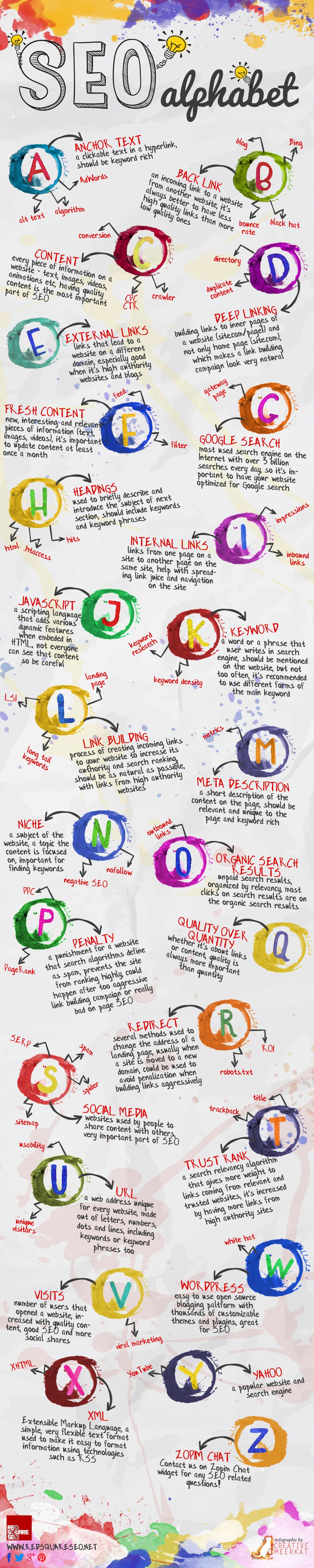
In the vast and ever-evolving world of digital marketing, Search Engine Optimization (SEO) stands as a cornerstone. Whether you’re a business owner looking to boost your website’s visibility or a curious individual seeking to unravel the complexities of online marketing, understanding SEO terminology is crucial. SEO is not just about keywords and backlinks; it involves a multitude of concepts, strategies, and practices that can seem overwhelming at first glance. Fear not, for this comprehensive guide is designed to demystify SEO terminology for beginners, providing you with a solid foundation to navigate this dynamic field.
Introduction to SEO
1. SEO (Search Engine Optimization)
SEO is the process of enhancing a website’s visibility in search engine results pages (SERPs) to attract organic (non-paid) traffic. It involves optimizing various elements of a website to improve its ranking on search engines like Google, Bing, and Yahoo.
2. SERP (Search Engine Results Page)
SERP refers to the page displayed by search engines in response to a user’s query. It includes a list of search results that match the user’s keywords.
3. Organic Traffic
Organic traffic comprises visitors who find your website through unpaid (organic) search engine results. It is considered high-quality traffic as users typically click on organic results with higher trust.
On-Page SEO
4. Keyword
Keywords are words or phrases that users enter into search engines to find information. Effective keyword research is crucial for SEO success.
5. Meta Title and Meta Description
These are HTML elements that provide a concise summary of a web page’s content. They appear in search results and impact click-through rates.
6. Header Tags (H1, H2, H3, etc.)
Header tags are used to structure the content on a page. H1 is the main heading, followed by H2 for subsections, and so on. Proper use of header tags aids readability and SEO.
7. Alt Text
Alt text is a descriptive text added to images. It helps search engines understand the content of an image and is essential for accessibility.
8. Keyword Density
Keyword density is the percentage of times a keyword appears in a piece of content. Overusing keywords can lead to keyword stuffing, a practice frowned upon by search engines.
9. Internal Linking
Internal links connect pages within the same website. They help distribute link equity and improve navigation.
Off-Page SEO
10. Backlinks (Inbound Links)
Backlinks are links from other websites to your site. They are a vital ranking factor and signal the authority and credibility of your content.
11. Link Building
Link building is the process of acquiring backlinks from reputable websites to improve your own site’s authority.
12. Domain Authority (DA) and Page Authority (PA)
DA and PA are metrics developed by Moz to assess a website’s or a specific page’s ranking potential. Higher values indicate a stronger online presence.
Technical SEO
13. Crawling and Indexing
Search engines use bots (spiders) to crawl and index web pages. Crawling is the process of discovering web pages, while indexing involves storing them in the search engine’s database.
14. XML Sitemap
An XML sitemap is a file that lists all the pages on a website, helping search engines understand its structure and content.
15. Robots.txt
Robots.txt is a file that tells search engine bots which pages or sections of a website should not be crawled or indexed.
16. Canonical URL
A canonical URL is the preferred version of a web page, used to resolve duplicate content issues.
17. 301 Redirect
A 301 redirect is a permanent redirect that informs search engines that a page has moved to a new URL. It passes the SEO value of the old page to the new one.
18. 404 Error
A 404 error occurs when a web page is not found. Custom 404 pages can help retain visitors and maintain SEO.
Content SEO
19. Content Quality
High-quality content is informative, engaging, and relevant to the target audience. Search engines reward websites with valuable content.
20. Evergreen Content
Evergreen content remains relevant over time and can continue to attract traffic long after it’s published.
21. Duplicate Content
Duplicate content refers to identical or very similar content that appears on multiple pages, which can harm SEO efforts.
22. User-Generated Content (UGC)
UGC includes content created by users, such as product reviews and comments. It can enhance SEO and user engagement.
Local SEO
23. Local SEO
Local SEO focuses on optimizing a website to appear in local search results, primarily for location-based queries.
24. Google My Business (GMB)
GMB is a free tool from Google that allows businesses to manage their online presence on Google, including Maps and Search.
25. NAP (Name, Address, Phone Number)
NAP consistency is critical for local SEO. It ensures that your business’s contact information is accurate across the web.
Mobile SEO
26. Mobile-Friendly (Responsive) Design
A mobile-friendly website is designed to provide an optimal user experience on mobile devices. Google considers mobile-friendliness in its rankings.
27. Mobile-First Indexing
Google predominantly uses the mobile version of a website’s content for indexing and ranking.
SEO Tools
28. Google Analytics
Google Analytics is a web analytics service that tracks and reports website traffic. It provides valuable insights for SEO optimization.
29. Google Search Console
Search Console is a tool provided by Google that helps website owners monitor and troubleshoot their site’s presence in Google search results.
30. Keyword Research Tools
Tools like SEMrush, Ahrefs, and Moz Keyword Explorer help identify relevant keywords and assess their search volume and competition.
SEO Strategies
31. White Hat SEO
White hat SEO refers to ethical and best-practice SEO techniques that comply with search engine guidelines.
32. Black Hat SEO
Black hat SEO involves unethical practices that aim to manipulate search engine rankings, often resulting in penalties.
33. Gray Hat SEO
Gray hat SEO falls somewhere between white hat and black hat techniques, as it may involve practices that are technically within guidelines but can be seen as manipulative.
SEO Metrics
34. Click-Through Rate (CTR)
CTR measures the percentage of clicks a link receives compared to the number of times it’s shown. It’s a crucial metric for assessing the performance of titles and meta descriptions.
35. Bounce Rate
Bounce rate is the percentage of visitors who leave a website after viewing only one page. A high bounce rate may indicate issues with content or user experience.
36. Conversion Rate
Conversion rate tracks the percentage of visitors who take a desired action, such as making a purchase or signing up for a newsletter.
37. Keyword Ranking
Keyword ranking refers to a website’s position in search engine results for specific keywords. Higher rankings generally lead to more organic traffic.
SEO Updates and Algorithms
38. Algorithm
Search engines use algorithms to determine the relevance and ranking of web pages in response to a user’s query. Google, for example, uses various algorithms, including the famous PageRank.
39. Google Updates (e.g., Panda, Penguin, Hummingbird)
Google frequently updates its search algorithm to improve search results and combat spammy practices. Understanding these updates is vital for SEO success.
40. Mobile-Friendly Update (Mobilegeddon)
Mobilegeddon was a Google update that prioritized mobile-friendly websites in mobile search results.
SEO Trends
41. Voice Search Optimization
As voice-activated devices become more common, optimizing for voice search is a growing trend in SEO.
42. Featured Snippets
Featured snippets are concise answers that appear at the top of some search results, providing quick answers to user queries.
43. Video SEO
Video content optimization involves making video content more discoverable in search results, such as through YouTube SEO.
Conclusion
This SEO terminology guide is your entry point into the dynamic world of Search Engine Optimization. Armed with these fundamental terms, you’ll be better equipped to explore advanced SEO strategies, stay informed about industry developments, and make informed decisions to boost your website’s visibility and success. Remember, SEO is a long-term game, and staying updated with the latest trends and algorithm changes is key to achieving lasting results in the ever-evolving landscape of digital marketing. So, dive in, explore, and harness the power of SEO to drive organic traffic and achieve your online goals.

Author:
Mark Ford