

In today’s digital age, businesses have a multitude of options when it comes to online marketing strategies.
Two of the most popular and effective methods are Search Engine Optimization (SEO) and Pay Per Click (PPC) marketing.
Both approaches aim to increase online visibility and drive traffic to your website, but they do so in different ways and come with their own set of advantages and disadvantages.
In this comprehensive guide, we’ll delve deep into the world of SEO and PPC to help you make informed decisions about which strategy or combination of strategies is right for your business.
Part 1: Understanding SEO
What is SEO?
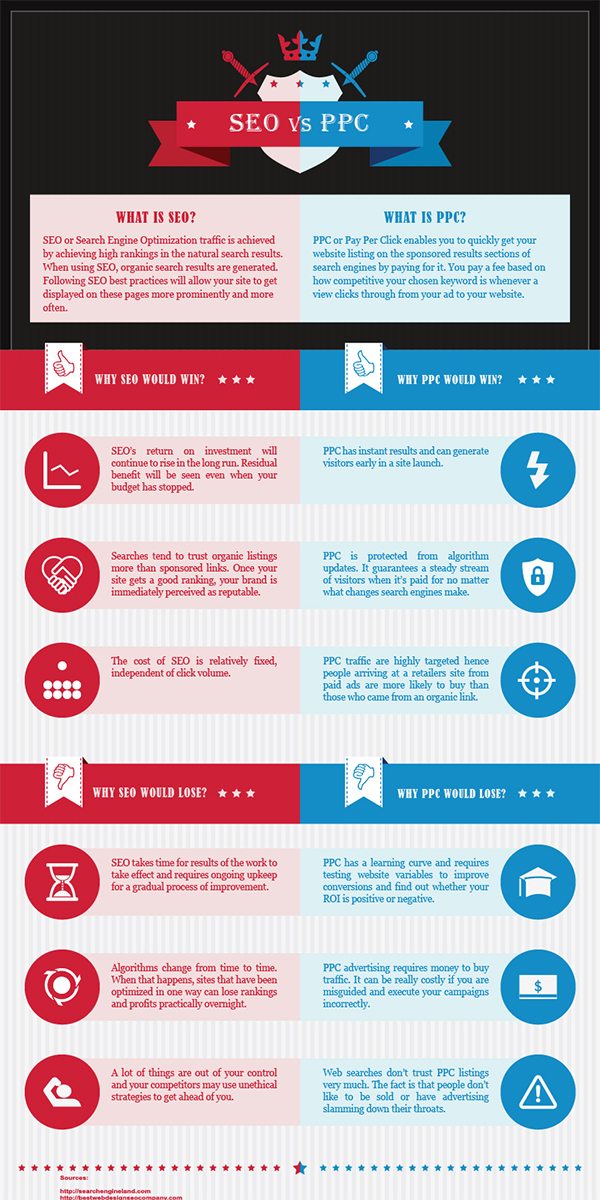
SEO stands for Search Engine Optimization, and it refers to the practice of optimizing your website’s content and structure to improve its visibility in organic (non-paid) search engine results. The goal of SEO is to rank higher in search engine results pages (SERPs) for relevant keywords, ultimately driving more organic traffic to your site.
The Pros of SEO
- Cost-Effective: Organic traffic generated through SEO is essentially free. Once you’ve optimized your website and achieved high rankings, you don’t have to pay for each click, unlike PPC.
- Sustainable Results: SEO efforts can lead to long-lasting results. If you consistently maintain good SEO practices, your website can maintain high rankings over an extended period.
- Credibility and Trust: Organic search results are often perceived as more trustworthy by users compared to paid ads. Ranking well in organic results can boost your brand’s credibility.
- Targeted Traffic: Properly executed SEO helps attract highly relevant traffic. Users who find your site through organic search are more likely to be interested in your products or services.
- Higher Click-Through Rates (CTRs): Studies have shown that organic results tend to receive more clicks than paid ads, especially for informational queries.
The Cons of SEO
- Time-Consuming: SEO is a long-term strategy that takes time to show results. It can take months or even years to achieve top rankings, depending on your competition and industry.
- Continuous Effort: SEO is an ongoing process. To maintain and improve your rankings, you need to regularly update and optimize your website’s content, monitor performance, and adapt to algorithm changes.
- Uncertain Results: SEO success is not guaranteed. Search engine algorithms are complex and constantly evolving, making it challenging to predict outcomes.
- Competitive Landscape: Depending on your industry, you may face intense competition for top rankings, which can make SEO more challenging and expensive.
Part 2: Exploring PPC Marketing
What is PPC Marketing?
PPC, or Pay Per Click, is a digital advertising model where advertisers pay a fee each time their ad is clicked. It’s a method of buying visits to your website rather than earning them organically. Google Ads and Bing Ads are two of the most popular PPC platforms.
The Pros of PPC
- Immediate Results: PPC campaigns can generate instant traffic to your website. As soon as your campaign is live, you can start receiving clicks and visitors.
- Control Over Budget: With PPC, you have full control over your budget. You can set daily or monthly spending limits and adjust them as needed.
- Targeting Options: PPC platforms offer advanced targeting options, allowing you to reach specific demographics, locations, and devices. This precision can help you reach your ideal audience.
- Measurable Results: PPC campaigns provide detailed performance metrics, allowing you to track the effectiveness of your ads and make data-driven decisions.
- Adaptability: You can quickly modify PPC campaigns to respond to changing market conditions, promotions, or events.
The Cons of PPC
- Costly: PPC can be expensive, especially if you’re in a competitive industry or targeting high-value keywords. Click costs can add up quickly.
- Temporary Results: PPC traffic stops flowing as soon as you pause or end your campaigns. It doesn’t have the lasting impact that SEO can provide.
- Click Fraud: PPC campaigns are susceptible to click fraud, where competitors or bots click on your ads to deplete your budget without providing any real value.
- Learning Curve: Setting up and managing PPC campaigns can be complex, and mistakes can be costly. It’s essential to have a good understanding of the platform or hire a professional.
- Ad Blindness: Some users have developed ad blindness and may intentionally ignore paid ads in search results.
Part 3: Making Informed Decisions
Now that we’ve explored the pros and cons of both SEO and PPC, the question remains: which one should you choose for your business? The answer may not be as straightforward as picking one over the other. Here are some considerations to help you make informed decisions:
1. Your Business Goals
Your business objectives should guide your marketing strategy. Are you looking for quick results and immediate traffic, or are you willing to invest time and effort for sustainable, long-term growth? If you need fast results, PPC might be the way to go. If you’re thinking long-term, a combination of SEO and PPC could work best.
2. Budget
Consider your budget constraints. PPC requires a direct financial investment for each click, while SEO’s costs are primarily associated with content creation, optimization, and monitoring. Assess what you can afford and allocate your budget accordingly.
3. Competition
Analyze the competitive landscape in your industry. If the competition for top organic rankings is fierce, it might take a considerable amount of time and effort to see results with SEO. In highly competitive markets, PPC can help you gain visibility while you work on your SEO strategy.
4. Keyword Strategy
Review your keyword strategy. High-value keywords with high search volume often have expensive clicks in PPC. SEO, on the other hand, requires in-depth keyword research and optimization to rank for specific terms. Your choice depends on your keyword strategy and budget.
5. Timeframe
Consider your desired timeframe for results. If you need immediate results, PPC is the quicker option. SEO is a long-term strategy that requires patience.
6. Combination of Strategies
In many cases, a combination of SEO and PPC can be highly effective. Use PPC to generate immediate traffic and test the effectiveness of different keywords and ad copy. Simultaneously, work on your SEO strategy to build a sustainable online presence.
7. Analytics and Monitoring
Regardless of your choice, it’s crucial to have robust analytics and monitoring in place. Both SEO and PPC benefit from data-driven decision-making, allowing you to refine your strategies over time.
Part 4: SEO and PPC Best Practices
SEO Best Practices
- Keyword Research: Conduct thorough keyword research to identify relevant and high-traffic keywords for your industry.
- On-Page Optimization: Optimize your website’s structure, meta tags, headings, and content to align with your target keywords.
- Content Quality: Create high-quality, valuable content that addresses the needs and interests of your target audience.
- Link Building: Build a diverse and authoritative backlink profile to improve your site’s credibility.
- Mobile Optimization: Ensure your website is mobile-friendly, as Google considers mobile-friendliness in rankings.
- Page Speed: Improve page loading times, as faster websites tend to rank better.
PPC Best Practices
- Keyword Selection: Choose relevant keywords and use match types effectively to control the relevance of search queries triggering your ads.
- Compelling Ad Copy: Write persuasive ad copy that entices users to click and includes relevant keywords.
- Landing Page Optimization: Ensure your landing pages are highly relevant to the ad and offer a clear call to action.
- Negative Keywords: Use negative keywords to filter out irrelevant traffic and reduce costs.
- Ad Extensions: Take advantage of ad extensions to provide additional information and improve click-through rates.
- A/B Testing: Continuously test and optimize your ad campaigns for better performance.
Part 5: Conclusion
In the battle of SEO vs. PPC, there is no one-size-fits-all answer. The choice between these two strategies depends on your specific business goals, budget, competition, and timeframe for results. Both SEO and PPC offer unique advantages and disadvantages, and often, the most effective approach involves a combination of the two.
Remember that the digital landscape is constantly evolving, and what works best for your business today may need adjustments in the future. Regular monitoring, analysis, and adaptation are key to maximizing the benefits of SEO and PPC for your online marketing efforts. Ultimately, a well-informed strategy that aligns with your business objectives will lead to success in the ever-competitive world of online marketing.

Author:
Mark Ford

The Most Common Local SEO Mistakes That Stop You Getting Found Online
Are you struggling to understand why your business isn’t showing up in local search results when customers are actively looking for your services? Want to uncover the common local SEO mistakes that could be quietly costing you enquiries and visibility? […]


