Are there people working for you that annoy the hell out of you? Want to know if you should give them the boot?
Bad employees can cost a business thousands of pounds. From poor work through to poisoning morale of others, their effect can be far reaching and long lasting. But what type of employees are costing you the most money?
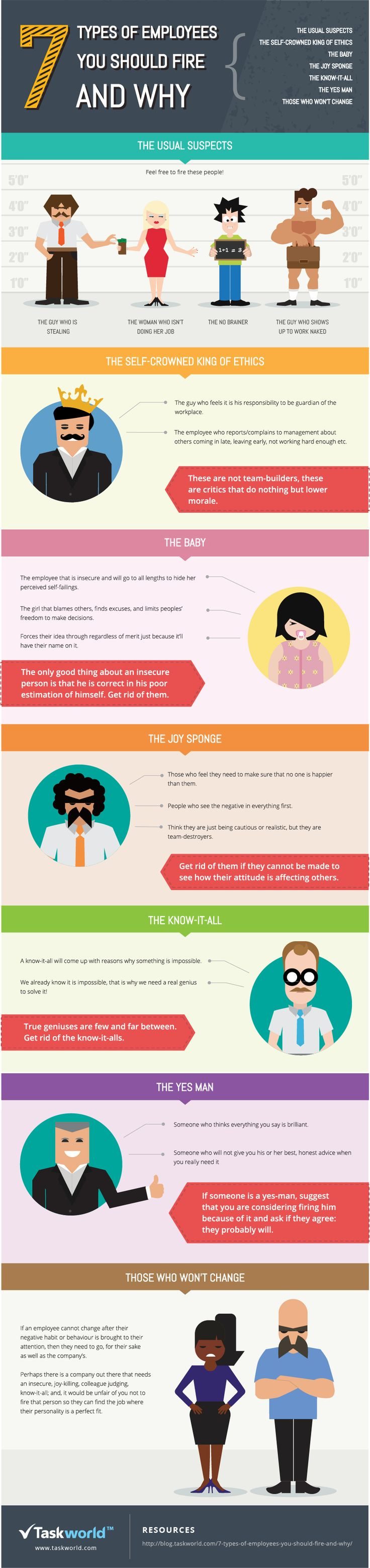
The guys at Taskworld have highlighted seven in the infographic below.
Running a small business is no easy task. As an entrepreneur or manager, you’re responsible for every aspect of your company’s success, and that includes your workforce. While hiring the right people is crucial, it’s equally important to recognize when it’s time to let go of certain employees who may be harming your business more than helping it. In this blog post, we’ll discuss seven types of employees you should consider firing and why it’s essential for the growth and sustainability of your small business.
- The Chronic Underperformer
Every business expects employees to have occasional off days, but when an employee consistently fails to meet expectations and underperforms despite feedback and support, it’s time to consider termination. Chronic underperformers can drag down team morale, hinder productivity, and ultimately affect your company’s bottom line. Continuously carrying underperforming employees can also send a demotivating message to high-performing team members, who may question why their efforts are not being rewarded or why standards are not consistently enforced.
Why you should fire them:
- To maintain a high standard of productivity and quality.
- To prevent the demoralization of your high-performing employees.
- To allocate resources to more valuable team members.
- The Toxic Team Player
Toxic employees can poison the workplace environment and create a hostile atmosphere that negatively affects everyone around them. These individuals often exhibit behaviors such as gossiping, spreading rumors, engaging in office politics, and undermining team cohesion. Their actions can lead to increased conflict, reduced productivity, and higher turnover rates as other employees may leave to escape the toxicity.
Why you should fire them:
- To preserve a positive workplace culture.
- To prevent conflicts and maintain team cohesion.
- To protect the mental and emotional well-being of your employees.
- The Habitual Rule Breaker
Every company has its rules, policies, and procedures in place for good reasons, whether related to safety, security, or efficiency. Employees who consistently disregard these guidelines can jeopardize your business’s operations, reputation, and even legal standing. Habitual rule breakers often ignore warnings and continue their misconduct, posing a significant risk to your organization.
Why you should fire them:
- To ensure compliance with regulations and policies.
- To maintain a safe and secure work environment.
- To demonstrate that rules and standards are non-negotiable.
- The Unwilling Learner
In today’s fast-paced business world, adaptability and continuous learning are essential traits for employees. Workers who refuse to acquire new skills or resist change can hold your business back. They may become obsolete in their roles and hinder your company’s ability to innovate and grow.
Why you should fire them:
- To keep your business competitive in a rapidly changing market.
- To promote a culture of learning and development.
- To open up opportunities for employees who are willing to embrace change.
- The Constantly Negative Employee
Negativity can be contagious, and one chronically pessimistic employee can bring down the morale of an entire team. Constant complainers tend to focus on problems rather than solutions, which can hinder progress and innovation. Moreover, their negative attitude can deter potential clients, partners, and investors from wanting to work with your business.
Why you should fire them:
- To maintain a positive work environment.
- To promote a problem-solving and solution-oriented culture.
- To protect your business’s reputation and relationships.
- The Insubordinate Employee
Respect for authority and teamwork is essential in any organization. Employees who consistently challenge authority, refuse to follow directions, or engage in insubordination can disrupt your business’s operations and hinder effective leadership. Insubordination can manifest as open defiance or more subtle forms of resistance, such as passive-aggressive behavior.
Why you should fire them:
- To maintain a chain of command and effective leadership.
- To preserve team cohesion and respect.
- To prevent disruptions to your business’s daily operations.
- The Chronic Time-Waster
Time is money, especially for small businesses with limited resources. Employees who consistently waste time on non-work-related activities, excessive personal calls, or extended breaks can significantly impact productivity and profitability. While occasional breaks and downtime are necessary for employee well-being, chronic time-wasters hinder your business’s ability to meet deadlines and achieve goals.
Why you should fire them:
- To maximize productivity and use resources efficiently.
- To maintain a culture of accountability.
- To ensure that employees prioritize their work responsibilities.
Conclusion
Firing an employee is never an easy decision, and it should always be approached with fairness, empathy, and adherence to legal requirements. However, recognizing when it’s necessary to let go of certain employees is essential for the overall health and success of your small business.
While the seven types of employees mentioned in this blog post represent valid reasons for termination, it’s crucial to handle the process professionally and ensure that all relevant employment laws and regulations are followed. Additionally, providing clear feedback, documentation of performance issues, and opportunities for improvement can help employees understand the reasons for their termination and, in some cases, make necessary changes in their behavior and performance.
Ultimately, your goal as a small business owner or manager is to create a positive, productive, and thriving workplace where employees are motivated to contribute their best efforts. Firing employees who consistently exhibit the behaviors outlined above is a step toward achieving that goal and safeguarding the future of your business.

Author:
Mark Ford

The Four Dimensions of Market Opportunity (And How to Use Them to Grow Your Business)
Are you trying to identify new ways to grow your business by spotting untapped market opportunities? Want to learn how to recognise and leverage the four key dimensions of opportunity that drive lasting success? […]