Are your email campaigns falling flat with low open rates and minimal engagement? Want to learn which email marketing mistakes to avoid—and how to fix them for better results?
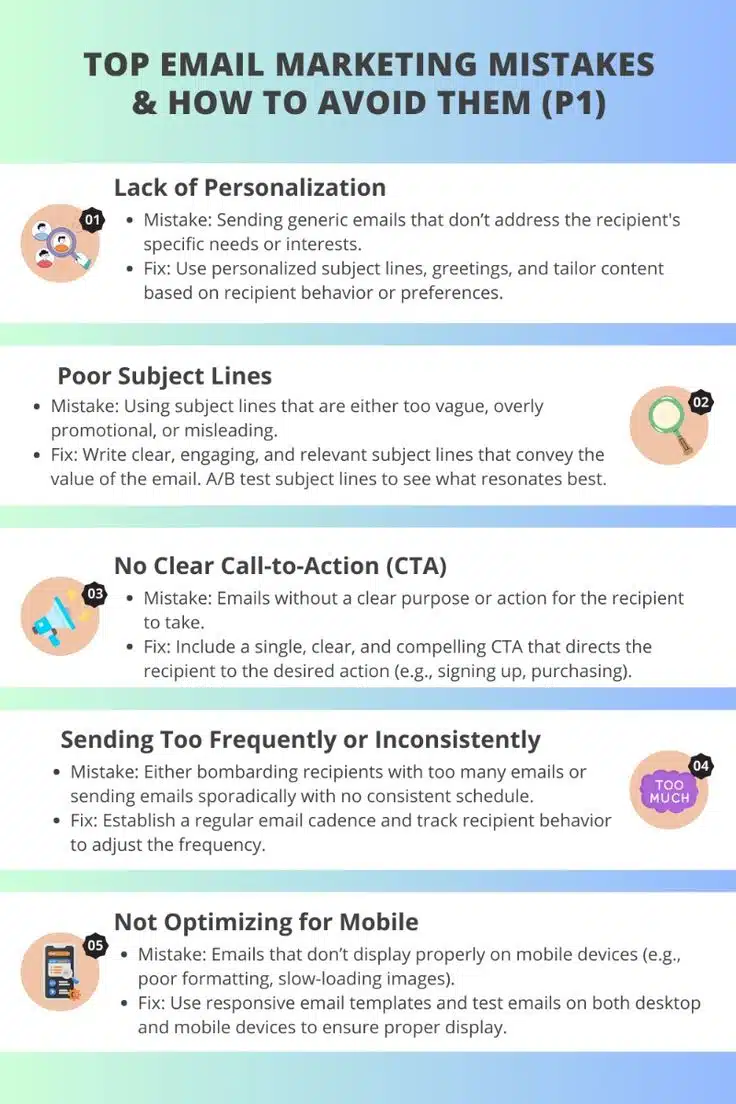
You’ll find some email marketing basics in this infographic.
Here’s a summary of what’s covered:
- Lack of Personalisation
- Poor Subject Lines
- No Clear Call-to-Action (CTA)
- Sending Too Frequently or Inconsistently
- Not Optimising for Mobile
- Overloading Emails with Content
- Ignoring Email Analytics
- Not Maintaining a Clean Email List
- Forgetting Compliance and Permissions
- Using Outdated or Poorly Designed Templates
Check out the post below for more.
Email marketing remains one of the most powerful tools in any marketer’s arsenal. But when done poorly, it can alienate your audience, hurt your brand, and waste valuable time and money. Many businesses fall into common traps that prevent their emails from delivering results.
In this post, we’ll break down the most frequent email marketing mistakes—and show you exactly what to do instead.
Lack of Personalisation
Generic emails that treat every recipient the same rarely capture attention. Today’s consumers expect content tailored to their needs, preferences, and behaviour. If your emails feel like mass broadcasts, they’re likely to be ignored—or worse, marked as spam. Personalisation isn’t just a nice touch; it’s essential for engagement and conversion.
- Use dynamic fields for first names, past purchases, and browsing behaviour to personalise each email.
- Segment your list based on demographics, location, or user activity to send more relevant content.
- Send personalised recommendations, reminders, or follow-ups that show you understand the recipient.
- Avoid blanket promotions—tailor offers to match the individual’s preferences or history with your brand.
Poor Subject Lines
The subject line is the first thing your audience sees—and it often determines whether they open your email or delete it. A vague, misleading, or overly promotional subject line can ruin your chances before your message is even read. Crafting strong subject lines is crucial for driving engagement and opens.
- Keep subject lines short, clear, and benefit-focused—ideally under 50 characters.
- Avoid clickbait or misleading claims, which damage trust and hurt long-term performance.
- Use A/B testing to experiment with different tones, lengths, and formats to find what works.
- Add urgency or curiosity when appropriate—but only if it genuinely reflects the content inside.
No Clear Call-to-Action (CTA)
Every marketing email should guide the reader toward a specific action. Without a clear CTA, your email may confuse recipients or leave them wondering what to do next. A compelling CTA turns passive reading into active engagement—and ultimately leads to results.
- Focus each email on one primary goal or action—don’t overwhelm with multiple directions.
- Use action-oriented language like “Download now,” “Claim your offer,” or “Book your place.”
- Place your CTA prominently, ideally both mid-way and at the end of the email.
- Test different CTA styles and placements to optimise conversion rates over time.
Sending Too Frequently or Inconsistently
Your audience needs consistency—but not overload. Sending emails too frequently can annoy recipients and lead to unsubscribes. On the other hand, sporadic contact makes your brand forgettable. A predictable, balanced schedule is key to maintaining engagement.
- Set and stick to a regular email schedule based on your audience’s expectations.
- Track open rates, unsubscribe rates, and engagement to find your optimal frequency.
- Use automation to maintain consistency without manual effort or guesswork.
- Give subscribers control by allowing them to set their preferences for how often they hear from you.
Not Optimising for Mobile
More than half of all emails are opened on mobile devices—yet many campaigns are still designed with only desktop in mind. Poor formatting, tiny text, and slow-loading images can make your email unreadable on smaller screens. Mobile optimisation is no longer optional; it’s a basic requirement.
- Use responsive email templates that automatically adjust to different screen sizes.
- Keep subject lines and preview text short so they don’t get cut off on mobile devices.
- Use large, tap-friendly buttons instead of small text links for CTAs.
- Test every email on multiple devices and email clients before hitting send.
Overloading Emails with Content
Trying to cram too much into a single email is a common mistake. Long blocks of text, multiple offers, and excessive images can overwhelm the reader. When emails are cluttered, it becomes harder for recipients to focus on what really matters—and easier for them to disengage entirely.
- Stick to one core message per email and keep your layout clean and focused.
- Use headers, bullet points, and short paragraphs to break up the text.
- Prioritise your content so the most important information appears near the top.
- Link out to more detailed pages rather than including everything in the email body.
Ignoring Email Analytics
Without tracking performance, you’re flying blind. Many marketers send emails without analysing open rates, click-through rates, or conversions. These metrics provide essential feedback that helps you improve over time. Ignoring analytics means missing out on growth opportunities.
- Monitor key metrics like open rate, click-through rate, bounce rate, and unsubscribe rate.
- Set benchmarks and regularly compare campaign results to identify trends and improvements.
- Use heat maps to see which parts of your emails attract the most engagement.
- Let your findings guide future campaign decisions, from timing to content strategy.
Not Maintaining a Clean Email List
A bloated email list full of inactive or incorrect addresses can harm your deliverability. Continuously sending emails to people who never engage can also skew your metrics and waste resources. A healthy, engaged list is far more valuable than a large, unresponsive one.
- Regularly remove inactive subscribers who haven’t opened or clicked in several months.
- Use double opt-in methods to confirm interest and reduce spam complaints.
- Validate email addresses to catch typos or fake submissions before they enter your system.
- Run re-engagement campaigns to try to win back dormant contacts before removing them.
Forgetting Compliance and Permissions
Failing to follow email marketing laws—such as GDPR or CAN-SPAM—can lead to serious consequences. This includes sending to people without proper consent, failing to offer unsubscribe options, or neglecting your privacy policy. Compliance isn’t just about law; it builds trust with your audience.
- Always obtain clear, documented consent before adding someone to your list.
- Include an easy-to-find unsubscribe link in every email you send.
- Be transparent about how you collect, store, and use subscriber data.
- Stay up to date with legal requirements in all countries where you have subscribers.
Using Outdated or Poorly Designed Templates
First impressions matter. If your email template looks outdated, unprofessional, or broken, recipients will be less likely to trust your brand or take action. Good design supports your message—bad design undermines it. Regularly refreshing your templates can make a big difference.
- Use modern, visually appealing templates that reflect your brand identity.
- Ensure your layout is consistent across all devices and email clients.
- Stick to a clear hierarchy of information with readable fonts and colour contrasts.
- Update your template design periodically to stay current and avoid fatigue.
Conclusion
Even experienced marketers can fall into bad habits when it comes to email campaigns. But the good news is that each of these common mistakes has a clear solution. By focusing on personalisation, clarity, consistency, and mobile-friendly design, you can dramatically improve your email performance.
Keep testing, learning, and adapting—and your emails will not only avoid the bin but drive real results.

Author:
Mark Ford