
Are you looking for proven ways to make your blog posts more engaging and effective? Want to learn the essential steps to creating content that connects with readers and strengthens your brand?
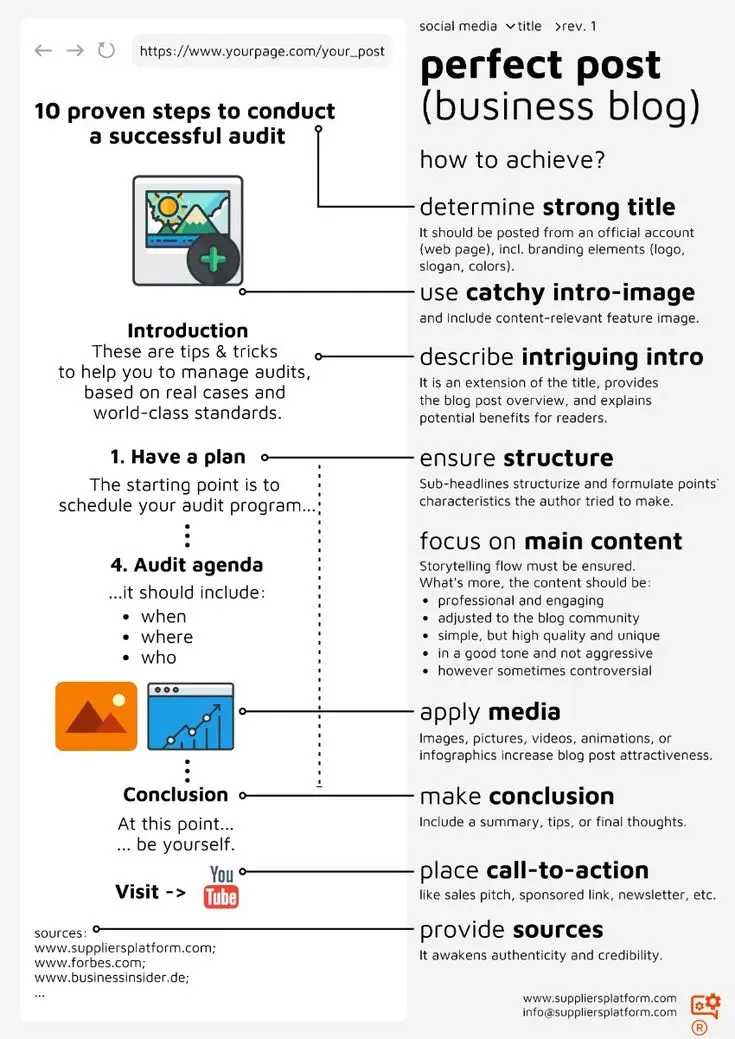
You’ll find some blogging basics in this infographic.
Here’s a summary of what’s covered:
- Craft a Strong Title
- Use a Catchy Intro-Image
- Write an Intriguing Introduction
- Ensure Clear Structure
- Focus on the Main Content
- Apply Media Effectively
- Create a Strong Conclusion
- Add a Call-to-Action (CTA)
- Provide Reliable Sources
Check out the post below for more.
In the digital age, a blog is more than just a space for words—it’s a platform for building trust, authority, and meaningful connections with your audience. To achieve this, your blog posts need to do more than provide information. They should capture attention, deliver value, and inspire readers to act.
This guide will show you how to create engaging blog content step by step, ensuring your brand’s voice resonates and your message is remembered.
Craft a Strong Title
Your title is the first impression of your blog post, and often the deciding factor in whether someone clicks to read more. A strong title needs to be clear, concise, and enticing without being misleading. Think of it as a promise to your reader—set the right expectation and then deliver. Done well, it can dramatically improve engagement and visibility.
- Use power words that spark curiosity or urgency without resorting to clickbait.
- Keep it under 60 characters so it displays well in search engines.
- Align the title with your brand identity, tone, and target audience.
- Test variations of titles to see which resonate best with your readers.
Use a Catchy Intro-Image
A striking image instantly draws attention and helps your blog stand out. Humans are highly visual, and an effective image can communicate a message before the reader even sees the first word. It also helps your post perform better on social media, where visuals dominate. Pairing the right image with your content adds context and emotional appeal.
- Choose images directly relevant to the topic of your post.
- Optimise file size and dimensions for fast loading without losing quality.
- Incorporate branded visuals, colours, or styles for consistency.
- Use alt text for accessibility and to support SEO performance.
Write an Intriguing Introduction
The introduction sets the stage for your entire blog post. It should draw readers in by highlighting the problem, teasing the solution, and making it clear why continuing to read is worth their time. A good intro combines storytelling with clarity, making the audience feel understood. Done right, it keeps them hooked past the opening lines.
- Start with a question, statistic, or bold statement to grab attention.
- Summarise what the blog will cover without giving everything away.
- Highlight the benefits readers will gain from the article.
- Keep the tone conversational to build connection from the start.
Ensure Clear Structure
Readers crave clarity, and structure is what keeps them moving through your content without confusion. Subheadings break up the text into digestible chunks, guiding the flow and highlighting key takeaways. A well-organised blog post not only improves readability but also helps with SEO. Structure makes the difference between skimmed content and fully absorbed insights.
- Use H2 and H3 subheadings to organise content logically.
- Break paragraphs into short, manageable sections for easier reading.
- Use bullet points to present lists clearly and concisely.
- Maintain a consistent flow from one section to the next.
Focus on the Main Content
The main content is the heart of your blog post, and where your expertise shines. Readers expect depth, accuracy, and value that makes the time spent worthwhile. To achieve this, balance professional insight with accessibility, ensuring your message is clear to both experts and beginners. Quality content builds credibility and encourages return visits.
- Prioritise original, unique insights rather than recycled ideas.
- Adjust tone and style to fit your target audience’s preferences.
- Keep language simple but ensure the content is informative and detailed.
- Don’t shy away from addressing controversial or thought-provoking topics.
Apply Media Effectively
Media elements make your blog posts more engaging and memorable. Images, videos, infographics, and interactive elements can illustrate complex ideas better than text alone. They also provide breaks in long-form content, making the reading experience smoother. Using the right media adds both professionalism and impact to your blog.
- Add charts, infographics, or visuals to support data-heavy points.
- Include short video clips or animations to increase engagement.
- Use images that reflect your brand personality and reinforce your message.
- Ensure all media is optimised for web performance and mobile viewing.
Create a Strong Conclusion
A conclusion is not just a sign-off—it’s your final chance to reinforce the key messages and inspire action. Readers should leave with clarity about what they’ve learned and why it matters. A strong closing paragraph ties everything together while encouraging reflection or next steps. It’s where your blog lingers in their mind.
- Summarise the key takeaways from the article without repeating everything.
- End with a memorable statement, idea, or thought.
- Encourage readers to apply what they’ve learned.
- Use your conclusion to naturally transition into a call-to-action.
Add a Call-to-Action (CTA)
A blog without a CTA misses an opportunity to move readers further along their journey with your brand. Whether it’s signing up for a newsletter, exploring your services, or sharing the post, a CTA turns passive reading into active engagement. The right CTA feels like a natural extension of your content, not a forced sales pitch.
- Tailor the CTA to match the goal of the specific blog post.
- Use persuasive but approachable language that guides action.
- Place the CTA at the end of the post, and consider subtle in-content prompts.
- Test different CTA formats (buttons, text links, banners) for effectiveness.
Provide Reliable Sources
Citing credible sources builds trust with your audience and demonstrates professionalism. It shows that your content is backed by evidence rather than opinion alone. References also improve SEO and encourage networking with other thought leaders. Reliable sourcing transforms a blog post from a personal opinion into an authoritative piece of content.
- Link to established industry sites, research, or reports.
- Use data and statistics to back up key claims.
- Ensure sources are current, ideally published within the last few years.
- Attribute ideas or quotes properly to avoid plagiarism concerns.
Conclusion
Creating engaging blog content is about more than words on a screen—it’s about crafting an experience that informs, connects, and inspires. By focusing on strong titles, compelling introductions, structured content, and powerful visuals, you ensure every post leaves an impression.
Adding thoughtful conclusions, effective calls-to-action, and credible sources ties everything together into a professional and impactful piece. When done consistently, this approach not only strengthens your brand but also builds lasting trust with your audience.

Author:
Mark Ford