Are you concerned about the future success of your business website? Want to know what ranking factors Google is likely to give more prominence to in the years to come?
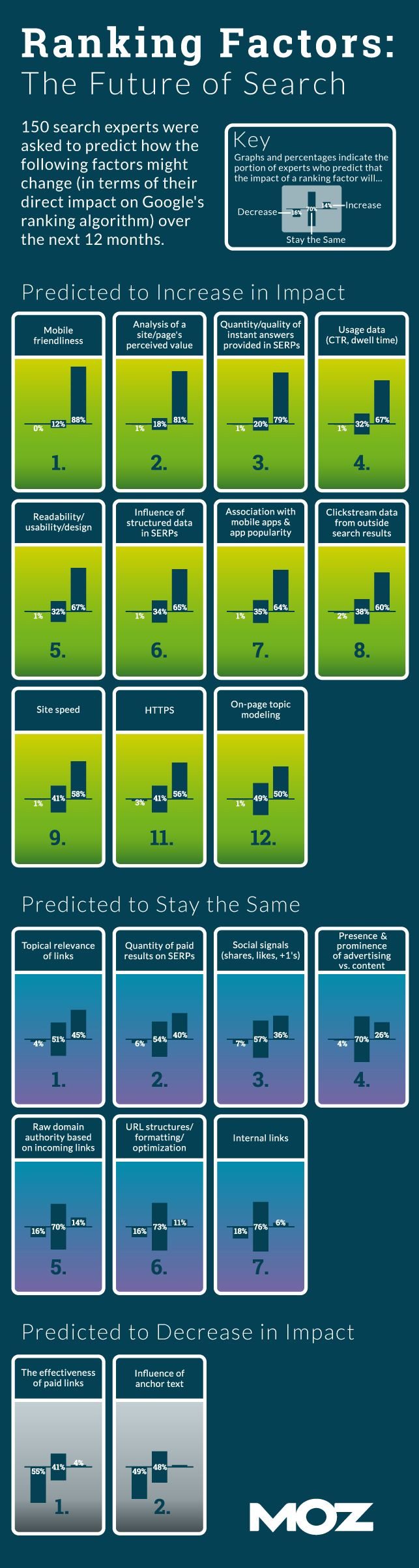
Moz have recently announced the results of their biennial ranking factors study. As part of that study they interview a panel of experts whose task it was to predict the future of search, and the results are in.
Take a look at what they predict in the infographic below.
Search Engine Optimization (SEO) has been a cornerstone of digital marketing for years. Business owners, marketers, and website owners have continually adapted their strategies to keep up with Google’s ever-evolving search algorithms. In recent years, Google has been rolling out significant updates that prioritize user experience, relevance, and trustworthiness. As we look ahead to the coming year, it’s crucial to understand how Google will likely rank your site in the future and how you can stay ahead of the curve in the ever-competitive world of SEO.
In this comprehensive guide, we’ll explore the expected trends and changes in SEO for the upcoming year. We’ll delve into topics such as user intent optimization, Core Web Vitals, artificial intelligence, and the importance of content quality and trustworthiness. By the end of this article, you’ll have a clear understanding of the strategies and tactics you’ll need to implement to ensure your website ranks well in Google’s search results in the near future.
- User Intent Optimization
One of the most significant shifts in SEO over the past few years has been Google’s focus on user intent. In the coming year, this trend will become even more crucial. Google aims to provide users with the most relevant results based on their intent, not just their search queries.
To optimize for user intent, you’ll need to:
a. Understand User Intent: Conduct thorough keyword research and analyze the search intent behind them. Are users looking for information, products, services, or answers to specific questions?
b. Create High-Quality Content: Develop content that directly aligns with user intent. Provide valuable and comprehensive information to meet their needs.
c. User-Centric SEO: Optimize your website’s structure and content for user experience. Make sure your pages load quickly, are mobile-friendly, and easy to navigate.
d. Semantic SEO: Implement semantic SEO techniques to ensure your content is semantically related to the main topic, increasing its relevance.
- Core Web Vitals
Core Web Vitals have been a hot topic in the SEO community, and Google has officially incorporated them into its ranking factors. These vitals measure the user experience of a website, focusing on loading performance, interactivity, and visual stability.
In the future, you’ll need to pay close attention to:
a. Loading Speed: Optimize your website’s loading speed by compressing images, minifying code, and utilizing content delivery networks (CDNs).
b. Interactivity: Ensure that your website is responsive and interactive. Minimize render-blocking resources and prioritize the loading of critical assets.
c. Visual Stability: Prevent layout shifts on your pages, as these can frustrate users. Use proper image and video dimensions, and ensure that elements don’t shift unexpectedly during page load.
- Artificial Intelligence (AI) and Machine Learning
Google’s algorithms are becoming increasingly sophisticated thanks to AI and machine learning. In the future, AI will play an even more significant role in how Google ranks websites. This means that traditional SEO techniques may not be as effective as they once were.
Here’s how AI will impact SEO:
a. RankBrain and Natural Language Processing (NLP): Google’s RankBrain uses machine learning to understand and interpret user queries. Content that is written in a natural, conversational tone and that answers user questions effectively is more likely to rank well.
b. Personalization: AI algorithms will personalize search results based on user behavior, location, and previous searches. To rank well, consider implementing personalized content and offers.
c. Voice Search: As voice search continues to grow, optimizing for voice-activated assistants like Siri and Alexa will be essential. Focus on conversational keywords and providing concise, accurate answers.
d. Algorithm Updates: Be prepared for more frequent and impactful algorithm updates driven by AI. Stay agile and adapt quickly to these changes.
- Mobile-First Indexing
Mobile usage has surpassed desktop, making mobile-first indexing a top priority for Google. In the coming year, your website’s mobile version will be the primary basis for ranking and indexing.
To prepare for mobile-first indexing:
a. Responsive Design: Ensure your website is responsive and looks and functions well on various mobile devices.
b. Mobile Speed: Optimize loading times for mobile users, as slow-loading pages can hurt rankings and user experience.
c. Mobile Usability: Make sure mobile users can easily navigate and interact with your website, including forms and calls to action.
d. Structured Data: Implement structured data markup for mobile to help search engines understand your content better.
- Content Quality and Trustworthiness
Google has been emphasizing the importance of high-quality and trustworthy content for years, and this trend will continue into the future. To rank well, you must establish your website as a reliable source of information.
Here’s how to focus on content quality and trustworthiness:
a. E-A-T (Expertise, Authoritativeness, Trustworthiness): Establish your expertise in your field and demonstrate authority by creating comprehensive and well-researched content. Ensure that your website is transparent about its authors and sources.
b. Fact-Checking: Verify the accuracy of the information you present. Cite credible sources and correct any inaccuracies promptly.
c. User-Generated Content: Monitor user-generated content on your website and social media channels to prevent the spread of false information or spam.
d. Secure Website: Implement HTTPS to secure your website, which also contributes to trustworthiness.
e. Backlinks: Focus on acquiring high-quality backlinks from reputable websites in your niche to build trust with search engines.
- Visual Search and Video SEO
Visual search and video content are becoming increasingly popular among users. Google has started to incorporate visual search capabilities into its search results, and video content continues to gain prominence.
To leverage visual search and video SEO:
a. Optimize Images: Use descriptive file names and alt tags for your images. Implement structured data to provide context and improve the chances of appearing in visual search results.
b. Video Optimization: Create high-quality video content and optimize video titles, descriptions, and tags. Host videos on your website or platforms like YouTube to improve visibility.
c. Schema Markup: Implement schema markup for video content to provide search engines with additional information about your videos.
d. Image and Video Sitemaps: Create sitemaps specifically for your images and videos to help search engines index and rank this content.
Conclusion
The future of SEO is evolving rapidly, with Google focusing on user intent, Core Web Vitals, AI, mobile-first indexing, content quality, trustworthiness, visual search, and video SEO. To stay ahead of the curve and ensure your website ranks well in the coming year, it’s essential to adapt your SEO strategy to align with these trends.
Remember that SEO is an ongoing process, and staying informed about industry developments and algorithm updates is crucial. By prioritizing user experience, creating high-quality content, and optimizing for emerging technologies, you can position your website for success in the ever-changing landscape of SEO.

Author:
Mark Ford