Are you struggling to understand why your LinkedIn posts attract engagement but never seem to bring in real client enquiries? Want to uncover the hidden mistakes that silently undermine founders who are trying to grow their business on the platform?
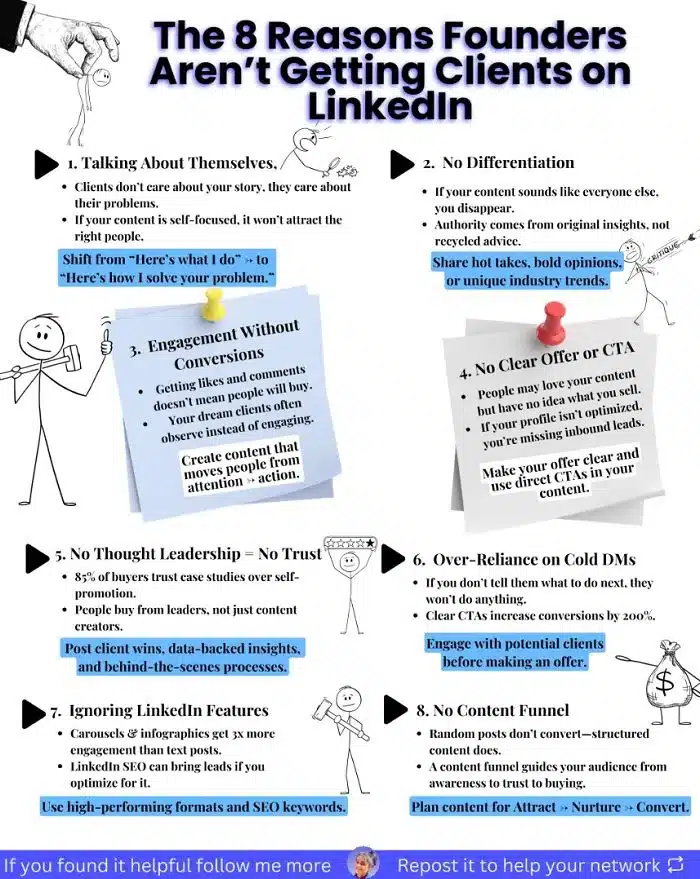
You’ll find the most common founder pitfalls clearly broken down in this infographic.
Here’s a summary of what’s covered:
- Talking Too Much About Themselves
- Lack of Differentiation
- Engagement Without Conversions
- No Clear Offer or CTA
- Weak Thought Leadership
- Over-Reliance on Cold DMs
- Ignoring LinkedIn Features
- No Content Funnel
Check out the post below for more.
Building a presence on LinkedIn should be one of the simplest ways for founders to generate interest, enquiries, and long-term opportunities. Yet many discover the opposite. They post consistently, gather respectable engagement, and stay active on the platform, but the clients they’re hoping for never seem to appear. What looks like effort on the surface often hides deeper strategic issues that silently stop conversion. Most founders are not failing because they lack talent or value, but because their LinkedIn activity works against them without their knowledge.
This post breaks down the major mistakes that hold founders back from winning clients on LinkedIn. These mistakes are easy to fall into, especially when you’re juggling multiple roles. When left unaddressed, they drain time, dilute credibility, and prevent your audience from recognising your value. Understanding these issues helps turn LinkedIn from a place of frustration into a channel that actually attracts clients who want to work with you. By the end, you’ll know exactly where your strategy may be falling short and how to correct it.
Talking Too Much About Themselves
Many founders unintentionally position themselves at the centre of every post, believing personal updates automatically create connection. While personal content has its place, an overemphasis on self can push potential clients away. Prospects come to LinkedIn looking for clarity, solutions, and guidance, not long narratives about someone else’s journey. When the balance tilts too far, the content becomes less about value and more about self-expression, which undermines credibility.
- Shift from personal storytelling to problem-solving that reflects real challenges your audience faces.
- Focus your messaging on outcomes clients want, not achievements you’ve already made.
- Use personal stories only when they directly support a lesson that benefits your audience.
- Prioritise clarity, structure, and usefulness over emotional expression or diary-style updates.
Lack of Differentiation
LinkedIn is filled with founders sharing similar opinions, advice, and formulas. When your content blends in, your brand becomes forgettable. Prospects need a reason to remember you, trust you, and choose you over alternatives. Without a clear point of view or a distinct tone, even high-quality posts fail to leave an impression. Differentiation is not about being louder but about being unmistakably specific.
- Develop a point of view that challenges assumptions or reframes industry norms.
- Bring unique experiences, frameworks, or observations into your content to stand out.
- Avoid repeating generic tips that thousands of others already post daily.
- Show personality through consistent tone and perspective while maintaining professionalism.
Engagement Without Conversions
Many founders focus heavily on raising engagement metrics, but likes and comments are not indicators of revenue. High engagement can mask significant problems with targeting, messaging, or positioning. You may attract an audience that enjoys your posts but would never buy from you. Without content designed to move people through a decision-making journey, engagement becomes vanity rather than progress.
- Create posts that naturally lead your audience to ask questions or explore your services.
- Use real examples, scenarios, or processes that hint at your expertise in action.
- Avoid chasing viral content that appeals to the masses but ignores your ideal clients.
- Build consistency with posts that support awareness, trust, and conversion, not just attention.
No Clear Offer or CTA
One of the biggest reasons founders fail to convert on LinkedIn is the simplest: nobody knows what they actually sell. You may build authority, share insights, and publish valuable content, yet still lose potential clients because they cannot see a path to working with you. Without clear offers, calls to action, or service descriptions, prospects move on to someone who communicates their value more visibly.
- Include subtle but clear invitations to learn more about your services.
- Mention outcomes your clients achieve so people understand your offer instantly.
- Ensure your LinkedIn profile clearly explains what you do and who you help.
- Add CTAs that encourage the next step, such as booking a call or downloading a resource.
Weak Thought Leadership
Founders often believe they are creating thought leadership when they are merely sharing surface-level advice. True authority is built through depth, clarity, and original contribution. Buyers look for credibility, insight, and evidence, not recycled ideas. When your content lacks substance, prospects struggle to see you as someone who can deliver measurable impact. Weak thought leadership is a silent conversion killer.
- Share frameworks, processes, or insights that demonstrate how you think and operate.
- Use case examples or lessons that reveal real problems and real results.
- Publish content that teaches something new or reframes something familiar in a new way.
- Focus less on motivation and more on actionable, practical guidance with clear value.
Over-Reliance on Cold DMs
Cold DMs feel quick, scalable, and easy, but they rarely produce results when used in isolation. Without context, familiarity, or a clear value proposition, most cold outreach becomes noise in a crowded inbox. Founders who rely heavily on cold messages often miss the deeper opportunity: building content that naturally draws prospects in. Outreach works best when your audience already sees you as credible.
- Use content to warm your audience before initiating any outreach.
- Add context and relevance to messages so they feel personalised, not automated.
- Build engagement through comments and interactions before approaching prospects.
- Let your profile and content do the heavy lifting so outreach becomes a final step, not the starting point.
Ignoring LinkedIn Features
LinkedIn rewards creators who make use of platform features designed to increase engagement and visibility. Founders who stick only to text posts or avoid experimenting with format options limit their reach. Carousels, infographics, and SEO-aware posts perform strongly when used effectively. Overlooking these tools restricts your ability to attract attention from the right audience.
- Use carousels to break down complex ideas into digestible steps clients can follow.
- Create infographics or visual summaries that stop people scrolling and encourage shares.
- Optimise posts with search-friendly wording to appear in LinkedIn’s search and surfaces.
- Experiment with different formats to discover what resonates most with your ideal clients.
No Content Funnel
Posting consistently is not the same as guiding someone through a journey that ends in a sale. Many founders rely on random content ideas, unaware that this method offers no structure for building trust or desire. A content funnel ensures your posts work together, moving your audience from awareness to interest and eventually to conversion. Without it, even the best posts sit in isolation, generating noise rather than opportunity.
- Map your content to different stages of the customer journey from awareness to action.
- Use educational posts to create clarity and thought leadership posts to build authority.
- Add experience-based posts that demonstrate proof, expertise, and understanding.
- Include conversion posts that give your audience a clear moment to take the next step.
Conclusion
Founders rarely fail on LinkedIn because of a lack of effort. More often, they fail because the strategy behind their activity does not support the outcomes they want. When content centres too much on the founder, borrows from generic advice, or lacks clear calls to action, even the most dedicated posting schedule cannot produce meaningful results. Likewise, without differentiation, a visible offer, or a structured content funnel, the platform remains a place for engagement rather than revenue.
Addressing these mistakes is not complicated. It involves reviewing your messaging, strengthening your thought leadership, clarifying your offers, and ensuring your content works together rather than in isolation. When these areas align, LinkedIn becomes more than a social platform. It becomes a predictable system for attracting clients who understand your value and want the solutions only you can provide.

Author:
Mark Ford