Your website is often the first impression your visitors have of your business or brand. It’s where they learn about your products or services, your values, and your professionalism.
In the digital age, where content is king, the quality of your written content matters more than ever. Unfortunately, even the best websites can be undermined by common spelling and grammar mistakes.
These mistakes can harm your credibility, make your content difficult to read, and ultimately drive potential customers away.
In this blog post, we’ll explore the most commonly misspelled or misused words that may be ruining your website’s effectiveness and offer tips on how to avoid them.
Infographic by Your Dictionary.
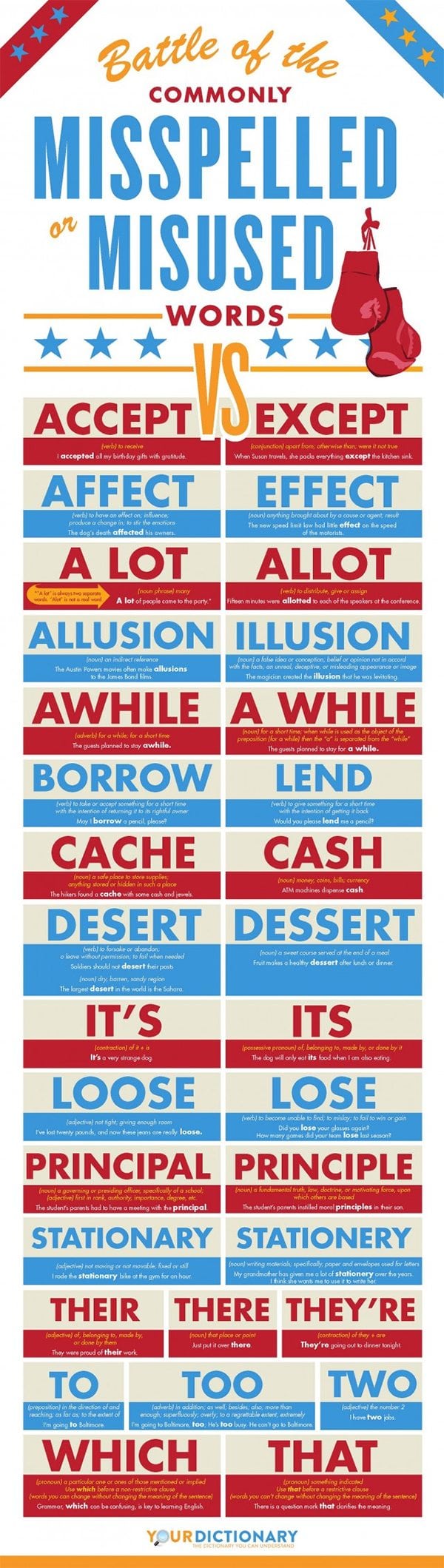
- They’re, Their, and There
One of the most frequent grammatical errors on websites is the misuse of “they’re,” “their,” and “there.” These homophones sound the same but have distinct meanings:
- “They’re” is a contraction of “they are.” For example, “They’re going to the conference.”
- “Their” is a possessive pronoun indicating ownership. For example, “Their website is well-designed.”
- “There” is an adverb used to indicate a place. For example, “The information you need is over there.”
Using the wrong word in these situations can make your content confusing and unprofessional. To avoid this mistake, always double-check which word is appropriate for the context.
- Your and You’re
Similar to the previous point, “your” and “you’re” are frequently mixed up, even though they have distinct meanings:
- “Your” is a possessive pronoun, indicating ownership or association. For example, “Is this your website?”
- “You’re” is a contraction of “you are.” For example, “You’re doing a great job with your content.”
Using the wrong form can make your writing look careless and detract from your message. Be vigilant and ensure you use the correct word in each situation.
- Its and It’s
The misuse of “its” and “it’s” is another common error that can undermine the professionalism of your website’s content:
- “Its” is a possessive pronoun, indicating ownership or belonging. For example, “The company increased its revenue.”
- “It’s” is a contraction of “it is” or “it has.” For example, “It’s important to proofread your content.”
Be cautious when using these words, as confusing them can lead to misunderstandings in your content.
- Effect and Affect
“Effect” and “affect” are often used interchangeably, but they have distinct meanings:
- “Effect” is a noun that refers to the result or consequence of an action. For example, “The new marketing strategy had a positive effect on sales.”
- “Affect” is a verb that means to influence or have an impact on something. For example, “The weather can affect website traffic.”
Confusing these two words can make your writing unclear and imprecise. Ensure you understand the difference and use them correctly in your content.
- Loose and Lose
“Loose” and “lose” are homophones that are frequently misused:
- “Loose” is an adjective used to describe something that is not firmly attached or is free from restraint. For example, “The loose screws caused the issue.”
- “Lose” is a verb that means to fail to keep or to misplace something. For example, “Don’t lose sight of your website’s goals.”
Using the wrong word can create confusion and affect the clarity of your message. Carefully proofread your content to catch such errors.
- To, Too, and Two
The trio of “to,” “too,” and “two” are commonly confused:
- “To” is a preposition used to indicate direction or intention. For example, “Go to the About Us page.”
- “Too” is an adverb that means also or excessively. For example, “We offer fast shipping too.”
- “Two” is the number 2. For example, “There are two main categories on our website.”
Mixing up these words can make your content look unprofessional and disrupt the flow of your writing. Pay attention to their proper usage.
- Then and Than
“Then” and “than” are frequently interchanged, but they have distinct purposes:
- “Then” is an adverb used to indicate a time or sequence of events. For example, “We will launch the new product, and then we’ll announce it.”
- “Than” is a conjunction used to make comparisons. For example, “Our product is faster than the competition’s.”
Confusing these words can lead to misunderstandings in your content. Always use the appropriate word based on the context of your sentence.
- Complement and Compliment
“Complement” and “compliment” are another pair of words that are often used incorrectly:
- “Complement” is a noun or verb referring to something that completes or enhances another thing. For example, “The color scheme on our website complements our brand.”
- “Compliment” is a noun or verb used to express praise or admiration. For example, “We received a compliment on our website’s design.
Using the wrong word can change the meaning of your sentence and potentially lead to confusion. Proofread your content carefully to ensure you’ve used these words correctly.
- Principal and Principle
“Principal” and “principle” may look and sound similar, but they have different meanings:
- “Principal” is a noun that typically refers to a person, often the head of a school or a sum of money. For example, “The principal of the school made an announcement.”
- “Principle” is a noun that denotes a fundamental truth, belief, or rule. For example, “We adhere to the principle of transparency.”
Confusing these two words can make your content appear unprofessional. Make sure you choose the right word to convey your intended meaning.
- Advise and Advice
“Advise” and “advice” are often confused due to their similar spelling, but they have distinct functions:
- “Advise” is a verb meaning to offer guidance or recommendations. For example, “We advise our customers to read our user guides.”
- “Advice” is a noun referring to the guidance or recommendations themselves. For example, “I appreciate your advice on improving our website.”
Misusing these words can make your writing appear careless and unprofessional. Always double-check which word is appropriate for your sentence.
Conclusion
In the world of online content, where first impressions and professionalism are crucial, the correct use of words can make a significant difference. Commonly misspelled or misused words can undermine the credibility of your website and turn potential customers away. By paying close attention to these frequently confused words and proofreading your content thoroughly, you can enhance the effectiveness of your website and ensure that your message is clear, concise, and professional. Don’t let simple spelling and grammar errors ruin the impression you work so hard to create – make precision in language a priority on your website.

Author:
Mark Ford