Are you trying to turn more social media followers into paying customers? Want to learn how to guide your audience from first click to final conversion using a proven funnel strategy?
You’ll find some email marketing basics in this infographic.
Here’s a summary of what’s covered:
- Awareness Stage (Top of Funnel)
- Consideration Stage (Middle of Funnel)
- Conversion Stage (Bottom of Funnel)
- Why the Funnel Works
- Statistics That Prove Its Power
Check out the post below for more.
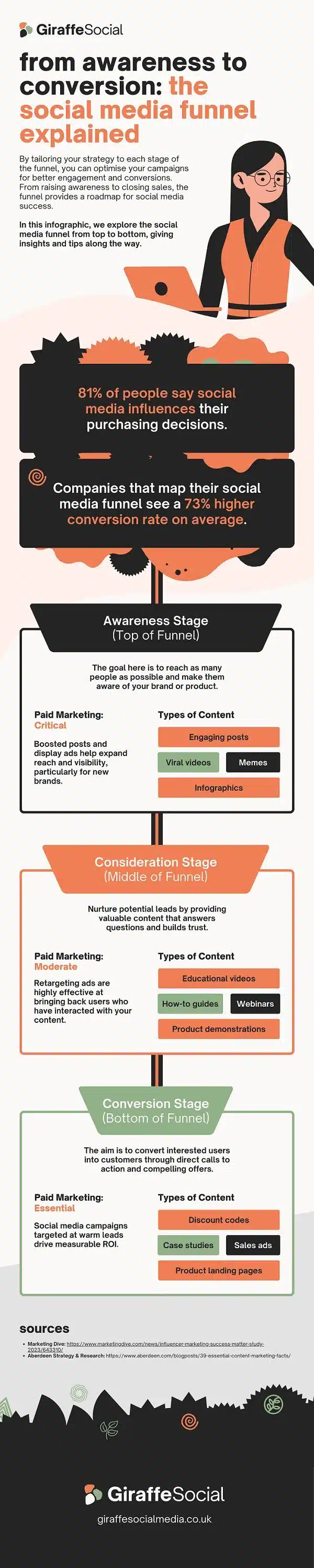
Social media can feel chaotic—millions of posts, trends changing overnight, and algorithms constantly shifting. But behind the noise lies a clear opportunity: guiding potential customers from casual browsers to loyal buyers. That’s where the social media funnel comes in.
In this post, we’ll break down the funnel into its three core stages: Awareness, Consideration, and Conversion. For each stage, you’ll learn exactly what kind of content to create, how to approach paid marketing, and what tactics work best to move your followers from curious to committed.
Awareness Stage (Top of Funnel)
The awareness stage is all about visibility. This is where you cast the widest net and make potential customers aware of your brand, product, or service. At this point, your audience may not know who you are or what you do—your job is to change that. Think of this stage as the first handshake in a long-term relationship.
- Use eye-catching visuals and trending formats to grab attention quickly in busy social feeds.
- Boost posts to extend reach beyond your organic followers and reach people who’ve never seen your content before.
- Leverage humour, relatability, and emotion to encourage shares and reactions.
- Create consistent branding with logos, colours, and tone to become instantly recognisable.
Types of Content: Engaging Posts, Viral Videos, Memes, Infographics
To succeed at the top of the funnel, you need content that’s fun, attention-grabbing, and easily shareable. The goal isn’t to sell just yet—it’s to get noticed. Creative and educational content that aligns with your audience’s interests will work best. These formats are perfect for driving visibility without pushing too hard.
- Engaging posts like questions, polls, or audience shoutouts get people interacting without requiring much commitment.
- Viral videos that entertain or inspire can expand your reach exponentially if they strike the right chord.
- Memes add a relatable, light-hearted twist to your brand voice, increasing your chances of being shared.
- Infographics make complex topics simple, helping your audience learn something new while associating your brand with value.
Consideration Stage (Middle of Funnel)
Once you’ve got your audience’s attention, it’s time to build trust and provide value. The consideration stage is about nurturing interest and helping your audience understand how you solve their problems. They might not be ready to buy just yet—but they’re thinking about it. This is your chance to stay top of mind.
- Retarget your engaged audience with content that dives deeper into their specific interests or pain points.
- Offer educational resources that help users move from curiosity to understanding.
- Answer common questions and address objections your audience may have before making a decision.
- Position your brand as an expert through thoughtful, informative, and genuinely helpful content.
Types of Content: Educational Videos, How-To Guides, Webinars, Product Demonstrations
Mid-funnel content should be more informative than promotional. This is where your expertise shines through. Give your audience the tools they need to evaluate your product or service and understand how it fits into their lives. Use detailed content that answers their questions and builds credibility.
- Educational videos explain the “why” and “how” behind what you offer, making your value proposition clearer.
- How-to guides help your audience solve a problem, showing that your brand is a trusted source of support.
- Webinars allow real-time interaction, giving you the opportunity to address questions and build rapport.
- Product demonstrations bring your offer to life, helping people visualise how it works and what they’ll gain.
Conversion Stage (Bottom of Funnel)
At the bottom of the funnel, your goal is clear: convert interest into action. This is where followers become customers. The audience here is warmer, more engaged, and already aware of your brand—they just need the right nudge. Use targeted messaging and strong calls to action to close the gap between interest and decision.
- Run conversion-focused campaigns that speak directly to users who’ve engaged with previous content.
- Use urgency and exclusivity with limited-time offers or discount codes to prompt immediate action.
- Make your messaging specific and benefit-driven, focusing on what the user will gain.
- Track performance closely and adjust your approach based on what content actually drives sales or sign-ups.
Types of Content: Discount Codes, Case Studies, Sales Ads, Product Landing Pages
Bottom-of-funnel content should remove the final friction between your offer and your audience. People at this stage want to know exactly what they’re getting—and why it’s worth it. Use content that focuses on results, social proof, and direct value to encourage immediate action and measurable ROI.
- Discount codes offer an instant incentive to complete a purchase, especially for users who are on the fence.
- Case studies build trust with real-world examples, showing how others have benefited from your offer.
- Sales ads should be clear, direct, and visually compelling, tailored to the specific needs of warm leads.
- Product landing pages provide all the essential info, including features, benefits, and testimonials, to encourage conversion.
Why the Funnel Works
The funnel isn’t just a fancy framework—it’s a proven method that aligns your marketing efforts with the way people actually buy. Instead of jumping straight to the sale, you meet your audience where they are. You build awareness, nurture trust, and convert with confidence.
- It reflects real human behaviour, helping you create more natural, effective campaigns.
- It improves ROI by focusing your spend where it matters most at each stage of the buyer journey.
- It makes your content more purposeful, giving you a strategy instead of just posting randomly.
- It boosts long-term loyalty, since customers who move through the funnel tend to stick around.
Statistics That Prove Its Power
You don’t have to take our word for it—the numbers speak for themselves. Social media is one of the most influential touchpoints in modern purchasing decisions. When used strategically, it has the power to transform engagement into revenue.
- 81% of people say social media influences their buying decisions, highlighting the need for strategic funnel planning.
- Companies that map their funnel see a 73% higher conversion rate, showing the direct impact of structured marketing.
- Retargeting users can increase conversion rates by 70%, especially in the middle and bottom of the funnel.
- Content marketing generates 3x more leads than outbound methods, proving the value of educational and trust-building content.
Putting It All Together
The beauty of the social media funnel is that it’s both simple and powerful. It helps you stay strategic without being robotic. Each stage of the funnel has a specific goal, and your content should reflect that—whether you’re introducing your brand, educating your audience, or closing the sale.
- Audit your current content to identify where it fits into the funnel and where the gaps are.
- Plan content campaigns by funnel stage, ensuring your messaging stays relevant and effective.
- Use platform-specific tools (like Meta Ads Manager or LinkedIn retargeting) to guide users through the funnel.
- Track funnel performance with metrics like reach (top), engagement (middle), and conversions (bottom).
Final Thoughts
A well-crafted social media funnel helps you move beyond vanity metrics and into meaningful results. By tailoring your content and paid strategy to match each stage of the buyer journey, you build stronger relationships, increase engagement, and drive more sales.
It’s not about posting more—it’s about posting smarter.

Author:
Mark Ford