How are your blog posts performing? Are they grabbing your readers’ attention and making them come back for more?
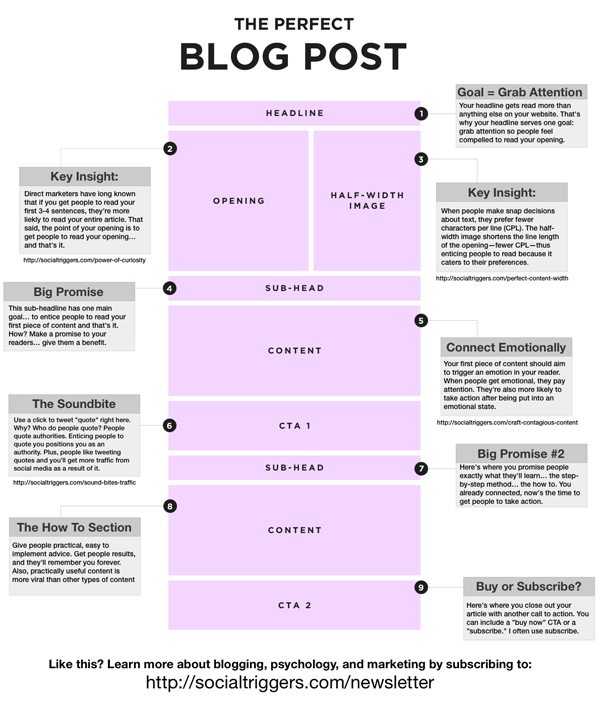
Unless you’re simply introducing an infographic like we do there are a number of components to consider when crafting your posts. It all starts with an attention grabbing headline with various additional sections that encourage your readers to continue and take your desired action.
For some guidance take a look at this infographic from Social Triggers.
Blogging has become a powerful medium for individuals and businesses to share their thoughts, expertise, and stories with the world. With millions of blogs published every day, it’s essential to stand out from the crowd and create compelling content that resonates with your audience. Whether you’re a seasoned blogger or just starting, there are specific steps you can follow to improve your blog posts and drive more traffic and engagement. In this article, we’ll explore nine key steps to help you create better blog posts that captivate your readers and leave a lasting impression.
- Define Your Audience
Before you start writing your blog post, it’s crucial to have a clear understanding of your target audience. Who are they? What are their interests, needs, and pain points? What kind of information are they seeking? By defining your audience, you can tailor your content to resonate with them and provide value.
To identify your audience:
- Conduct market research: Use tools like Google Analytics, social media insights, and surveys to gather data about your current audience.
- Create buyer personas: Develop detailed profiles of your ideal readers, including demographics, interests, and behaviors.
- Analyze competitors: Study the blogs and content of your competitors to identify their target audience and engagement strategies.
- Choose the Right Topic
Selecting the right topic is the foundation of a successful blog post. Your topic should align with your audience’s interests and your expertise. Here’s how to choose the right topic:
- Brainstorm ideas: Create a list of potential topics that resonate with your audience and relate to your niche.
- Research keywords: Use keyword research tools to identify popular and relevant keywords in your niche.
- Analyze trends: Stay updated on industry trends and current events to find timely and engaging topics.
- Craft a Compelling Headline
Your headline is the first thing readers see, and it plays a significant role in whether they click through to read your post. A compelling headline should be:
- Specific: Clearly convey what the post is about.
- Intriguing: Spark curiosity and interest.
- Benefit-driven: Highlight the value readers will gain from the post.
You can also experiment with different headline formulas, such as lists (“10 Tips for…”), how-tos (“How to…”), or questions (“Are You…?”).
- Plan Your Content Structure
An organized and well-structured blog post is easier for readers to follow and digest. To plan your content structure:
- Create an outline: Outline the main points you want to cover in your post.
- Use headings and subheadings: Break your content into sections with clear headings to make it skimmable.
- Incorporate visuals: Use images, infographics, and videos to enhance your content and engage readers.
- Keep paragraphs concise: Aim for shorter paragraphs to improve readability.
- Write High-Quality Content
The heart of any blog post is its content. To create high-quality content:
- Be original: Offer a unique perspective, insights, or personal experiences.
- Provide value: Address your audience’s needs, answer their questions, or offer solutions to their problems.
- Research thoroughly: Back your points with credible sources and data.
- Edit and proofread: Review your post for grammar, spelling, and clarity.
- Add Engaging Visuals
Visual content can significantly enhance the reader’s experience and make your blog post more shareable. Consider including:
- Images and graphics: Use relevant images to illustrate your points or create custom graphics.
- Videos: Embed videos to explain complex concepts or provide additional context.
- Infographics: Present data and statistics in a visually appealing format.
Visuals break up the text and make your post more appealing, especially in today’s visually-oriented online landscape.
- Optimize for SEO
Search engine optimization (SEO) is crucial for increasing your blog’s visibility and attracting organic traffic. To optimize your blog post for SEO:
- Research keywords: Use relevant keywords throughout your post, including in the title, headings, and body.
- Optimize meta tags: Craft compelling meta titles and descriptions that entice users to click.
- Build internal and external links: Link to other relevant pages on your website and reputable external sources.
- Improve page speed: Ensure your blog loads quickly, as slow-loading pages can negatively impact SEO.
- Mobile optimization: Make sure your blog is responsive and mobile-friendly.
- Promote Your Blog Post
Once your blog post is live, it’s essential to promote it to reach a wider audience. Some effective promotion strategies include:
- Share on social media: Share your post across your social media channels and engage with your audience.
- Email marketing: Send out newsletters to your subscribers, including a link to your new post.
- Collaborate with influencers: Partner with influencers in your niche to share your content.
- Guest posting: Write guest posts for other blogs and include links back to your blog.
- Analyze and Iterate
The final step in creating better blog posts is to analyze your results and iterate on your content strategy. Use tools like Google Analytics to track metrics such as page views, bounce rate, and conversion rate. Pay attention to reader comments and feedback to understand what resonates with your audience.
Based on your analysis, make adjustments to your content strategy, such as refining your topics, improving your writing style, or optimizing your promotion efforts. Blogging is an ongoing process of learning and adapting, so don’t be afraid to experiment and evolve your approach.
Conclusion
Creating better blog posts is a journey that requires careful planning, high-quality content, and ongoing optimization. By defining your audience, selecting the right topics, crafting compelling headlines, planning your content structure, and following the other steps outlined in this article, you can improve the quality of your blog posts and drive more engagement and traffic.
Remember that blogging is a dynamic field, and what works today may not work tomorrow. Stay updated on industry trends and continue to refine your skills to stay ahead in the world of blogging. With dedication and persistence, you can create blog posts that resonate with your audience and establish yourself as a trusted authority in your niche.

Author:
Mark Ford