In today’s digital age, having a strong online presence is essential for businesses and individuals alike.
Whether you’re running an e-commerce store, a personal blog, or a corporate website, search engine optimization (SEO) plays a crucial role in determining your online success.
Google, as the dominant search engine, holds the key to a vast audience, making it imperative to make Google love your site.
In this comprehensive guide, we’ll explore ten proven strategies to enhance your website’s SEO and win Google’s affection.
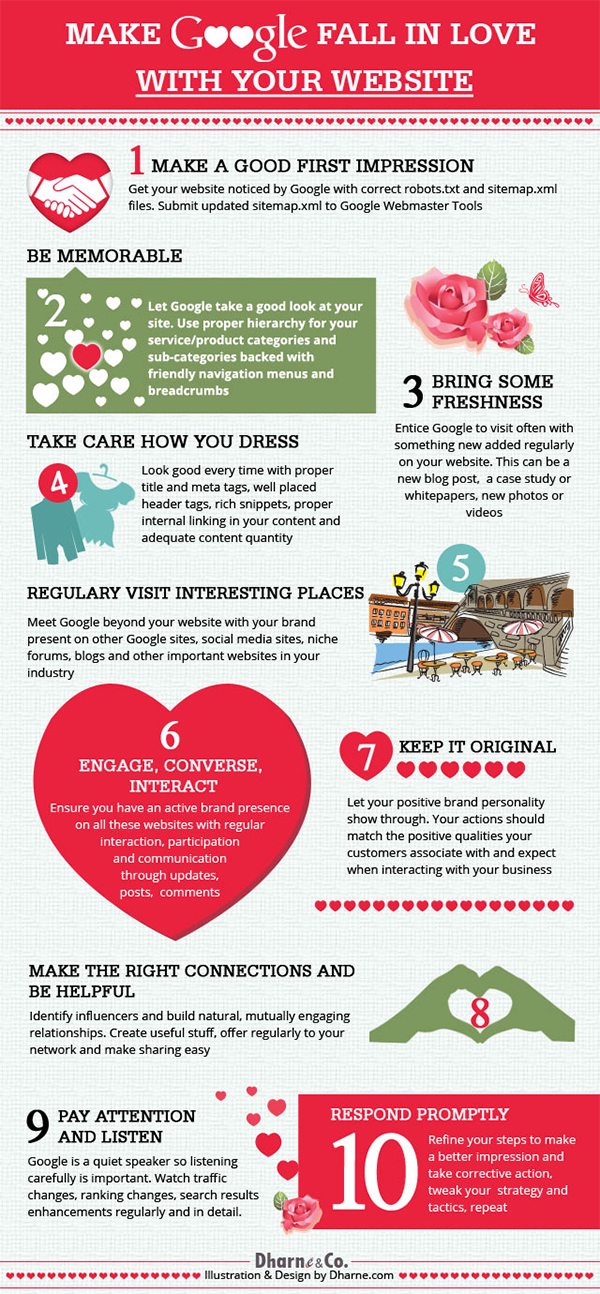
Infographic from Dharne & Co..
1. High-Quality Content is King
You’ve probably heard it a thousand times, but it’s worth emphasizing once more: high-quality content reigns supreme in the world of SEO. Google’s algorithms have become increasingly sophisticated at identifying and rewarding valuable content. To make Google love your site, focus on the following aspects of your content:
A. Originality
Ensure that your content is original and not duplicated from other sources. Google penalizes duplicate content, so always strive for uniqueness. Use tools like Copyscape to check for duplicate content across the web.
B. Relevance
Your content should be relevant to your target audience and align with the purpose of your website. Research keywords and topics that resonate with your niche, and create content that addresses your audience’s needs and interests.
C. Depth and Authority
Long-form, informative content tends to perform well in search engine rankings. Aim for in-depth articles that establish your authority on a subject. Back your claims with credible sources and data to boost your content’s reliability.
D. User Engagement
Google considers user engagement metrics like bounce rate, time on page, and click-through rate when assessing a website’s quality. Create compelling headlines, incorporate multimedia elements, and format your content for readability to keep visitors engaged.
2. Optimize for Mobile Devices
Mobile optimization is no longer optional but a necessity. Google prioritizes mobile-friendly websites in its search results, given the increasing number of users accessing the web via smartphones and tablets. To ensure Google loves your site on mobile:
A. Responsive Design
Implement a responsive web design that adapts seamlessly to various screen sizes. This ensures a consistent user experience across devices and helps improve your mobile SEO ranking.
B. Page Speed
Mobile users are often on the go and expect fast-loading pages. Optimize your website’s performance by compressing images, leveraging browser caching, and minimizing server response times.
C. Mobile-Friendly Content
Pay attention to the readability of your content on smaller screens. Use legible fonts and appropriately sized text, and ensure that images and videos are displayed correctly on mobile devices.
3. Keyword Research and Optimization
Keywords are the foundation of SEO. Effective keyword research and optimization can significantly boost your site’s visibility in search results. Here’s how to get it right:
A. Keyword Research
Invest time in keyword research to identify relevant search terms that your target audience is likely to use. Tools like Google Keyword Planner, SEMrush, and Ahrefs can help you discover valuable keywords.
B. On-Page Optimization
Once you’ve identified your target keywords, strategically place them in your content, including the title, headings, meta descriptions, and body text. However, avoid keyword stuffing, as it can lead to penalties.
C. Long-Tail Keywords
Incorporate long-tail keywords into your content. These are more specific, less competitive search terms that can attract a highly targeted audience.
4. Optimize Website Structure and Navigation
A well-structured website with intuitive navigation not only improves the user experience but also makes it easier for search engines to crawl and index your content. To optimize your site’s structure:
A. Clear Hierarchy
Organize your content into a clear hierarchy with logical categories and subcategories. Use descriptive and keyword-rich URLs to enhance clarity.
B. Internal Linking
Internal links connect your web pages, allowing users and search engines to navigate your site efficiently. Use anchor text that describes the linked page’s content and relevance.
C. XML Sitemap
Create an XML sitemap and submit it to Google Search Console. This helps Google’s crawlers discover and index your pages more effectively.
5. Improve Page Loading Speed
Website speed is a critical factor in SEO rankings. Slow-loading pages can lead to high bounce rates and frustrated users. To enhance page loading speed:
A. Image Optimization
Compress images to reduce their file size without compromising quality. Use modern image formats like WebP and lazy loading to expedite image loading.
B. Minimize HTTP Requests
Reduce the number of HTTP requests by consolidating CSS and JavaScript files. Use browser caching to store frequently accessed resources locally.
C. Content Delivery Network (CDN)
Consider using a CDN to distribute your website’s content across multiple servers worldwide. CDNs can significantly improve page loading times, especially for international audiences.
6. Secure Your Website with HTTPS
Security is a top priority for Google, and HTTPS is now a ranking factor. A secure website not only boosts SEO but also builds trust with your audience. To secure your site with HTTPS:
A. SSL Certificate
Obtain an SSL (Secure Sockets Layer) certificate from a trusted certificate authority (CA). This certificate encrypts data transmitted between your website and visitors, ensuring secure communication.
B. Update Internal Links
Ensure that all internal links on your site use the “https://” protocol instead of “http://” to prevent mixed content issues.
C. Update Google Search Console
In Google Search Console, configure your website’s preferred domain as “https://” to inform Google about the secure version of your site.
7. Optimize for Voice Search
Voice search is gaining popularity, with devices like Amazon Echo and Google Home becoming commonplace. To make Google love your site in the era of voice search:
A. Natural Language Keywords
Optimize your content for natural language queries. Voice searches tend to be more conversational, so consider how people might ask questions verbally.
B. Featured Snippets
Featured snippets are often the answers read aloud in voice search results. To increase your chances of being featured, structure your content with clear, concise answers to common questions.
C. Local SEO
Many voice searches are location-based. Ensure that your business information, such as address and phone number, is accurate and up to date in online directories.
8. Implement Schema Markup
Schema markup, also known as structured data, provides search engines with additional context about your content. This can lead to rich snippets in search results, which can improve click-through rates. To implement schema markup:
A. Choose Appropriate Markup
Identify the most relevant schema types for your content, such as articles, products, or reviews. You can use Google’s Structured Data Markup Helper to generate code.
B. Test Markup
Use Google’s Structured Data Testing Tool to verify that your markup is correctly implemented and displays as intended.
C. Monitor Performance
Regularly monitor your search results to see if your structured data is generating rich snippets. Adjust your markup if necessary to improve visibility.
9. Create High-Quality Backlinks
Backlinks, or inbound links from other websites to yours, remain a powerful SEO factor. However, not all backlinks are created equal. To build high-quality backlinks:
A. Content Outreach
Create exceptional content that other websites in your niche would want to link to. Reach out to relevant websites and offer your content as a valuable resource.
B. Guest Blogging
Contribute guest posts to reputable websites in your industry. Ensure that the content you provide is informative and adds value to the host site’s audience.
C. Avoid Toxic Links
Regularly monitor your backlink profile and disavow any toxic or spammy links that could harm your site’s reputation.
10. Monitor and Adapt
SEO is an ongoing process that requires constant monitoring and adaptation to stay competitive. Here’s how to keep your SEO strategy up to date:
A. Google Analytics
Use Google Analytics to track your website’s performance. Monitor key metrics such as organic traffic, bounce rate, and conversion rates to identify areas for improvement.
B. Google Search Console
Regularly check Google Search Console for crawl errors, indexation issues, and other technical problems that may affect your SEO.
C. Algorithm Updates
Stay informed about Google’s algorithm updates and industry trends. Adapt your SEO strategy accordingly to align with the latest best practices.
In conclusion, making Google love your site requires a multifaceted approach that encompasses high-quality content, mobile optimization, keyword research, website structure, page speed, security, voice search, schema markup, backlinks, and ongoing monitoring. By implementing these ten strategies, you’ll not only improve your website’s SEO but also provide a better experience for your visitors. Remember that SEO is a long-term investment, and the results may not be immediate, but with patience and persistence, you can achieve higher rankings and greater online visibility. So, get started today and watch your website soar in Google’s rankings.

Author:
Mark Ford