Do you think SEO is a one-time trick that will generate immediate and long lasting results? If so, you’re destined for disappointment!
Just because one of your mates paid some guy to do this one thing and they’ve been on the first page ever since doesn’t mean that’s the right way to do things. Chances are if that is correct they’ve done something naughty and they’re heading for a penalty.
For some more myths you need to ignore take a look at this infographic from SEOPressor.
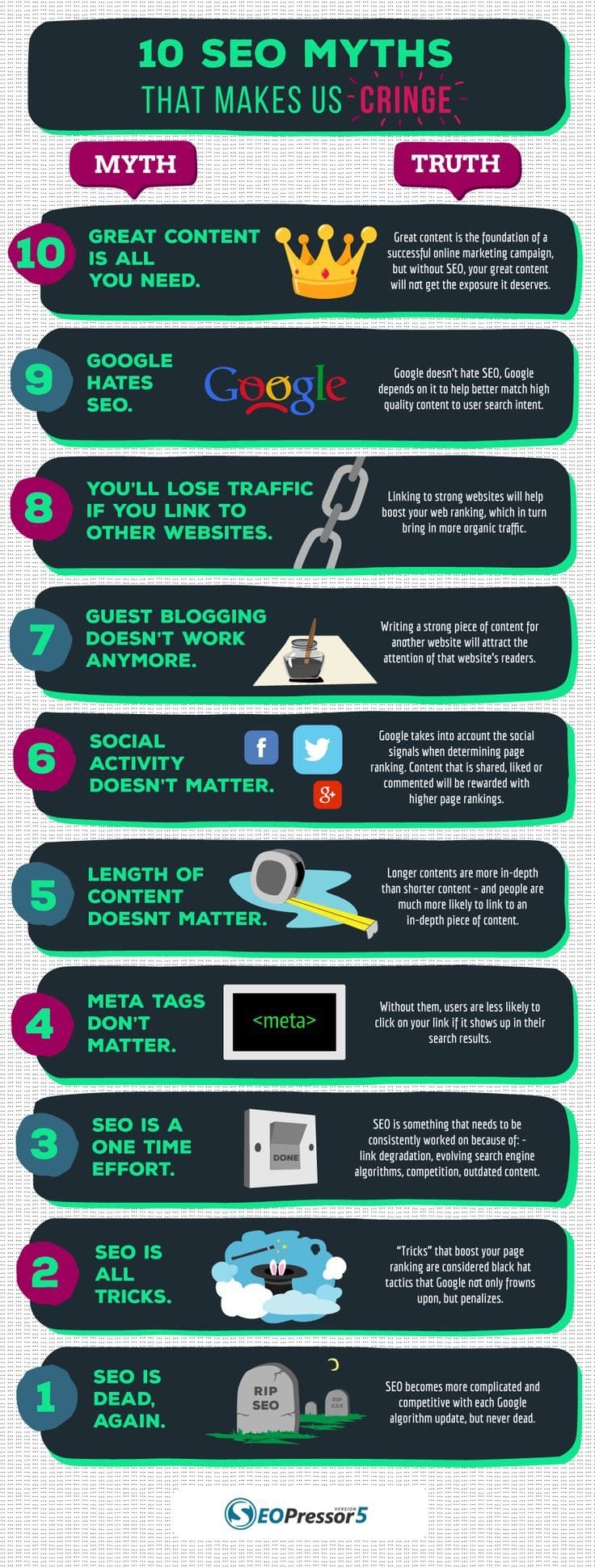
Search Engine Optimization (SEO) is an ever-evolving field, and it’s no surprise that myths and misconceptions often crop up. In the fast-paced world of digital marketing, clinging to outdated or incorrect information can seriously hinder your SEO efforts. That’s why it’s essential to separate fact from fiction and debunk the most cringeworthy SEO myths. In this blog post, we’ll shine a light on ten common SEO myths you should stop listening to immediately.
Myth 1: “Keyword Stuffing is the Key to SEO Success”
Once upon a time, keyword stuffing might have worked. However, search engines have come a long way in understanding the nuances of language. Today, overloading your content with keywords not only looks spammy but can also lead to penalties from search engines like Google.
The Reality: Instead of stuffing keywords, focus on creating high-quality, valuable content that naturally incorporates relevant keywords. Google’s algorithms are smart enough to recognize synonyms and context, so prioritize readability and user experience.
Myth 2: “Meta Tags Are Irrelevant”
Some SEO “gurus” claim that meta tags, such as meta titles and meta descriptions, don’t matter anymore. They argue that search engines don’t pay much attention to them when ranking websites.
The Reality: Meta tags are still crucial for SEO. While they may not be the sole factor in ranking, they play a significant role in attracting clicks from search engine results pages (SERPs). Well-optimized meta tags can improve click-through rates and indirectly influence your rankings.
Myth 3: “Backlinks Are No Longer Important”
With Google’s continuous algorithm updates, some believe that backlinks have lost their significance. They argue that quality content alone can propel a website to the top of search results.
The Reality: Backlinks remain a critical factor in SEO. High-quality, relevant backlinks from authoritative websites can significantly boost your website’s authority and trustworthiness in the eyes of search engines. However, it’s crucial to focus on earning natural backlinks rather than resorting to black-hat tactics.
Myth 4: “You Should Submit Your Website to Search Engines”
In the past, website owners often submitted their sites to search engines manually, believing it would speed up the indexing process and improve rankings.
The Reality: Search engines today are highly proficient at discovering and indexing websites on their own. Manual submission is unnecessary and, in some cases, can even be seen as a red flag. Instead, concentrate on creating high-quality content and earning natural backlinks to improve your website’s visibility.
Myth 5: “The More Pages You Have, the Better Your SEO”
Some website owners believe that having a vast number of pages, even if they’re low-quality or duplicate content, can boost their SEO.
The Reality: Quality over quantity is the rule of thumb in SEO. Search engines prioritize content that provides value to users. Instead of churning out numerous low-quality pages, focus on creating in-depth, informative content that addresses the needs and questions of your target audience.
Myth 6: “SEO is a One-Time Effort”
Many businesses think of SEO as a one-and-done task. They optimize their website once and expect it to rank well indefinitely.
The Reality: SEO is an ongoing process. Search engine algorithms change regularly, and your competitors are constantly vying for the same positions in SERPs. Regularly updating and optimizing your website, monitoring your performance, and adapting to algorithm changes are essential for long-term success.
Myth 7: “Social Media Has No Impact on SEO”
Some believe that social media and SEO are entirely separate entities, with no influence on each other.
The Reality: While social media signals themselves may not be direct ranking factors, a strong social media presence can indirectly impact your SEO. Social media can help drive traffic to your website, increase brand awareness, and foster backlinks and brand mentions—all of which can positively affect your SEO efforts.
Myth 8: “Longer Content Always Ranks Better”
There’s a common misconception that longer content, regardless of its quality or relevance, is always favored by search engines.
The Reality: Lengthy content can be beneficial, but it should be informative and valuable. Thin content that’s merely padded with words won’t rank well. Focus on creating comprehensive, well-researched content that genuinely satisfies the user’s intent.
Myth 9: “HTTPS Doesn’t Matter for SEO”
Some website owners believe that switching from HTTP to HTTPS doesn’t impact their SEO performance.
The Reality: HTTPS does matter for SEO. Google considers HTTPS as a ranking signal, and websites with secure connections are generally favored in search results. Additionally, it enhances user trust and security, which can positively influence user experience and click-through rates.
Myth 10: “SEO is All About Gaming the System”
There’s a persistent myth that SEO is primarily about finding shortcuts and gaming search engine algorithms to achieve quick results.
The Reality: SEO is about optimizing your website to provide the best possible experience for users. While there may be some short-term gains from black-hat tactics, they often result in penalties and long-term damage to your online presence. Ethical, white-hat SEO practices are the key to sustainable success.
Conclusion
In the ever-changing world of SEO, it’s essential to stay up-to-date with the latest trends and best practices. Dismissing these ten cringeworthy SEO myths is a crucial step toward achieving better rankings, more organic traffic, and improved online visibility. Remember that SEO is not about tricking search engines but about delivering high-quality content and an exceptional user experience. By debunking these myths and focusing on the realities of SEO, you’ll be better equipped to succeed in the competitive digital landscape.

Author:
Mark Ford