
In the digital age, businesses have more options than ever when it comes to promoting their products and services and engaging with their audience.
Social media platforms like Facebook have long been a popular choice for businesses to connect with their customers, but there’s another tool that’s gaining traction – business blogs.
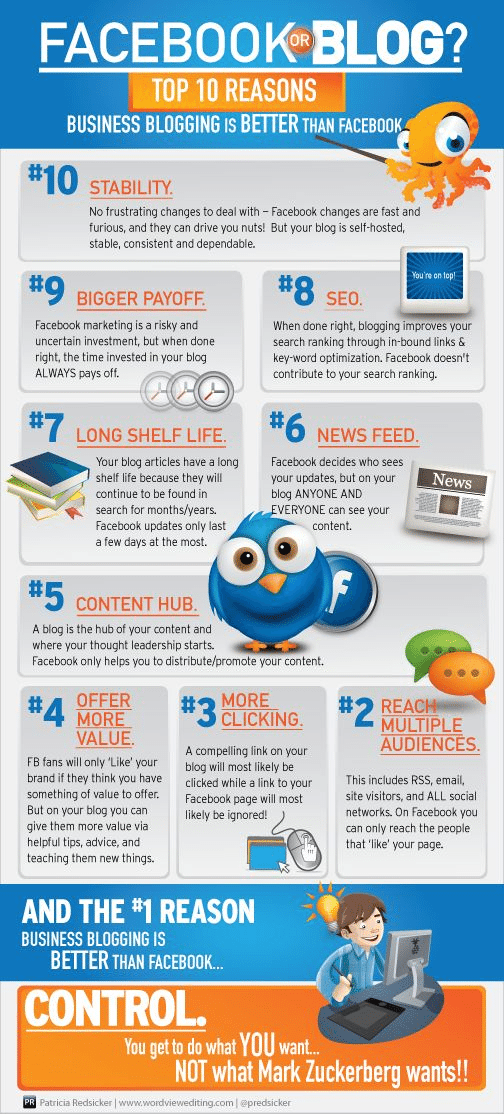
In this blog post, we’ll explore 10 compelling reasons why you should consider ditching Facebook in favor of a business blog.
Infographic by Word View Editing.
1. Ownership and Control
One of the most significant advantages of running a business blog is that you have complete ownership and control over your content. When you rely on Facebook, you’re at the mercy of their ever-changing algorithms and policies. They can limit your reach, censor your content, or even shut down your page at any time. With a business blog, you have full control over what you publish, ensuring your message gets out to your audience without interference.
2. Branding and Customization
A business blog allows you to create a unique and tailored online presence that reflects your brand’s identity. You can customize the design, layout, and style to match your branding, making it a seamless extension of your business. On Facebook, your page looks like every other page, limiting your ability to stand out and differentiate yourself in a crowded digital space.
3. Improved SEO
Search engine optimization (SEO) is crucial for increasing your online visibility. Business blogs are a fantastic tool for optimizing your website for search engines. By consistently publishing high-quality, keyword-rich content, you can improve your website’s ranking on search engine results pages (SERPs). This organic traffic can be a game-changer for your business and is something you have more control over with a blog than on Facebook.
4. Long-Lasting Content
On Facebook, your posts have a short lifespan. They appear in your followers’ feeds briefly and then disappear into the abyss of their timeline. In contrast, blog posts are evergreen, meaning they remain accessible and relevant for an extended period. This long-lasting content can continue to drive traffic and generate leads long after you’ve hit the publish button.
5. Monetization Opportunities
While you can run ads on Facebook, it’s not as straightforward or profitable as monetizing a blog. With a business blog, you have more flexibility in generating revenue streams. You can earn money through affiliate marketing, sponsored content, selling digital products or services, or even offering premium content behind a paywall. These options provide more control and potential for profitability than relying solely on Facebook ads.
6. Data and Analytics
Understanding your audience’s behavior and preferences is essential for business growth. Business blogs provide detailed analytics tools that can help you gain insights into your readers. You can track which posts are performing well, what keywords are driving traffic, and who your target audience is. This data-driven approach can guide your content strategy and marketing efforts effectively.
7. Enhanced Credibility
Having a well-maintained blog can significantly boost your business’s credibility and authority within your industry. When you consistently produce valuable and informative content, you establish yourself as an expert in your field. Readers are more likely to trust businesses that provide educational content through a blog than those with just a Facebook presence.
8. Audience Ownership
On Facebook, your followers are essentially Facebook’s customers. You have limited access to their contact information, making it challenging to build a direct relationship with them. With a blog, you can collect email addresses through subscriptions and build your email list. This ownership of your audience’s contact details allows you to communicate directly with them, fostering a more personal and lasting connection.
9. Content Variety
A blog offers more flexibility in the types of content you can create. While Facebook primarily revolves around short posts and images, a blog enables you to produce diverse content such as in-depth articles, tutorials, videos, podcasts, infographics, and more. This variety keeps your audience engaged and caters to different learning and consumption preferences.
10. Control Over Monetization
When you run a business blog, you have control over how you monetize your content. You can experiment with various revenue streams and tailor your monetization strategy to your audience’s preferences. On Facebook, your monetization options are more limited and come with their own set of rules and restrictions.
Conclusion
While Facebook has been a go-to platform for businesses seeking to connect with their audience, a business blog offers distinct advantages in terms of ownership, control, branding, SEO, content longevity, monetization opportunities, data analytics, credibility, audience ownership, and content variety. By investing in a business blog, you can establish a stronger online presence, build a loyal audience, and drive sustainable growth for your brand. So, if you’re looking for a more robust and effective way to connect with your target audience, it might be time to consider ditching Facebook in favor of a business blog.

Author:
Mark Ford