In today’s digital age, where almost every business has an online presence, getting noticed by potential customers can be a challenging task. This is where Search Engine Optimization (SEO) comes into play. SEO is the practice of optimizing your website and online content to rank higher on search engine results pages (SERPs). And if you’re a local business looking to attract local customers, then Local SEO should be your focus.
Local SEO is a specialized branch of SEO that aims to improve your visibility in local search results, making it easier for people in your area to find your business when they search for relevant products or services. It’s an invaluable strategy for businesses of all sizes, from small mom-and-pop shops to large corporations with multiple locations.
In this comprehensive guide, we’ll walk you through the four essential steps to achieving Local SEO greatness and getting your business higher on Google’s search results.
If you want to get your products and services in front of your local customers your local SEO ranking massively important. The infographic below from 123 Print gives you 4 steps to ensure your site appears in the local search results.
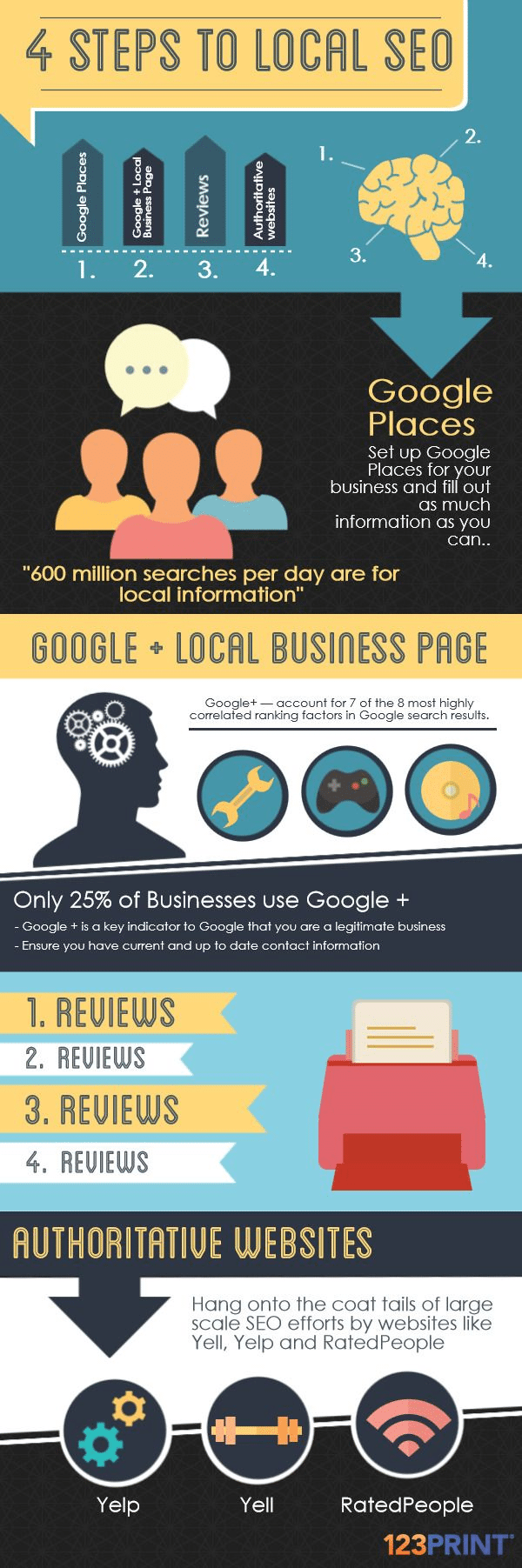
1. Optimize Your Google My Business (GMB) Profile
Your Google My Business (GMB) profile is your business’s digital storefront. It’s the first thing that users see when they search for a local business on Google. Optimizing your GMB profile is crucial because it not only provides valuable information to potential customers but also plays a significant role in local search rankings.
a. Claim and Verify Your GMB Listing
The first step is to claim and verify your GMB listing. This process involves proving to Google that you are the owner or authorized representative of the business. Once verified, you’ll have control over the information displayed on your GMB profile.
To claim and verify your listing:
- Go to the Google My Business website (https://www.google.com/business/).
- Sign in to your Google account.
- Search for your business using its name and address.
- If your business appears in the search results, select it.
- Follow the prompts to verify your business through a postcard, phone call, or email.
b. Complete Your GMB Profile
After verification, it’s essential to fill out your GMB profile completely. This includes providing accurate and up-to-date information about your business, such as:
- Business name, address, and phone number (NAP).
- Business category.
- Hours of operation.
- A brief description of your business.
- High-quality photos of your business, products, and services.
Ensuring that your NAP information is consistent across all online platforms is crucial for local SEO. Inconsistent information can confuse both search engines and potential customers.
c. Gather and Showcase Reviews
Customer reviews play a significant role in local search rankings and can influence potential customers’ decisions. Encourage satisfied customers to leave positive reviews on your GMB profile. Respond to all reviews, both positive and negative, professionally and promptly.
d. Post Regular Updates
Keep your GMB profile active by posting regular updates, such as special offers, events, or blog posts. These posts appear directly in the search results, making your business more engaging and informative to potential customers.
2. Optimize Your Website for Local SEO
Your website is the digital hub of your business, and optimizing it for local search is crucial for attracting local customers. Here are some key steps to ensure your website is optimized for Local SEO:
a. Keyword Research
Start by conducting keyword research to identify the terms and phrases potential customers are using to find businesses like yours. Use keyword research tools like Google Keyword Planner or SEMrush to discover relevant keywords with local intent.
Once you’ve identified these keywords, incorporate them naturally into your website’s content, including your homepage, service pages, and blog posts.
b. On-Page SEO
Optimize your website’s on-page elements for local SEO:
- Use descriptive title tags and meta descriptions that include relevant keywords and your location.
- Ensure your website is mobile-friendly and loads quickly, as mobile-friendliness is a ranking factor.
- Create unique and valuable content that addresses the needs and questions of your local audience.
- Use header tags (H1, H2, H3) to structure your content and make it more readable.
- Include your NAP information in the footer of every page.
c. Create Local Landing Pages
If your business serves multiple locations, create dedicated landing pages for each one. Each landing page should include specific location-based information, such as the address, phone number, hours of operation, and customer reviews for that location.
d. Optimize for Voice Search
With the rise of voice-activated devices like smartphones and smart speakers, optimizing for voice search is becoming increasingly important. Voice search queries often have a conversational tone, so consider incorporating natural language phrases and long-tail keywords into your content.
3. Build High-Quality Backlinks
Backlinks, also known as inbound links, are links from other websites to your site. They are a crucial factor in search engine rankings and can significantly impact your local SEO efforts. However, not all backlinks are created equal. Here’s how to build high-quality backlinks for local SEO:
a. Local Citations
A local citation is a mention of your business’s NAP information on other websites, such as local directories, review sites, and social platforms. Ensure that your NAP information is consistent across all citations, as discrepancies can harm your local SEO efforts.
To build local citations:
- List your business on popular local directories like Yelp, Yellow Pages, and TripAdvisor.
- Ensure your business is listed accurately on data aggregators like Neustar Localeze and Infogroup.
- Seek opportunities to get mentioned in local news articles or blogs.
b. Guest Posting
Guest posting involves writing articles or blog posts for other websites within your industry. When you contribute valuable content to authoritative websites, you can often include a link back to your own site. Look for opportunities to guest post on local blogs or news sites to build relevant backlinks.
c. Partner with Local Businesses
Building relationships with other local businesses can lead to link-building opportunities. Consider partnering with complementary businesses in your area and exchanging links or co-promoting each other’s content.
d. Monitor and Disavow Bad Backlinks
Regularly monitor your backlink profile using tools like Google Search Console or Ahrefs. If you notice any low-quality or spammy backlinks pointing to your site, disavow them to prevent them from negatively impacting your SEO.
4. Local SEO Content Strategy
Content is the backbone of SEO. Creating high-quality, relevant, and engaging content is essential for local SEO success. Here’s how to develop a local SEO content strategy:
a. Create Local Content
Produce content that’s tailored to your local audience. This could include:
- Local guides and resources.
- Stories and profiles of your employees or customers.
- Event coverage and promotions for local events.
- Case studies highlighting your work with local clients.
b. Blog Regularly
Maintain an active blog on your website, and publish blog posts regularly. Blogging allows you to target specific keywords, address common questions, and establish your authority in your industry.
c. Use Local Keywords
Incorporate local keywords into your content naturally. These keywords should reflect your location and the areas you serve. For example, if you’re a dentist in New York City, you might target keywords like “NYC dentist” or “dental care in Manhattan.”
d. Leverage User-Generated Content
Encourage customers to create and share content related to your business. User-generated content, such as reviews, testimonials, and photos, can enhance your online presence and build trust with potential customers.
e. Monitor Your Analytics
Regularly analyze the performance of your content using tools like Google Analytics. Identify which pieces of content are driving the most traffic, engagement, and conversions. Use this data to refine your content strategy over time.
Conclusion
Achieving local SEO greatness and getting your business higher on Google’s search results requires a well-rounded approach that encompasses your Google My Business profile, website optimization, backlink building, and a strategic content strategy. By following these four essential steps, you’ll be well on your way to improving your local online visibility and attracting more local customers to your business.
Remember that SEO is an ongoing process, and staying up-to-date with the latest trends and algorithms is crucial for long-term success. Continuously monitor your results, adapt your strategy, and stay committed to providing the best possible experience for your local customers. With dedication and the right strategy, your business can thrive in the competitive world of local SEO.

Author:
Mark Ford