
Is your website still aligned with your business goals and audience needs? Want to know the key questions that reveal whether it’s time for a strategic redesign?
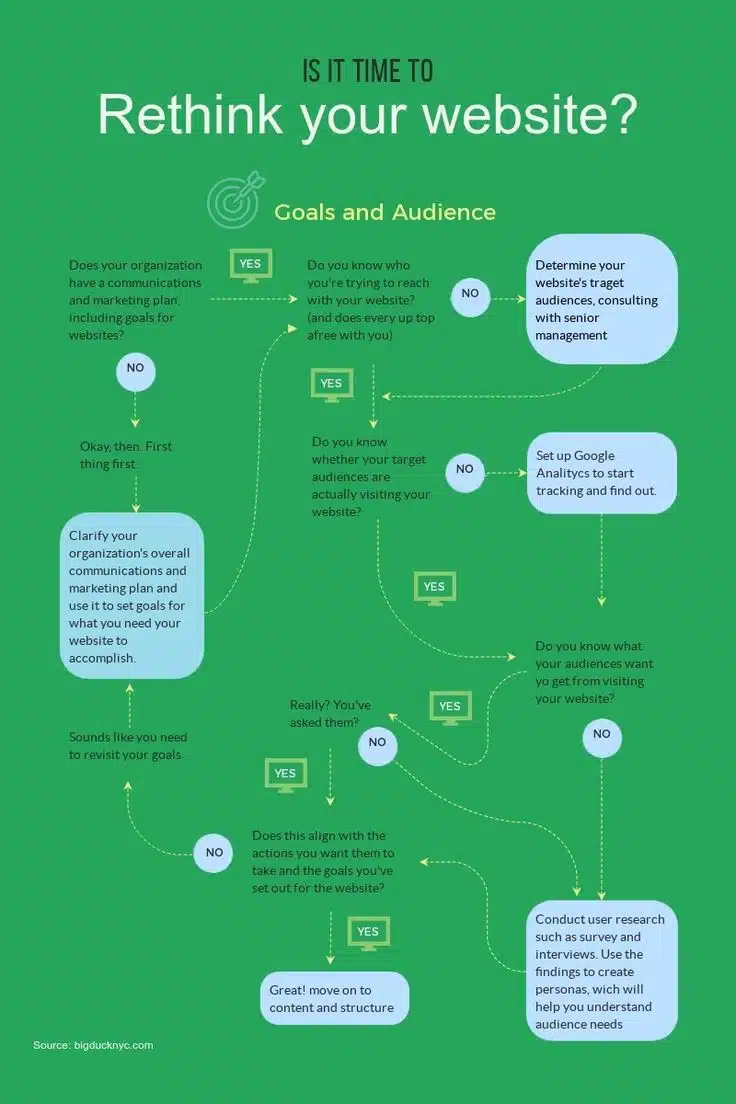
You’ll find some website basics in this infographic.
Here’s a summary of what’s covered:
- Do You Have a Communications and Marketing Plan with Website Goals?
- Do You Know Who You’re Trying to Reach with Your Website?
- Are Your Target Audiences Actually Visiting Your Website?
- Do You Know What Your Visitors Want from Your Website?
- Have You Confirmed Their Needs Through Research?
- Does This Align with the Actions You Want Them to Take?
Check out the post below for more.
Your website is one of your most powerful marketing tools—but only if it’s working for you. If it’s unclear, outdated, or out of sync with your goals, it could be costing you more than just visitors.
Before diving into a redesign, it’s worth stepping back to evaluate whether your site is doing what it should. Here are six essential questions to help guide that process.
Do You Have a Communications and Marketing Plan with Website Goals?
A solid website starts with a solid strategy. If your organisation lacks a clear communications and marketing plan—especially one that includes website-specific goals—everything else is likely to fall short. Before you touch the layout, copy, or tech, revisit the big picture. What exactly is your website supposed to do for your business?
- Review your overall marketing strategy and identify where the website fits into it.
- Define specific, measurable goals for your website (e.g., lead generation, sales, engagement).
- Make sure these goals are aligned with your business objectives and wider campaigns.
- Share these goals with all relevant teams so everyone understands what success looks like.
Do You Know Who You’re Trying to Reach with Your Website?
Understanding your target audience is fundamental to building an effective website. It’s not enough to guess or assume—you need clarity on who they are, what they need, and why they would choose your business. If everyone on your team would give a different answer, it’s time to regroup and refocus.
- Identify your primary and secondary audience groups, with input from marketing and senior leadership.
- Define the problems these audiences face and how your business solves them.
- Create audience personas to visualise user goals, motivations, and behaviours.
- Align your site’s tone, content, and features with what these specific users value.
Are Your Target Audiences Actually Visiting Your Website?
Even with a clear audience in mind, you still need to check whether those people are actually finding—and staying on—your site. This is where analytics come into play. Without data, you’re flying blind. With it, you can make smarter decisions based on how real users behave.
- Install Google Analytics (GA4) and regularly review audience and traffic reports.
- Compare actual visitor demographics with your target personas to identify gaps.
- Track traffic sources to see how visitors are finding your site and whether key channels are performing.
- Monitor bounce rates and engagement metrics to gauge the quality of your traffic.
Do You Know What Your Visitors Want from Your Website?
Understanding user intent is key to delivering a valuable website experience. Visitors arrive at your site for a reason—whether it’s to buy, learn, sign up, or get in touch. If you don’t know what those reasons are, you won’t be able to design a site that meets their needs and converts.
- Use heatmaps and session recordings to see where visitors are clicking, scrolling, and getting stuck.
- Conduct on-site surveys or popups asking users what they came to do and whether they succeeded.
- Analyse search queries and internal site search data for insight into what people are looking for.
- Interview existing customers about how they use your site and what they find helpful or frustrating.
Have You Confirmed Their Needs Through Research?
Assumptions only take you so far. You might think you know what your audience wants—but have you actually asked them? Direct research like surveys, interviews, and usability testing can uncover insights that analytics alone won’t reveal. It’s the best way to make sure your strategy is based on facts, not guesswork.
- Create user surveys that ask about goals, pain points, and how your site could improve.
- Run one-on-one interviews to dive deeper into specific experiences and needs.
- Build and test user personas using a mix of qualitative and quantitative data.
- Conduct usability tests to see where real people struggle to complete tasks on your site.
Does This Align with the Actions You Want Them to Take?
Ultimately, your website should drive action. That could mean booking a consultation, making a purchase, signing up for an email list, or something else entirely. If there’s a disconnect between what users want and what you want them to do, your site won’t deliver results. Alignment is where strategy becomes conversion.
- Map out the user journey and identify points where users drop off or disengage.
- Ensure every page has a clear call to action that supports your business goals.
- Test different content layouts and messaging to see what drives more engagement.
- Revisit your website goals regularly and refine them based on performance data.
Final Thoughts
If your website feels like it’s underperforming—or you’re not even sure how it’s performing—these six questions will help you get to the root of the issue.
They’ll guide you through a strategic rethink that goes beyond design and digs into purpose, people, and performance. Once you’ve worked through them, you’ll be in a much stronger position to build a site that not only looks great but actually works hard for your business.
Want help evaluating or redesigning your website? Let’s talk. At Red Website Design, we turn strategy into stunning, high-performing sites tailored to your goals and audience.

Author:
Mark Ford