Are you just getting started with an email marketing campaign for your business? Need help coming up with content ideas to include in your marketing emails?
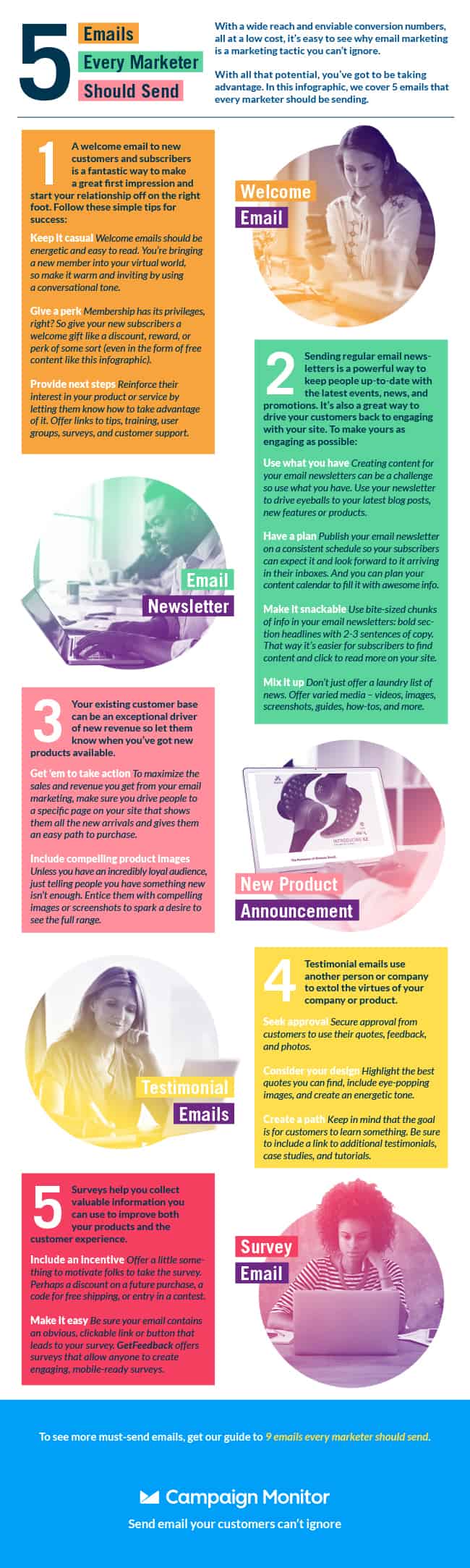
Campaign Monitor share their marketing email suggestions in this infographic.
Here’s a quick summary:
- Welcome email
- Newsletters
- New product announcements
- Testimonials
- Surveys
Check out the infographic for more detail.
Email marketing continues to be one of the most effective tools for businesses of all sizes. With an ROI of $36 for every $1 spent, it’s clear that email marketing is a powerful and cost-effective way to engage your audience, nurture leads, and drive sales. However, to maximize the potential of your email marketing strategy, it’s essential to understand the types of emails that work best for different stages of the customer journey.
In this blog post, we’ll explore five must-have email types that your business should be sending to improve customer engagement and conversion rates: the welcome email, newsletters, new product announcements, testimonials, and surveys. Each type of email has a specific purpose, and when used correctly, it can build stronger relationships with your audience, encourage brand loyalty, and drive revenue.
Welcome Email
A welcome email is the first interaction your new subscribers or customers have with your brand after they sign up for your email list, purchase a product, or create an account. Think of it as your business’s virtual handshake—first impressions matter, and this initial message sets the tone for your ongoing relationship. While the welcome email is relatively simple, it holds tremendous potential to increase engagement, build loyalty, and guide your audience toward becoming repeat customers. For small businesses especially, a well-crafted welcome email can make a significant impact on customer retention and future sales.
Why Welcome Emails Matter for Small Businesses
Small businesses often rely on building strong personal relationships with customers, and the welcome email is a critical step in this process. Unlike large corporations, where communication can feel impersonal, small businesses can leverage their size to offer a more personalized, friendly, and authentic touch.
Here are some key reasons why welcome emails are so important for small businesses:
- First impressions count: A well-crafted welcome email provides an opportunity to make a positive first impression and set expectations for future communication.
- Higher engagement rates: As mentioned, welcome emails often have higher open and click-through rates compared to other types of emails. This is the perfect opportunity to introduce your business and encourage interaction.
- Brand introduction: For small businesses, it’s essential to tell your brand story. This can include who you are, what you do, and why you’re passionate about your business. Since small businesses often operate within niche markets, it’s important to communicate the uniqueness of your brand from the get-go.
- Establish a relationship: The welcome email is a great opportunity to start nurturing your relationship with the subscriber. Building a connection at this early stage can lead to stronger customer loyalty and a higher lifetime value.
Key Elements of an Effective Welcome Email
To make the most of your welcome email, it’s important to include key elements that engage your subscribers, communicate your brand’s value, and encourage action. Let’s break down the crucial components that should be part of every small business welcome email.
- Personalization
Personalization is essential in email marketing, and the welcome email is no exception. Studies show that personalized emails deliver higher open and engagement rates. Even something as simple as addressing the recipient by their first name can make a significant impact.
For small businesses, where customer relationships are paramount, personalization should go beyond using a name. If possible, segment your audience based on how they signed up (e.g., through a promotion, an event, or a purchase) and tailor the content of the email accordingly.
- Example: If a customer just signed up after making a purchase, you could thank them for their order and provide product-related tips, such as how to best use or care for their new purchase.
- Introduction to Your Brand
While keeping it brief, use the welcome email to introduce your brand and the unique value you offer. Remember, the subscriber might not know much about your business at this stage, so give them a quick overview. Share a bit about your story, your products or services, and what makes your business stand out.
- Example: “Thank you for joining the [Your Brand] family! We’re a small, family-owned business with a passion for crafting high-quality, handmade goods that bring a little joy into everyday life. Every product we create is made with love and care, and we can’t wait to share more with you.”
- Set Expectations
Let your subscribers know what type of content they can expect from your future emails. Will you be sending newsletters, promotional offers, product updates, or industry insights? Setting clear expectations helps build trust and ensures your audience is excited to open your emails rather than viewing them as spam.
- Example: “You can expect to hear from us about twice a month, where we’ll share exciting updates, exclusive offers, and behind-the-scenes looks at what we’re working on!”
- Exclusive Offer or Incentive
Offering an incentive in your welcome email can encourage immediate action. For example, many businesses include a discount code for first-time customers, free shipping, or access to exclusive content. This tactic not only drives engagement but also increases the likelihood of a sale.
- Example: “As a thank you for joining our email list, we’d love to offer you 10% off your first purchase. Just use the code WELCOME10 at checkout!”
- Call to Action (CTA)
Your welcome email should include a clear and concise call to action (CTA) that guides your subscribers on what to do next. This could be anything from browsing your product selection, following you on social media, or learning more about your services. The key is to make it easy for subscribers to take the next step in their journey with your business.
- Example CTA: “Ready to explore our collection? Click here to shop and take 10% off your first order!”
- Visual Appeal
While the content of your welcome email is important, how it looks matters just as much. Use high-quality images that represent your brand and products. If your business has a visual aspect, such as a retail store, restaurant, or e-commerce shop, consider showcasing images of your most popular items or giving a glimpse of your workspace.
Best Practices for Small Business Welcome Emails
Now that you know what to include, let’s dive into some best practices that small businesses should follow when sending welcome emails.
- Timing is Key
The timing of your welcome email is critical. You want to send the email as soon as possible after someone subscribes to your list. Immediate follow-up shows that you’re responsive and helps capitalize on the excitement and interest the subscriber had when they signed up. Most email marketing platforms allow you to automate this process, ensuring that your welcome email is sent out instantly.
- Keep It Simple and Concise
While it’s tempting to cram as much information as possible into your welcome email, simplicity is key. A cluttered email can overwhelm the recipient, reducing its effectiveness. Instead, stick to one or two primary messages, and make your CTAs easy to find and follow.
- Optimize for Mobile Devices
With over 50% of emails being opened on mobile devices, it’s essential to ensure your welcome email is mobile-friendly. Use responsive design templates that automatically adjust to different screen sizes. Ensure that your images load quickly, and that your text is easy to read on smaller screens. Buttons should also be large enough to be easily clicked on mobile devices.
- Create a Series of Welcome Emails
Instead of sending just one welcome email, consider creating a welcome email series. This allows you to gradually introduce your business, your products, and the benefits of staying on your email list over a period of time. For example:
- Email 1: Introduce your brand, set expectations, and offer a welcome discount.
- Email 2: Share your brand’s story, mission, and values.
- Email 3: Highlight your best-selling products or services, along with customer testimonials.
- Email 4: Provide additional value with helpful tips or resources, and encourage engagement on social media.
A welcome email series keeps your audience engaged and allows you to nurture leads at a comfortable pace.
- Test and Optimize
Testing is an essential component of any email marketing strategy, and your welcome emails are no exception. Small businesses should experiment with different subject lines, email designs, CTAs, and copy to see what resonates best with their audience. Use A/B testing to compare two versions of your welcome email and identify which one performs better in terms of open rates, click-through rates, and conversions.
Additionally, pay attention to metrics such as bounce rates, unsubscribe rates, and overall engagement. These insights can help you refine your approach over time.
Common Mistakes to Avoid
Even though the welcome email might seem straightforward, there are a few common mistakes that can reduce its effectiveness:
- Not Sending a Welcome Email at All
Surprisingly, some businesses don’t send a welcome email, missing out on the opportunity to engage with new subscribers. Failing to send a welcome email can make subscribers forget why they signed up in the first place, reducing their likelihood of interacting with future emails.
- Overloading with Information
As mentioned earlier, too much information can overwhelm recipients. Keep your welcome email simple, focusing on the most important messages.
- Using a Generic, Non-Personalized Message
Welcome emails should feel personal and unique to each subscriber. Avoid sending a generic message that feels like it could apply to anyone. Instead, make an effort to personalize it based on your subscriber’s actions, preferences, or location.
- No Clear Next Steps
The goal of a welcome email is to guide subscribers toward the next step, whether it’s making a purchase, learning more about your business, or following you on social media. Without a clear CTA, your subscribers might not know what action to take, which reduces the effectiveness of the email.
Examples of High-Performing Welcome Emails
For inspiration, here are a couple of examples of well-designed welcome emails from small businesses:
- E-Commerce Business: “Welcome to the Family!” The email includes a 15% discount on the first purchase, with a CTA to “Shop Now.” There’s also a brief introduction to the brand’s story and values, along with social media buttons for Instagram and Facebook.
- Service-Based Business: “Thanks for Joining Us!” The email provides an overview of the services offered, an invitation to book a consultation, and a free downloadable guide on the topic related to their business. The email is short but includes a clear CTA to “Schedule a Consultation.”
A well-crafted welcome email is more than just a formality; it’s a strategic touchpoint that sets the stage for your relationship with new subscribers and customers. For small businesses, where every interaction counts, the welcome email is a powerful tool to increase engagement, build loyalty, and drive sales.
By taking the time to personalize your welcome email, crafting a compelling message, and optimizing it for both desktop and mobile devices, you can ensure that this essential email serves its purpose and strengthens your email marketing efforts from the very beginning.
Newsletters
Newsletters are a versatile email type that helps you stay top-of-mind with your audience by providing regular updates on your business. Whether sent weekly, bi-weekly, or monthly, newsletters can cover a wide range of content, including industry news, blog posts, upcoming events, special promotions, and more.
Why Newsletters Matter
Newsletters are one of the most powerful tools in a small business’s email marketing toolkit. They offer an ongoing line of communication between your business and your audience, allowing you to keep subscribers informed about your products, services, updates, and industry news. Unlike promotional emails, newsletters are typically more content-focused and aim to provide consistent value to your audience.
For small businesses, newsletters are an effective way to build long-term relationships with customers, showcase expertise, and maintain brand visibility in the inbox. With the right strategy, newsletters can nurture leads, increase brand loyalty, and drive engagement, all while positioning your business as a trusted resource.
Why Newsletters Matter for Small Businesses
Small businesses often thrive on community and customer loyalty. A newsletter helps strengthen these connections by offering relevant, helpful content that keeps your audience engaged over time. The frequency and format of newsletters allow businesses to stay top of mind without being overly promotional, which is important for fostering a positive brand image.
Here are several reasons why newsletters are crucial for small businesses:
- Consistency in Communication: Newsletters give you a regular opportunity to communicate with your audience. This consistency can improve brand recall and ensure that your business is the first they think of when they need your product or service.
- Educational Opportunities: Many small businesses use newsletters to educate their audience about industry trends, best practices, and new developments. Providing valuable content builds trust and positions you as an expert in your field.
- Promotion Without Hard Selling: While newsletters are not primarily sales-focused, they still provide opportunities to softly promote your products or services. A well-crafted newsletter subtly blends informative content with calls to action that encourage subscribers to engage further with your business.
- Boosting Website Traffic: By linking to blog posts, product pages, or landing pages, newsletters can be a significant driver of traffic to your website.
- Building Community: Newsletters help create a sense of belonging among your subscribers. Regular updates about your business, team, or behind-the-scenes stories help foster a community feel, which can be especially effective for local small businesses.
Key Elements of an Effective Newsletter
Creating a successful newsletter goes beyond just sending out company updates. It’s about providing value and delivering content that your audience wants to read. Let’s break down the essential components of a newsletter that can help small businesses keep subscribers engaged and eager to open your emails.
- Engaging Subject Line
The first thing your subscribers see is the subject line, so it’s crucial to make it stand out. A good subject line is clear, concise, and intriguing. It should give the recipient a reason to open the email while accurately reflecting the content inside.
- Example: Instead of “Monthly Newsletter – September,” try something more engaging like “5 Tips to Supercharge Your Fall Marketing Efforts” or “See What’s New at [Your Business] This Month!”
Make sure to test different subject lines through A/B testing to determine which ones yield higher open rates for your audience.
- Strong Opening Line
After the subject line, the first few lines of your email (or preview text) will determine if subscribers continue reading. Avoid generic openings and instead dive right into something of interest to your audience.
- Example: “Fall is here, and it’s the perfect time to refresh your marketing strategy. Here are our top tips to help you finish the year strong.”
Your opening line should grab attention while leading naturally into the content of the newsletter.
- Valuable Content
Content is the heart of your newsletter. For small businesses, providing value means offering tips, insights, or updates that your audience finds helpful, entertaining, or educational. Newsletters are an excellent place to share blog posts, case studies, how-to guides, product tips, and company updates.
- Example: “This month, we’re diving into the benefits of using eco-friendly packaging for small businesses. Read our latest blog post to learn how it can improve customer satisfaction while reducing your environmental impact.”
When crafting your newsletter, focus on providing content that resonates with your audience’s needs and pain points. This will keep them engaged and eager to read future emails.
- Clear and Visually Appealing Design
Your newsletter should be visually appealing and easy to read. Use a simple, clean design that aligns with your brand’s aesthetic. Break up text with images, headlines, and bullet points to make the content scannable. Make sure that your newsletter is mobile-friendly, as a large portion of your audience will likely open it on their phones.
For small businesses, visuals play a critical role in showcasing your products, services, and behind-the-scenes content. High-quality images help break up the text and add interest, making your newsletter more engaging. Tools like Canva can be used to create professional-looking visuals without a large design budget.
- Call to Action (CTA)
Every newsletter should have at least one clear and concise CTA, whether it’s to visit your website, read a blog post, or take advantage of a special offer. The CTA should stand out visually and guide your subscribers toward the next action you want them to take.
- Example CTA: “Want to learn more? Check out our latest blog post here!”
- Another CTA example: “Shop our new collection and enjoy 20% off with code FALL20.”
Make sure not to overwhelm your audience with too many CTAs in one email. One or two focused actions are enough to direct readers without confusing them.
- Personalization
Personalized content can significantly increase engagement with your newsletters. Using your subscriber’s name, tailoring content to their preferences, or segmenting your audience based on behaviors or past interactions can make the newsletter feel more relevant and engaging.
- Example: “Hi [First Name], we noticed you’ve been browsing our new fall collection—here’s a special discount to help you get started!”
For small businesses, personalization is especially impactful because it aligns with the personal, relationship-driven nature of your business. The more you can tailor your newsletters to individual subscribers, the more engaged they’ll be.
Types of Content to Include in Newsletters
To keep your newsletters fresh and engaging, consider incorporating a variety of content types. A well-rounded newsletter offers a mix of value-driven content and subtle promotional material. Here are some content ideas that small businesses can include in their newsletters:
- Business Updates
Keep your audience informed about what’s happening within your company. This could include new product launches, upcoming events, or behind-the-scenes insights. Sharing internal updates creates a sense of transparency and can strengthen your relationship with subscribers.
- Example: “We’re excited to announce that we’re expanding our product line with eco-friendly packaging options. Stay tuned for more details coming soon!”
- Industry News or Trends
If there’s an important development in your industry that your audience should know about, share it in your newsletter. Offering insights on industry trends can position your business as a thought leader and build credibility.
- Example: “Here’s what you need to know about the latest digital marketing trends and how they could impact your business.”
- Educational Content
Your newsletter is an excellent place to provide value through educational content such as tips, tutorials, and how-to guides. This helps establish your brand as a trusted resource while also addressing the pain points of your audience.
- Example: “Struggling to get more engagement on social media? Check out our top 5 tips for increasing your online presence.”
- Customer Spotlights or Testimonials
Highlighting your customers is a great way to create a sense of community while also building social proof. You can include short customer testimonials or success stories to demonstrate the value of your products or services.
- Example: “Meet Sarah, one of our long-time customers who has used our eco-friendly packaging to grow her online business. Here’s what she has to say about her experience with us!”
- Exclusive Offers
Offering special promotions or discounts in your newsletter can boost engagement and sales. Subscribers feel rewarded for being part of your email list, and it encourages them to act immediately.
- Example: “As a thank you for being part of our community, enjoy 15% off your next purchase. Use code THANKYOU15 at checkout!”
- Links to Blog Posts or Videos
Sharing your latest blog posts or video content is an excellent way to drive traffic to your website. Your newsletter can serve as a teaser for longer-form content that lives on your blog or YouTube channel.
- Example: “Looking for more tips? Read our latest blog post on maximizing your holiday sales.”
Best Practices for Small Business Newsletters
To maximize the effectiveness of your newsletters, here are some best practices to keep in mind:
- Establish a Regular Schedule
Consistency is key when sending newsletters. Whether you send them weekly, bi-weekly, or monthly, your audience should know when to expect them. A regular schedule ensures your business stays top of mind and builds trust over time.
- Tip: Use email marketing tools like Mailchimp or Constant Contact to automate and schedule your newsletters.
- Segment Your Audience
Not all your subscribers will be interested in the same content. By segmenting your email list based on customer behavior, interests, or demographics, you can send more targeted newsletters that resonate with different groups.
- Example: Send one version of your newsletter to customers who have purchased before and a different version to new subscribers, offering content that’s relevant to their journey with your brand.
- Track Metrics and Optimize
Tracking email performance metrics such as open rates, click-through rates, and conversion rates is crucial for optimizing your newsletters. Pay attention to which subject lines, CTAs, and content types are most effective, and adjust your strategy accordingly.
- Test and Experiment
Don’t be afraid to experiment with your newsletters. A/B testing different elements such as subject lines, design, and CTAs can help you determine what works best for your audience.
- Maintain a Clean Email List
Regularly clean your email list to remove inactive subscribers and ensure your emails are being sent to engaged recipients. A smaller, more engaged list is often more valuable than a large list of disinterested subscribers.
Conclusion
For small businesses, newsletters are a cost-effective and impactful way to maintain ongoing communication with customers, build brand loyalty, and drive traffic to your website. By focusing on delivering value, creating engaging content, and regularly analyzing performance, your business can use newsletters to cultivate stronger relationships and increase customer engagement over time.
Whether you’re sharing tips, product updates, or exclusive offers, newsletters provide a platform to connect with your audience in a meaningful and consistent way.
New Product Announcements
New product announcements are a critical aspect of email marketing for small businesses. Whether you’re launching a new product, introducing an additional service, or updating your product line, the way you communicate these changes can significantly impact the success of the launch. A well-crafted product announcement email builds anticipation, engages your audience, and encourages purchases or inquiries.
For small businesses, these emails are not just an opportunity to showcase new offerings but also a chance to strengthen customer relationships by demonstrating that your brand is continually evolving and working to meet their needs. Let’s delve into how to create effective new product announcement emails that drive engagement and sales.
Why New Product Announcements Are Important for Small Businesses
For small businesses, product launches can create significant momentum. However, this only happens if the launch is communicated properly and effectively. Here’s why new product announcements are essential:
- Excitement and Engagement: Announcing a new product or service is an opportunity to build excitement around your brand. It creates buzz and encourages customers to explore what’s new.
- Direct Line to Your Best Customers: Your email subscribers are some of your most engaged customers. They’ve opted in to receive updates from you, which means they are more likely to be interested in your new products than someone who is less familiar with your business.
- Drive Early Sales: New product announcements can prompt immediate purchases, especially when combined with an exclusive offer or limited-time discount. This helps you hit the ground running by generating sales as soon as the product is available.
- Strengthen Brand Loyalty: Regularly introducing new products and updating your offerings shows customers that your business is innovative and customer-focused, helping to enhance loyalty and keep them engaged with your brand.
Key Elements of a New Product Announcement Email
To create a new product announcement that grabs attention and drives results, you need to focus on a few essential elements. Let’s break down each part of a product announcement email that small businesses should pay attention to.
- Compelling Subject Line
Your subject line is the first thing your audience will see, so it needs to be attention-grabbing and concise. A well-written subject line for a new product announcement should build anticipation and make the recipient eager to learn more.
- Example: “Introducing [Product Name]: The Future of [Category] is Here!”
- Another Example: “Get Ready: Our Newest Product is Now Available!”
Your subject line should clearly convey the main purpose of the email without giving too much away. It’s about piquing curiosity and encouraging opens. Testing different variations through A/B testing can help you find what resonates best with your audience.
- Clear and Eye-Catching Design
Once your email is opened, the design plays a crucial role in guiding the reader’s attention and conveying the message. For new product announcements, visuals are key. High-quality images of your new product should be front and center, allowing subscribers to see what’s new at a glance.
The email should have a clean layout, with minimal distractions, so the product remains the focus. Use bold headings and short paragraphs to communicate the main points and emphasize your call to action.
- Tip: Use multiple angles of the product or a hero image to showcase its features, design, or key selling points.
Additionally, ensure that the email is optimized for mobile devices since many customers will view it on their phones. Mobile-friendly designs should be simple, scannable, and responsive, allowing for easy reading and navigation on smaller screens.
- Attention-Grabbing Opening
The first few lines of your email are critical for drawing your readers in. Avoid starting with generic phrases; instead, jump straight into what makes your new product special. You can use a question, a bold statement, or a problem-solving angle to capture attention.
- Example: “Tired of the same old [Product Category]? Meet [Product Name], designed to make your life easier.”
This opening should address why your audience should care about this new product. Whether it’s a solution to a common problem or an innovative feature, this is your opportunity to showcase the value right away.
- Product Features and Benefits
When announcing a new product, it’s essential to clearly communicate its features and, more importantly, how those features benefit your audience. While technical details are important, customers care more about how your product will solve their problems or make their lives better.
For each key feature, outline the associated benefit. This will help customers connect the dots between your product’s capabilities and their needs.
- Example: “Our new [Product Name] comes with [Feature 1] to help you [Benefit 1]. Plus, [Feature 2] makes it easier than ever to [Benefit 2].”
Avoid overwhelming your audience with too many technical details. Stick to a few key benefits that align with the needs and desires of your target customers.
- Exclusive Offers or Discounts
Offering an exclusive promotion or early-bird discount to your email subscribers can significantly increase the chances of driving immediate sales from your product announcement email. People love feeling like they’re getting something special, and a limited-time offer creates urgency.
- Example: “Be one of the first to try [Product Name] and get 15% off your purchase with code NEW15. Hurry, offer ends [Date]!”
Including a clear and enticing call to action (CTA) alongside the offer, such as “Shop Now” or “Learn More,” encourages your audience to take action.
- Customer Testimonials or Social Proof
If possible, incorporate early feedback from beta testers or loyal customers who have already tried the product. Testimonials and user-generated content can serve as powerful social proof, showing potential customers that your new product has been vetted and loved by others.
- Example: “Here’s what our early testers had to say about [Product Name]: ‘I’ve never seen anything like it! It’s a game-changer for [Benefit]!’”
If testimonials aren’t available yet, consider featuring a review of a similar product or showing trust signals such as certifications, awards, or media mentions.
- Clear and Focused Call to Action (CTA)
Every new product announcement email should have a single, clear CTA that guides the reader toward the next step. Whether you want them to purchase the product, learn more, or sign up for early access, your CTA needs to be visually prominent and action-oriented.
- Example CTA: “Shop Now” or “Get Early Access”
- Another Example: “Learn More About [Product Name]”
Avoid cluttering the email with multiple CTAs, as this can confuse the reader. Stick to one main action to keep the focus clear.
Strategies for Successful New Product Announcements
Now that you know the key elements of a new product announcement email, let’s explore some strategies that can help you maximize the impact of these emails.
- Tease the Product Before the Announcement
Creating anticipation before your product announcement can build excitement and make your launch feel more exclusive. Sending teaser emails in the weeks leading up to the announcement can generate buzz and get your audience curious about what’s coming.
- Example Teaser Email: “Something new is coming… Stay tuned for our biggest launch yet!”
These teaser emails don’t need to give away too much information—just enough to keep your audience intrigued. A teaser campaign can also be used to collect early sign-ups or expressions of interest.
- Segment Your Audience
Not every subscriber on your email list may be equally interested in your new product. Segmenting your list allows you to target the right audience based on their preferences, purchase history, or engagement level.
For example, you can create a segment for customers who have previously bought similar products or those who have expressed interest in new releases. Tailoring your product announcement to each segment increases relevance and can lead to higher engagement and conversion rates.
- Example Segments: Previous buyers of related products, VIP customers, or customers who have interacted with recent promotional emails.
- Leverage Multiple Channels
While email is a powerful tool for product announcements, don’t rely solely on it. A multi-channel approach helps you reach a broader audience and reinforces your message across different platforms. Consider promoting your new product on social media, through blog posts, or via targeted online ads.
- Example: Create a countdown on Instagram Stories, post a product demo video on YouTube, and promote your email signup on Facebook to ensure no one misses your launch.
- Follow Up with Reminder Emails
Not everyone will act on your product announcement email right away, so it’s important to send follow-up emails as reminders. These can include additional details, more in-depth product information, or a reminder about an exclusive offer.
- Example Reminder: “Just 48 hours left to claim 15% off our newest product! Don’t miss out—shop now.”
These reminder emails create urgency and encourage subscribers who may have missed or overlooked the original announcement to take action.
- Showcase Real-Life Use Cases
Once the product is launched, share real-life use cases, stories, or demonstrations of how the product is benefiting customers. This could be a follow-up email with user-generated content (UGC), such as photos or testimonials from happy customers using the product in their daily lives.
- Example: “Here’s how our customers are using [Product Name]—see it in action!”
These follow-up emails reinforce the value of your new product and provide additional proof points that encourage others to make a purchase.
Best Practices for Small Businesses
To make the most of your new product announcement emails, follow these best practices tailored specifically for small businesses:
- Focus on Benefits, Not Just Features: Your audience cares more about what your product can do for them than its technical specifications. Lead with benefits that address their pain points or desires.
- Create a Sense of Urgency: Limited-time offers, early-bird discounts, or exclusive access can push subscribers to act quickly.
- Be Consistent with Branding: Ensure the design, tone, and messaging align with your overall brand identity. This helps build brand recognition and trust over time.
- Track Performance: Monitor key metrics like open rates, click-through rates, and conversions to understand how well your new product announcement emails are performing. Use this data to optimize future launches.
Conclusion
For small businesses, product announcement emails are a powerful tool to generate excitement, increase engagement, and drive sales. By focusing on clear, engaging content and a well-designed email, you can effectively showcase your new product and make a lasting impression on your audience. Incorporating strategies like exclusive offers, teaser campaigns, and segmented targeting will help you maximize the impact of your product launch and build stronger customer relationships over time.
Testimonials
Testimonials are a powerful form of social proof that help build credibility and trust for your small business. They show potential customers that real people have had positive experiences with your products or services, which can significantly influence purchasing decisions. For small businesses, leveraging testimonials in email marketing is a smart way to boost engagement, reduce buyer hesitation, and encourage conversions.
In this section, we will explore why testimonials are essential, how to gather and use them effectively, and key strategies for small businesses to incorporate testimonials into their email marketing efforts.
Why Testimonials Are Important for Small Businesses
- Build Trust and Credibility: Trust is a critical factor in any purchasing decision, especially when people are unfamiliar with a brand. Customer testimonials offer real-world validation, showing potential buyers that others have successfully used and benefited from your offerings.
- Influence Purchasing Decisions: Studies show that people are more likely to trust recommendations from other customers than marketing messages directly from a business. Testimonials provide the reassurance that new buyers need to feel confident about their purchase.
- Showcase Product or Service Value: Testimonials allow customers to describe how your product or service solved a problem or made a difference in their lives. This helps demonstrate value in a way that is often more relatable and compelling than traditional sales copy.
- Differentiate Your Business: In a competitive market, testimonials can help your business stand out by highlighting unique strengths or features that have resonated with past customers.
Gathering Testimonials: Tips for Small Businesses
Before you can effectively use testimonials in your email marketing, you need to gather quality testimonials from your customers. Here are some ways to encourage customers to share their experiences:
- Ask Directly: The simplest way to gather testimonials is by asking satisfied customers directly. After a purchase, follow up with a polite email requesting feedback or a review. You can ask specific questions like:
- “What was your experience with our product?”
- “How has our service made a difference for you?”
- “Would you recommend us to others, and why?”
By making the request personal and easy to complete, you increase the likelihood of receiving thoughtful responses.
- Use Automated Surveys: After a transaction or service completion, send an automated survey asking customers to rate their experience. Include an open-ended question that invites them to leave detailed feedback. Positive responses can be converted into testimonials with the customer’s permission.
- Leverage Social Media: Social media is an excellent source of unsolicited testimonials. Look for positive comments, reviews, or posts where customers mention your brand. Reach out to those customers to ask if you can feature their feedback in your email marketing.
- Incentivize Testimonials: Offering a small incentive, such as a discount or exclusive access to new products, can encourage customers to leave reviews or testimonials. Just ensure that the testimonials remain authentic and not influenced by the incentive.
- Feature Video Testimonials: Video testimonials are highly engaging and provide a more personal touch. If you have customers who are comfortable on camera, ask them to share their experience via a short video. This format can be particularly impactful in email campaigns.
How to Use Testimonials in Your Email Marketing
Once you’ve gathered testimonials, the next step is to incorporate them effectively into your email marketing. Here are key strategies for using testimonials to enhance your emails:
- Feature Testimonials in Welcome Emails
Welcome emails set the tone for new customer relationships. Including a customer testimonial in your welcome email can immediately build trust with new subscribers by showing them that others have had positive experiences with your brand.
- Example: “Don’t just take our word for it—here’s what our customers are saying: ‘[Testimonial quote]’ – [Customer Name].”
Including a testimonial early in your email sequence reinforces that your products or services deliver real results, giving new customers confidence in their decision to subscribe or make a purchase.
- Highlight Testimonials in Product Launch Emails
When announcing a new product, include testimonials from customers who have tested it or from those who have had positive experiences with similar products. This creates a sense of credibility and excitement around the new offering.
- Example: “Our new [Product Name] is already making waves! Here’s what one of our early testers had to say: ‘[Testimonial quote]’.”
Testimonials can help validate your claims about the product’s benefits and make it more appealing to potential buyers.
- Use Testimonials to Overcome Common Objections
Incorporate testimonials that address specific objections or pain points your potential customers may have. For example, if customers are concerned about pricing, shipping times, or ease of use, you can feature testimonials that speak to those concerns.
- Example: “I was worried the product wouldn’t live up to the hype, but it exceeded my expectations. It’s worth every penny! – [Customer Name]”
By proactively addressing objections, testimonials can ease hesitation and encourage conversions.
- Include Testimonials in Promotional Emails
When running a promotion or sale, testimonials can add extra persuasive power by reminding customers of the positive experiences others have had with your products or services.
- Example: “Our customers love [Product Name]—and now’s your chance to get it at a discount! ‘[Testimonial quote]’ – [Customer Name]”
Pairing testimonials with a special offer reinforces the idea that customers are getting a great deal on a product that others value highly.
- Use Testimonials in Re-Engagement Emails
If you’re trying to re-engage inactive subscribers, testimonials can help reignite their interest in your brand. Share stories from customers who returned and had a great experience or show how your product or service has continued to provide value over time.
- Example: “It’s been a while! Here’s what customers are saying about the latest version of [Product Name]: ‘[Testimonial quote]’.”
Testimonials from satisfied customers can remind inactive subscribers why they signed up in the first place and encourage them to re-engage with your emails.
- Incorporate Video Testimonials for Higher Engagement
If you have video testimonials, embed them into your emails to add a dynamic, engaging element. Video content can increase click-through rates and allow customers to connect more deeply with the experiences of others.
- Example: “Watch what [Customer Name] had to say about [Product Name] and see why it’s changing the game!”
Make sure to optimize the video for mobile viewing, as many users will be reading their emails on smartphones.
Tips for Creating Effective Testimonial Emails
To maximize the impact of testimonials in your emails, keep these best practices in mind:
- Keep Testimonials Authentic and Specific: The most effective testimonials are specific and authentic. Avoid overly generic comments like “Great product!” Instead, focus on detailed feedback that describes the customer’s experience, the benefits they received, and why they recommend your business.
- Example: “I was struggling to find the right solution for [problem], but [Product Name] made all the difference. The [specific feature] saved me so much time, and I’ve already recommended it to friends. – [Customer Name]”
- Use Real Names and Photos: Whenever possible, include the customer’s full name and photo to add a personal touch and further validate the authenticity of the testimonial. People are more likely to trust feedback when they can see that it’s coming from a real person.
- Example: “Here’s what Sarah J. from Denver had to say about our services: [Photo and Testimonial quote]”
- Rotate Testimonials Regularly: If you send regular promotional emails, be sure to rotate the testimonials you feature. This keeps your content fresh and allows you to showcase a variety of customer experiences, appealing to different segments of your audience.
- Segment Testimonials Based on Customer Preferences: Consider tailoring testimonials to different customer segments based on purchase history or behavior. For example, if you sell both products and services, feature testimonials that are relevant to each customer segment. This makes the testimonial more relatable and impactful.
- Example: For product customers: “I’ve been using [Product Name] for months, and it’s been a game-changer for my workflow.”
- Example: For service customers: “The team at [Business Name] went above and beyond to deliver exactly what I needed.”
- Focus on Diverse Testimonials: Highlight testimonials from different types of customers to showcase the broad appeal of your product or service. This can include testimonials from customers in various industries, locations, or demographics. Diversity in testimonials shows that your business can meet the needs of a wide range of customers.
Conclusion
For small businesses, incorporating testimonials into email marketing is a highly effective way to build trust, influence purchasing decisions, and boost conversions. By showcasing real customer experiences, you can provide the social proof that potential buyers need to feel confident about choosing your products or services.
Whether used in welcome emails, product launch announcements, or promotional campaigns, testimonials can help create a connection between your brand and your audience, ultimately driving engagement and sales. By gathering authentic testimonials and strategically placing them in your emails, your business can harness the power of word-of-mouth marketing to grow your customer base and enhance brand credibility.
Surveys
Surveys are an essential tool for small businesses to gather valuable insights from customers, improve products and services, and enhance overall customer satisfaction. When incorporated into your email marketing strategy, surveys can help you understand your audience’s needs, preferences, and pain points, allowing you to tailor your offerings accordingly. This feedback loop not only strengthens customer relationships but also drives business growth by aligning your strategies with customer expectations.
In this section, we’ll explore the importance of surveys, the types of surveys you can conduct, best practices for creating effective surveys, and how to integrate them into your email marketing campaigns.
Why Surveys Matter for Small Businesses
- Gain Valuable Customer Insights: Surveys provide a direct line of communication with your customers, allowing you to gather feedback on their experiences, preferences, and suggestions. This information is invaluable for making informed business decisions.
- Improve Products and Services: Understanding what customers like and dislike about your offerings helps you identify areas for improvement. This feedback can guide product development, feature enhancements, and service modifications.
- Increase Customer Engagement: Inviting customers to share their opinions shows that you value their input. This can lead to increased engagement and loyalty, as customers feel more connected to a brand that listens to their feedback.
- Measure Customer Satisfaction: Regularly conducting surveys enables you to assess customer satisfaction over time. By tracking changes in feedback, you can identify trends and address potential issues before they escalate.
- Tailor Marketing Strategies: Surveys can provide insights into your audience’s preferences, enabling you to segment your email list and create targeted campaigns that resonate with specific customer groups.
Types of Surveys to Consider
- Customer Satisfaction Surveys: These surveys assess how satisfied customers are with your products, services, and overall experience. Commonly used metrics include the Net Promoter Score (NPS) and Customer Satisfaction Score (CSAT).
- Product Feedback Surveys: After a customer purchases a product, you can send a survey to gather feedback on its performance, usability, and any desired features or improvements.
- Market Research Surveys: Use these surveys to gather information about customer demographics, preferences, and buying behavior. This data can help you identify trends and opportunities in your target market.
- Post-Purchase Surveys: After a customer completes a purchase, ask them about their experience with the checkout process, shipping, and delivery. This feedback can help streamline your sales process and improve customer satisfaction.
- Event Feedback Surveys: If your business hosts events (virtual or in-person), surveys can help gather feedback on attendee experiences, logistics, and overall satisfaction. This information is crucial for planning future events.
Best Practices for Creating Effective Surveys
- Keep Surveys Short and Focused: Lengthy surveys can deter participation. Aim to keep your surveys concise, focusing on the most critical questions that will provide actionable insights. Ideally, surveys should take no longer than 5–10 minutes to complete.
- Use Clear and Simple Language: Ensure that your survey questions are easy to understand. Avoid jargon or complex terminology that might confuse respondents.
- Include a Mix of Question Types: Use a combination of multiple-choice, rating scale, and open-ended questions to gather quantitative and qualitative feedback. This mix can provide a richer understanding of customer opinions.
- Example: “On a scale of 1 to 5, how satisfied were you with your purchase?” (Rating scale)
- Example: “What features do you wish our product had?” (Open-ended)
- Be Specific with Questions: Ask direct questions to get the most relevant feedback. Instead of asking broad questions like “How do you feel about our product?”, try something more specific like “What did you like most about [Product Name]?”.
- Test Your Survey Before Sending: Before distributing your survey, conduct a test run with a small group (such as employees or loyal customers) to identify any confusing questions or technical issues.
- Incentivize Participation: Consider offering a small incentive (like a discount, gift card, or entry into a giveaway) to encourage more customers to complete your survey. Just ensure the incentive doesn’t bias the feedback.
- Ensure Anonymity: Allow respondents to remain anonymous if they wish. This can lead to more honest feedback, especially regarding sensitive topics.
- Follow Up: After gathering survey responses, send a follow-up email thanking participants for their input and sharing any insights or changes you plan to make based on their feedback. This shows that you value their opinions and reinforces the connection.
How to Integrate Surveys into Your Email Marketing
- Use Surveys in Welcome Emails: After new subscribers sign up, consider including a short survey in your welcome email. This can help you gather information about their preferences and interests, enabling you to tailor future communications.
- Example: “Welcome to [Business Name]! We’d love to learn more about you. Please take a moment to share your preferences so we can send you the most relevant content.”
- Include Surveys in Newsletters: Incorporate short survey questions or polls in your regular newsletters to keep engagement high. This approach can encourage subscribers to participate while providing valuable feedback.
- Example: “We want to hear from you! What type of content would you like to see more of in our newsletters? [Options: Tips & Tricks, Product Updates, Promotions, etc.]”
- Follow Up After Promotions: After running a promotional campaign, send a survey to participants asking for feedback on the offer and their overall experience. This information can help refine your marketing strategies.
- Example: “Thank you for participating in our recent promotion! We’d love your feedback to help us improve future offers. Please take a moment to complete our quick survey.”
- Gather Post-Purchase Feedback: After a customer makes a purchase, send a survey to gather feedback on their shopping experience and satisfaction with the product. This can provide insights into any issues and reinforce customer relationships.
- Example: “Thank you for your recent purchase! We’d love to hear your thoughts on your experience. Please take a moment to complete our survey and help us improve.”
- Segment Based on Survey Responses: Use the feedback gathered from surveys to segment your email list. Tailor your marketing messages based on the preferences and interests expressed by respondents.
- Example: If survey results indicate that a segment of your audience prefers eco-friendly products, consider sending targeted emails featuring those items.
Conclusion
Surveys are an invaluable tool for small businesses looking to gather customer feedback, improve offerings, and enhance overall customer satisfaction. By integrating surveys into your email marketing strategy, you can gain insights that inform your business decisions and drive growth.
When creating and sending surveys, keep them concise, clear, and relevant to your audience. Incentivize participation when appropriate, and be sure to communicate how you plan to use the feedback gathered. By actively seeking and acting on customer input, your business can foster a loyal customer base and continually adapt to meet their needs.
Conclusion
Email marketing remains one of the most effective ways to reach and engage with your audience. By incorporating these five types of emails—welcome emails, newsletters, new product announcements, testimonials, and surveys—you can create a well-rounded email marketing strategy that builds stronger relationships with your subscribers, increases brand loyalty, and drives sales.
Each type of email serves a different purpose, but they all work together to nurture leads, keep your audience informed, and convert prospects into loyal customers. Whether you’re just starting with email marketing or looking to optimize your existing strategy, these email types are essential for growing your business.

Author:
Mark Ford