Search Engine Optimization (SEO) is a dynamic and ever-evolving field.
To succeed in the digital landscape, you must constantly adapt and refine your SEO strategies. Google, being the dominant search engine, plays a pivotal role in determining the online visibility of your website.
If you’re looking to improve your website’s ranking on Google, mastering the following 10 SEO factors is crucial.
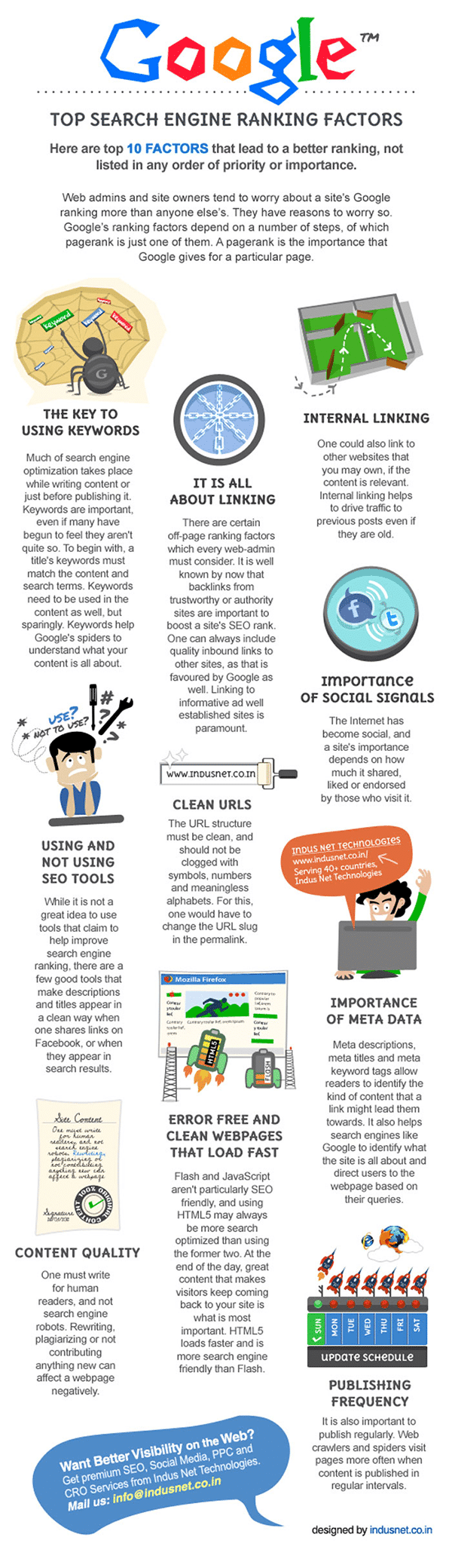
The infographic below from Indus Net gives you 10 of the most important and easy to manage SEO factors Google uses to rank a website.
1. High-Quality Content is King
It’s often said in the world of SEO that “Content is King,” and for good reason. Google’s algorithms have evolved to prioritize high-quality, relevant content that provides value to users. To master this SEO factor:
- Create original, informative, and engaging content.
- Use proper formatting with headings, bullet points, and images to enhance readability.
- Research and incorporate relevant keywords naturally.
Remember, your content should not only cater to search engines but also resonate with your target audience. Content that solves problems, answers questions, or educates your visitors tends to perform well.
2. Keyword Research and Optimization
Keywords are the foundation of SEO. Effective keyword research involves identifying the words and phrases that your target audience uses when searching for information related to your business or website. To optimize your content for keywords:
- Use tools like Google Keyword Planner or SEMrush to find relevant keywords.
- Focus on long-tail keywords for better targeting.
- Integrate keywords into your content, titles, meta descriptions, and headers.
- Avoid keyword stuffing; maintain a natural and user-friendly tone.
Keyword optimization helps Google understand the context of your content and improves your chances of ranking higher for relevant search queries.
3. Mobile-Friendly Design
Mobile devices now account for a significant portion of web traffic. Google has adapted to this trend by prioritizing mobile-friendly websites in its search results. To ensure your site is mobile-friendly:
- Use responsive web design to make your site adaptable to different screen sizes.
- Optimize images and other media for quick loading on mobile devices.
- Test your site’s mobile-friendliness using tools like Google’s Mobile-Friendly Test.
A mobile-friendly design not only improves your SEO but also enhances the user experience, which can lead to higher engagement and conversion rates.
4. Page Speed Matters
Google considers page speed as a ranking factor because it directly impacts user experience. Slow-loading pages can frustrate visitors and result in higher bounce rates. To optimize your website’s speed:
- Compress images and other media files to reduce their size.
- Minimize HTTP requests by reducing unnecessary scripts and plugins.
- Use content delivery networks (CDNs) to distribute content geographically.
- Leverage browser caching to store frequently accessed resources locally.
Faster-loading pages not only please Google’s algorithms but also improve your website’s overall usability.
5. On-Page SEO Elements
On-page SEO involves optimizing individual web pages to improve their search engine ranking. Key on-page SEO elements include:
- Title tags: Use descriptive and keyword-rich titles for each page.
- Meta descriptions: Craft compelling meta descriptions to entice users to click.
- Headers (H1, H2, etc.): Organize content with clear and hierarchical headers.
- URL structure: Create clean and descriptive URLs for better user understanding.
- Internal linking: Link to other relevant pages within your website to improve navigation.
By paying attention to these on-page elements, you can signal to Google the relevance and quality of your content.
6. High-Quality Backlinks
Backlinks, or incoming links from other websites to yours, are a significant ranking factor. However, not all backlinks are created equal. Google values high-quality, authoritative links over spammy or low-quality ones. To master this factor:
- Build relationships with other websites in your niche for potential collaborations.
- Create shareable content that others in your industry may want to link to.
- Monitor your backlink profile using tools like Ahrefs or Moz to disavow harmful links.
Quality over quantity is the key when it comes to backlinks. A few authoritative backlinks can have a more significant impact than many low-quality ones.
7. User Experience (UX) Optimization
User experience is not only important for retaining visitors but also for SEO. Google considers user signals, such as bounce rate and time spent on site, when ranking pages. To optimize UX:
- Ensure your website is easy to navigate with a clear menu structure.
- Make sure your website is accessible to all users, including those with disabilities.
- Improve your website’s overall design and layout for a visually appealing experience.
- Optimize for mobile devices, as mentioned earlier.
By providing a positive user experience, you’ll likely see improvements in your SEO rankings as well.
8. Schema Markup and Structured Data
Schema markup is a code that you can add to your website to provide search engines with more information about your content. It helps search engines understand the context of your content, leading to enhanced search results like rich snippets, knowledge graphs, and more. Implementing schema markup can improve your click-through rates and overall SEO performance.
9. Local SEO Optimization
If you have a physical presence or serve a local audience, optimizing for local search is crucial. To improve your local SEO:
- Claim and optimize your Google My Business listing.
- Ensure consistent NAP (Name, Address, Phone number) information across the web.
- Encourage customer reviews and respond to them promptly.
- Create locally-focused content and target location-based keywords.
Local SEO can help you appear in the coveted local map pack and improve visibility for local search queries.
10. Regular Monitoring and Analysis
SEO is an ongoing process, and regular monitoring and analysis are essential to track your progress and make necessary adjustments. Utilize tools like Google Analytics and Google Search Console to:
- Track your website’s performance, including organic traffic, click-through rates, and rankings.
- Identify and address issues like broken links, crawl errors, or duplicate content.
- Analyze user behavior and adjust your content and strategies accordingly.
Regular audits and analysis help you stay on top of changes in search engine algorithms and evolving user trends.
In conclusion, mastering these 10 SEO factors can significantly improve your website’s ranking on Google. Remember that SEO is not a one-time task but an ongoing effort. Keep up with industry trends, algorithm updates, and user preferences to ensure your website continues to perform well in search results. By staying committed to these SEO practices, you can achieve higher rankings, increased organic traffic, and ultimately, greater online success.

Author:
Mark Ford