Are you looking for ways to grab people’s attention online? Want to create a marketing story that compels followers and visitors into action?
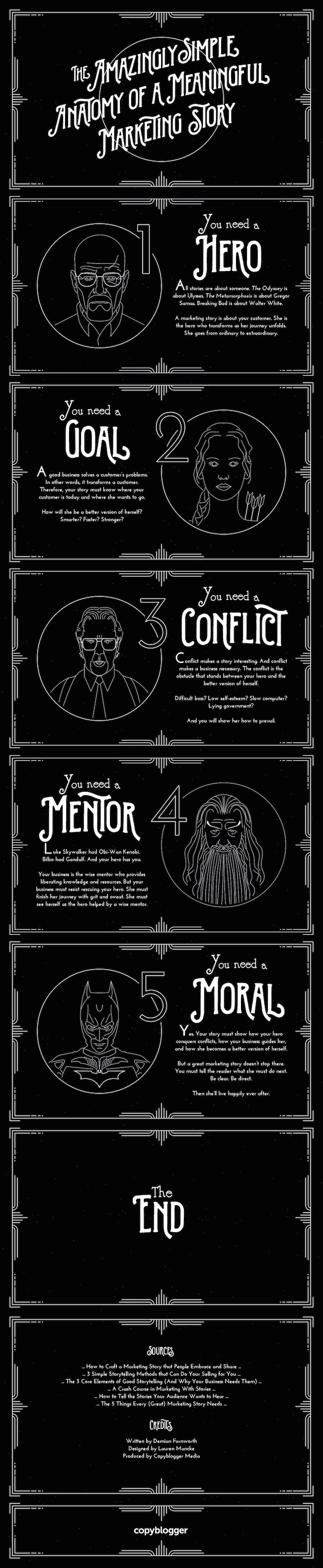
Copyblogger share their tips for success in this infographic.
Here’s a quick summary:
- You need a hero
- You need a goal
- You need a conflict
- You need a mentor
- You need a moral
Check out the infographic for more detail.
Storytelling is the backbone of marketing. It’s how you captivate audiences, connect on an emotional level, and stand out in a sea of noise. A meaningful marketing story goes beyond products or services; it tells a tale that resonates with people’s needs, dreams, and values. Here’s how to craft such a story in five compelling steps.
You Need a Hero
When it comes to marketing, one of the most powerful tools at your disposal is storytelling. But a story is only as strong as its hero. In the context of marketing, your hero isn’t your product or brand—it’s your customer. The hero is the central character of your marketing story who represents the aspirations, struggles, and dreams of your target audience. This hero drives the story forward and creates an emotional connection that captivates your audience.
For small businesses, understanding how to craft the right hero for your marketing story is crucial. It’s not just about selling a product; it’s about positioning your brand as the solution to your customer’s challenges and the vehicle for their transformation. Here’s a deeper look at how you can build a compelling hero in your marketing narrative.
- Understand Your Target Audience
The first step in creating a hero that resonates with your audience is understanding who they are. Your hero is a reflection of your ideal customer, so you need to know what they want, what they struggle with, and what motivates them.
Start by building detailed customer personas. These are semi-fictional representations of your ideal customers based on research and real data about your existing customers. Consider factors such as:
- Demographics: Age, gender, location, income, job title, etc.
- Psychographics: Values, interests, and lifestyle choices.
- Pain points: What problems are they trying to solve?
- Aspirations: What are their long-term goals or dreams?
- Buying behavior: What factors influence their purchasing decisions?
The more granular and specific you get, the better you can tailor your hero to reflect these characteristics.
For example, if you’re a small business selling eco-friendly cleaning products, your hero might be a parent who values sustainability but struggles to find cleaning solutions that are both effective and environmentally friendly. Understanding this customer profile will allow you to craft a hero who feels real and relatable to your audience.
- Make the Hero Relatable
Your hero must reflect your audience’s struggles, dreams, and desires. If the hero is too distant or doesn’t face challenges similar to those your audience experiences, they won’t be able to relate to the story.
The key is to humanize your hero. They need to represent someone your audience sees themselves in—someone who shares their frustrations and aspirations. The hero should have traits, behaviors, and goals that mirror those of your target customer. This builds empathy, which is crucial in establishing a deeper connection.
For instance, if your business offers a time-saving app for small business owners, your hero might be an overworked entrepreneur who is juggling too many responsibilities. Showcasing this character’s struggles—such as missed deadlines or feeling overwhelmed—will make your audience empathize with them. When your customers see themselves in the hero, they’ll feel more personally invested in your product or service.
- Define the Hero’s Motivation
What drives your hero? Every character has motivations, and understanding what makes your hero tick is essential for your story’s success. These motivations should align with your target audience’s desires, fears, or frustrations.
For example, if your business provides a productivity tool for freelancers, the hero’s motivation could be the need to work more efficiently to have more free time for personal life or to grow their business. The hero’s goal might not be just about productivity—it could also be about achieving a better work-life balance or gaining more control over their career.
Understanding your hero’s motivation gives your marketing story direction. It helps to create a narrative that resonates with your audience, as they can see that your product or service is the key to unlocking that motivation.
- Position Your Brand as the Enabler
Once you’ve established who the hero is, their struggles, and their motivation, it’s time to introduce your brand as the solution. Your product or service should be framed as a catalyst that enables the hero to reach their goal, overcome challenges, or transform their situation.
In great stories, the hero doesn’t just achieve their goal through their own efforts alone—they need some form of help or guidance. This is where your brand steps in. Position yourself as the mentor or enabler who provides the hero with the tools, support, and resources they need to succeed.
For example, a small business that sells software for managing finances can position itself as a mentor to the hero—a small business owner who struggles to track expenses and manage cash flow. The software can be the tool that helps the hero gain control over their finances and reach their goals of financial stability and growth.
Remember that your brand shouldn’t dominate the story. The focus should remain on the hero and their journey. Your product or service should play a supporting role, helping the hero achieve their goals and, in turn, benefiting the audience who relates to them.
- Evolve the Hero
Great heroes evolve over the course of the story. At the beginning, they may face challenges, but through their journey, they learn, grow, and overcome those obstacles. This evolution mirrors the transformation that your customers will experience when they engage with your product or service.
For small businesses, this means showing how your product or service leads to a positive change in the hero’s life. This could be a tangible result, like achieving a business goal, or an emotional shift, such as gaining confidence or finding peace of mind. By showing the hero’s transformation, you help your audience visualize their own potential change.
The evolution of the hero is not only about the end result but also about the process—the journey they undertake to get there. This journey should feel real and attainable, reinforcing the idea that your product or service will be instrumental in helping the audience achieve similar success.
- Use Authentic Storytelling
To make your hero truly resonate with your audience, authenticity is key. People can spot a fake story from a mile away, so be sure to keep your storytelling genuine and relatable. The hero’s struggles, motivations, and journey should feel real to your audience.
For small businesses, authenticity means avoiding overly polished or exaggerated portrayals. Share real stories from your customers or create personas based on real-life situations. Testimonials, case studies, or user-generated content are powerful tools that can help build credibility and make your hero feel more genuine.
Instead of presenting a “perfect” hero who has everything together, show the vulnerability and imperfections that make them human. When the hero experiences setbacks, doubts, or failures along their journey, it reinforces the message that success is a process and that your brand is there to help every step of the way.
Conclusion
Creating a compelling hero in your marketing story is all about understanding your audience and positioning them as the center of your narrative. By making the hero relatable, authentic, and motivated by clear goals, you create a character that your audience can connect with on a personal level. Remember, the hero’s journey isn’t just about achieving a goal; it’s about transformation, growth, and overcoming obstacles—something your product or service can help them do.
As a small business, the most important thing is to avoid focusing solely on your brand as the hero. Instead, use your brand as the catalyst that enables your customers to overcome their challenges and achieve their own success. By making your customers the hero, you build an emotional connection that goes beyond mere transactions and fosters lasting loyalty.
You Need a Goal
In every great story, the hero isn’t just wandering aimlessly—they are on a quest, pursuing a clear goal. Similarly, your marketing story needs a well-defined goal. Without it, your efforts will lack direction, and your audience won’t know what to rally behind or what’s at stake. Having a goal gives structure to your narrative, provides a reason for your hero’s journey, and helps your audience understand the value of your product or service in achieving that goal.
For small businesses, establishing a strong marketing goal is vital for creating a cohesive, effective strategy. A goal not only helps to guide your story, but it also aligns your marketing efforts, making them measurable and purposeful. Here’s a deep dive into how you can define and communicate a goal that resonates with your audience.
- Identify Your Business Objective
The first step in establishing a goal for your marketing story is to define your business objectives. Your marketing goal should align with these larger business objectives. Think about what you want your business to achieve in the short and long term, then translate those goals into a marketing context.
Some common business objectives might include:
- Brand awareness: Do you want to increase visibility and get your name out there?
- Lead generation: Is your goal to generate more qualified leads for your sales funnel?
- Sales growth: Are you focused on driving conversions and increasing sales?
- Customer retention: Is your goal to build customer loyalty and repeat purchases?
- Market expansion: Do you want to break into new markets or target different customer segments?
For example, if your small business is launching a new product, your goal might be to build awareness and educate your audience about the product’s unique features. Alternatively, if you’re trying to grow your customer base, your goal might be to increase leads through targeted content or promotional offers.
Once you have a clear business objective in mind, the next step is to translate it into a measurable marketing goal.
- Make Your Goal SMART
A great marketing goal is not just a wish—it’s something that can be actively worked toward and measured. One of the most effective frameworks for goal-setting is the SMART method, which stands for:
- Specific: The goal should be clear and well-defined.
- Measurable: You should be able to track your progress and measure success.
- Achievable: The goal should be realistic and attainable given your resources.
- Relevant: The goal should align with your broader business objectives.
- Time-bound: The goal should have a deadline or timeframe for completion.
For example, instead of setting a vague goal like “increase sales,” a SMART goal would be “Increase online sales by 20% in the next 6 months by targeting new customers through a social media campaign.” This goal is specific (increase online sales), measurable (by 20%), achievable (with the right campaign), relevant (aligned with sales growth objectives), and time-bound (to be achieved in 6 months).
The SMART framework helps you ensure your goal is both realistic and impactful, giving you a clear target to aim for. By breaking down your marketing goal into actionable steps, you can create a marketing plan that is strategic and effective.
- Align the Goal with Your Audience’s Needs
For your marketing goal to be effective, it should be closely tied to the needs and desires of your target audience. If your goal is to increase sales, for example, you need to understand what drives your customers to purchase. Why would they be interested in your product or service? What specific problem does it solve for them?
Think about how your product or service can help the hero of your story—your customer—achieve their own goals. The goal of your marketing campaign should center on addressing their needs and making their journey easier or more rewarding.
For instance, if your business sells software for small businesses, your marketing goal might be to increase sign-ups for a free trial by emphasizing how your software can help small business owners save time and reduce operational costs. In this case, your goal (getting more sign-ups) is tightly connected to your audience’s needs (time and cost savings). By positioning your product as a means to achieve the customer’s desired outcome, you show how your goal aligns with their own.
- Build a Narrative Around the Goal
In the context of storytelling, the goal is what drives the entire narrative forward. The hero (your customer) has a goal, and everything that happens in the story revolves around achieving it. In your marketing, the goal should not be a dry, transactional objective— it should be woven into the narrative in a way that builds excitement and engagement.
Instead of simply stating your goal—“We want to increase sales”—craft a compelling story around it. Show your audience why achieving this goal matters and how your brand plays a pivotal role in helping them get there.
For example, if your goal is to drive more traffic to your website, you could frame it as a journey where your customers are looking for the perfect solution to a specific problem. Along the way, they encounter your brand, which offers them the right tools, resources, or information to solve their problem. By incorporating your goal into a story, you make it more engaging and relatable.
Your marketing should communicate the significance of the goal through the lens of your customer’s experience, showing how your product or service helps them reach their destination or achieve a transformation.
- Break the Goal into Smaller Milestones
A single overarching goal can feel overwhelming, both for your team and your audience. Breaking that goal into smaller, achievable milestones makes it more manageable and gives you clear markers of progress along the way.
For example, if your goal is to grow your email list by 1,000 new subscribers over the next 6 months, you can break that goal down into smaller steps. Perhaps your first milestone is to attract 200 new subscribers in the first month through a targeted lead magnet campaign, followed by another 300 subscribers in the second month through a referral program. By setting incremental targets, you can keep your audience and your team motivated and focused.
As your business reaches each milestone, communicate those successes to your audience. Sharing progress creates a sense of accomplishment and builds momentum, making your goal feel achievable.
- Evaluate the Goal’s Impact
Once you’ve defined and pursued your goal, it’s important to evaluate its impact. Did you achieve what you set out to do? Did your marketing efforts help move the needle on your business objectives?
Measuring the success of your goal can be done in various ways, depending on the goal you’ve set. Key performance indicators (KPIs) such as website traffic, conversion rates, lead generation, or sales figures can help you determine if your efforts were effective.
Moreover, it’s crucial to assess whether the goal was aligned with your audience’s needs and whether it helped build long-term relationships with customers. For instance, if your goal was to increase brand awareness, track metrics such as social media engagement, mentions, and shares to evaluate whether your messaging resonated with your target audience.
Regularly evaluating and refining your goals will ensure that your marketing efforts remain relevant, focused, and results-driven.
Conclusion
A marketing goal is the guiding force behind your story. It provides your efforts with direction, purpose, and relevance. For small businesses, defining a clear and measurable goal that aligns with business objectives, addresses audience needs, and builds an engaging narrative is crucial for success.
A well-defined goal not only provides clarity but also creates a sense of achievement as you work toward and ultimately reach it. By breaking down your goals into smaller milestones and evaluating their impact, you can ensure that your marketing story resonates with your audience and drives meaningful results for your business.
You Need a Conflict
In every compelling story, conflict is the engine that drives the plot forward. It’s the challenge or obstacle that the hero must overcome to achieve their goal. Without conflict, the story feels stagnant, and the hero’s journey loses its emotional weight. The same principle applies to your marketing narrative. For your brand’s story to truly resonate with your audience, there needs to be a conflict—something that stands in the way of your customer’s success or happiness. This conflict is the problem your audience faces, and your product or service should be positioned as the solution.
For small businesses, creating an effective conflict is essential for engaging your audience and motivating them to take action. A well-crafted conflict creates empathy, highlights the value of your offering, and drives customer engagement. Let’s explore how you can develop a conflict that enhances your marketing strategy and makes your story more relatable and compelling.
- Identify the Problem Your Customer Faces
The conflict in your marketing story revolves around the problem that your customer is struggling with. To create a powerful conflict, you first need to understand the pain points and challenges your target audience faces. What are they trying to achieve, and what obstacles stand in their way?
Start by putting yourself in your customer’s shoes. Think about their day-to-day struggles, frustrations, and unmet needs. This could range from issues like financial constraints, lack of time, overwhelming choices, or complex decision-making processes. The more specific you are in identifying these pain points, the more your audience will connect with the story.
For example, if you run a small business that offers a productivity app, the conflict might revolve around the common issue of time management. Your audience (small business owners or entrepreneurs) may feel overwhelmed with multiple tasks and struggle to stay organized. The conflict is the inefficiency and stress that come from disorganization and poor time management.
- Create Emotional Resonance
For conflict to truly resonate with your audience, it needs to evoke an emotional response. Emotions drive decision-making, and if your conflict taps into your audience’s fears, frustrations, or desires, it can compel them to act.
Consider the emotional triggers that your target audience experiences. What keeps them up at night? What are their deepest fears regarding their business or personal life? Your goal is to identify and highlight the emotions tied to their struggles. For example, a conflict centered on financial insecurity might evoke feelings of anxiety or fear. A conflict around time management could trigger stress and frustration.
By highlighting these emotions, you show your audience that you understand their situation and are empathetic to their pain. This makes your marketing more human and relatable. For instance, if your marketing campaign focuses on time management for small business owners, you could use language that emphasizes how chaotic and stressful it feels to juggle everything, tapping into those emotions to create a stronger connection with your audience.
- Position the Conflict as a Barrier to Their Goal
In storytelling, the conflict doesn’t just exist for the sake of drama—it’s a direct barrier to the hero’s goal. The same logic applies to your marketing narrative. The conflict should not only be a pain point but also a barrier standing in the way of the customer achieving their desired outcome. This makes the conflict more relevant and urgent.
Once you’ve identified the problem your customer faces, explain how it prevents them from achieving their ultimate goal. What would they be able to accomplish if they were able to overcome this obstacle? Positioning the conflict as a roadblock to their goal makes it more tangible and motivates your audience to seek out a solution.
For example, if your business provides financial planning services, the conflict might be the lack of understanding about how to save for retirement, which is preventing your customers from securing their financial future. This creates a clear, relatable obstacle that resonates with people who are worried about their long-term financial stability.
- Highlight the Consequences of Ignoring the Conflict
To further emphasize the urgency of resolving the conflict, make it clear what’s at stake if the problem is left unaddressed. What will happen if your audience doesn’t act? This can help create a sense of urgency, compelling your customers to take action.
The consequences of ignoring the conflict don’t need to be extreme, but they should be significant enough to motivate change. For instance, if your business sells eco-friendly cleaning products, the conflict might be the environmental harm caused by traditional cleaning supplies. The consequence of ignoring this conflict could be worsening pollution, harm to wildlife, or long-term environmental damage.
In your marketing message, use language that paints a picture of the negative consequences of not addressing the conflict. This doesn’t have to be fear-based, but rather focused on the cost of inaction. For example, “Ignoring this issue could mean more time wasted, more stress, and fewer opportunities to grow your business.”
- Offer Your Product or Service as the Solution
Once the conflict is established, your audience needs to see how your product or service will resolve it. This is where your brand becomes the hero’s ally, offering the tools or support needed to overcome the conflict and achieve the goal.
Your solution should be positioned as a clear and effective way to eliminate or reduce the problem your audience faces. But be careful—don’t just present your product as a generic fix. Instead, frame it as the key to overcoming the specific challenge or pain point that your audience is dealing with.
For example, if your marketing story centers around a productivity app and the conflict of poor time management, position the app as the solution that can streamline tasks, improve organization, and help customers manage their time effectively. Highlight how your product eliminates the stress of disorganization and helps the customer get closer to their goals—whether it’s running a successful business or achieving a better work-life balance.
- Use Real-Life Examples and Testimonials
One of the most effective ways to reinforce the conflict and your solution is by showing real-life examples. Case studies, testimonials, and customer stories help humanize the conflict and demonstrate that others have experienced it too.
Sharing stories of customers who have faced the same conflict and successfully resolved it with your product creates social proof and builds trust. When potential customers see that your product has worked for others in similar situations, it reinforces the idea that your solution is both effective and trustworthy.
For example, if your conflict revolves around financial insecurity, a testimonial from a customer who struggled with budgeting and found success using your service can help paint a vivid picture of the journey from conflict to resolution.
- Keep the Conflict Relevant Throughout the Customer Journey
The conflict doesn’t just need to be established at the beginning of your marketing narrative—it should remain relevant throughout the customer journey. As you nurture relationships with leads and customers, continue to remind them of the conflict they are facing and reinforce how your solution helps address it.
For example, during the awareness stage of your marketing, you might introduce the conflict and highlight how it stands in the way of your audience’s goals. As leads move through the consideration stage, you can continue to remind them of the conflict while showcasing how your solution is the best way to overcome it. Finally, during the decision stage, emphasize the consequences of ignoring the conflict and reinforce the value of your product or service as the best option to achieve success.
Conclusion
The conflict in your marketing story is essential for creating engagement and driving action. By identifying a problem your customer faces, highlighting the emotional resonance of that issue, and framing it as a barrier to their goal, you set the stage for a powerful narrative.
Position your product or service as the solution to that conflict, and don’t be afraid to share real-life examples to strengthen your message. By weaving conflict into your marketing story, you create a compelling reason for your audience to care about your offering, making your brand the hero that helps them overcome their obstacles and reach their goals.
You Need a Mentor
In any great story, a mentor plays a pivotal role in helping the hero navigate challenges, providing wisdom, guidance, and the tools necessary for success. In marketing, your brand can take on the role of this mentor, offering valuable insights and solutions to guide your customers through their own challenges and towards achieving their goals. By positioning your business as a mentor, you build trust and authority, which strengthens your relationship with your audience and helps position your product or service as the key to overcoming their struggles.
For small businesses, embracing the role of a mentor in your marketing story can be incredibly powerful. It allows you to go beyond simply selling a product or service, and instead, become a trusted ally that helps customers achieve their dreams. Let’s explore how you can effectively position your business as a mentor in your marketing story and guide your customers on their journey.
- Understand Your Audience’s Needs and Aspirations
The first step to becoming a mentor in your marketing story is to deeply understand your audience’s needs, struggles, and aspirations. As a mentor, you’re not just offering a solution to a problem—you’re also helping your audience reach their full potential. To do this effectively, you need to know what motivates them, what challenges they face, and what their goals are.
Start by conducting research and engaging with your audience to gather insights. Surveys, social media interactions, and customer feedback can reveal what your audience cares about most. Additionally, consider the emotional drivers behind their decisions. Are they motivated by a desire for financial freedom? A passion for achieving personal growth? Or perhaps a drive to make their business more successful?
By understanding their core motivations, you can position your brand as a mentor that not only solves their problems but also supports them in reaching their greater aspirations. For example, if your business provides fitness coaching, understanding that your target audience is seeking not just weight loss but also a healthier, more fulfilling lifestyle helps you provide guidance on a deeper, more personal level.
- Offer Valuable Education and Resources
A mentor’s primary role is to educate and provide the necessary tools for growth. In your marketing story, this means offering valuable information and resources that empower your customers to succeed. The more knowledge and expertise you share, the more your audience will come to see you as a trusted guide.
Create educational content that helps your audience solve their problems and move closer to their goals. This can come in the form of blog posts, how-to videos, tutorials, downloadable resources, or webinars. The key is to focus on delivering real value without expecting immediate sales in return. By prioritizing education and providing solutions, you position your business as a helpful resource and demonstrate your authority in your field.
For example, if your small business offers marketing consulting, you might create a blog series that provides actionable tips on building a digital marketing strategy, crafting compelling content, or optimizing website performance. You could also host webinars where you dive deeper into marketing trends, offering actionable insights and strategies. By sharing your expertise, you build credibility and foster a sense of trust with your audience.
- Show Empathy and Relatability
A great mentor understands the emotions and struggles of the people they mentor. They don’t just offer advice—they listen, empathize, and relate to the challenges their mentees face. For your business, this means connecting with your audience on an emotional level, demonstrating that you understand their pain points, and showing empathy for their journey.
When positioning your brand as a mentor, make sure your messaging conveys that you recognize the difficulties your audience is going through. Share stories, testimonials, and case studies that reflect the struggles your customers face and how your product or service helped others overcome similar obstacles. This helps your audience see that they’re not alone in their challenges and that your business genuinely cares about their success.
For example, a brand that offers mental health support might share customer testimonials that discuss their struggles with anxiety or depression and how the product or service helped them take positive steps toward improvement. By sharing these real stories, the brand not only shows empathy but also helps its audience feel understood and supported.
- Be a Guide, Not Just a Seller
To truly step into the role of a mentor, it’s important to focus less on selling and more on guiding your audience through their journey. This means shifting your focus from pushing a product or service to helping your audience achieve their goals with your expertise.
Instead of leading with a hard sales pitch, guide your audience by providing the resources, tools, and advice they need to succeed. The more you help them without expecting something in return, the more likely they’ll turn to your brand when they’re ready to make a purchase. Think of it as building a relationship rather than just making a transaction.
For example, if you offer a software solution, instead of simply promoting the software’s features, you could offer a series of tutorials, training programs, or expert advice on how businesses can streamline their processes or increase productivity. By positioning your brand as a guide, you foster trust, and the decision to purchase your software becomes a natural next step in their journey.
- Encourage Growth and Transformation
Mentors don’t just solve immediate problems—they encourage growth and transformation. As a mentor in your marketing story, you need to position your brand as an enabler of positive change. Your product or service should not just be the solution to a specific problem but a stepping stone to greater growth and success.
Help your customers see the broader impact of solving their problems. How will their life or business be different once they’ve overcome the conflict and achieved their goal? Paint a picture of the transformation they’ll experience by using your product or service, and make it clear how this change will positively affect their future.
For instance, if you run a business that offers business coaching, don’t just focus on helping your clients reach a specific financial goal. Highlight how your coaching will help them develop essential leadership skills, grow their confidence, and create sustainable success for the long term. This broader perspective positions your brand as a mentor that is not only focused on immediate results but also on the overall growth and transformation of your clients.
- Lead by Example
Great mentors lead by example, demonstrating the behaviors and attitudes they encourage in others. As a business, you should showcase the values and principles you advocate for through your actions and marketing practices.
This might mean leading with transparency, demonstrating excellent customer service, or showing your commitment to quality. If your business is dedicated to sustainability, for example, lead by example by incorporating environmentally friendly practices into your operations and communicating your commitment to sustainability in your marketing efforts. This helps reinforce your role as a mentor who practices what they preach and inspires others to follow suit.
For example, a sustainable fashion brand could lead by example by ensuring all their products are ethically made, using eco-friendly materials, and supporting fair labor practices. Through marketing campaigns, the brand can share the story of how they got started, the challenges they’ve faced, and how they’ve managed to stay true to their values. This shows your audience that your brand isn’t just offering advice—it’s walking the talk.
- Build a Community of Learners
Mentorship is often most effective when it happens within a supportive community. As a business, you can foster this sense of community by creating spaces where your audience can interact, share their experiences, and support each other.
Consider building online forums, social media groups, or even live events where your customers can connect, share their journeys, and learn from each other. By facilitating peer-to-peer learning and creating a space where your audience can share their success stories, you further solidify your role as a mentor and build deeper relationships with your customers.
For instance, a business that offers coaching or consulting services could create a private Facebook group where clients share their experiences, ask questions, and exchange insights. By being part of the conversation and providing additional guidance when needed, you deepen your connection with your audience and reinforce your role as a trusted mentor.
Conclusion
Positioning your brand as a mentor in your marketing story is a powerful way to build trust, engage your audience, and ultimately drive sales. By offering valuable education, demonstrating empathy, guiding your customers through their journey, and encouraging their growth, you establish your brand as a source of support and wisdom.
Small businesses have a unique opportunity to create meaningful relationships with their audience by embracing the mentor role. By doing so, you not only help your customers achieve their goals but also position your product or service as the key to their success. With these strategies, you can guide your customers to a brighter future while building a lasting, loyal customer base.
You Need a Moral
In every compelling story, the moral is the core lesson or message that resonates with the audience long after the narrative ends. It’s the deeper truth or guiding principle that shapes the journey of the hero and offers value to those who hear the story. For small businesses, the “moral” of your marketing story is not just about promoting your product or service—it’s about conveying a message that speaks to the heart of your customers’ needs and values. The moral serves as the foundation for your brand’s purpose and guides the way you communicate with your audience.
Incorporating a moral into your marketing strategy not only gives your brand meaning but also fosters a deeper connection with your audience. It aligns your messaging with the values that matter to your customers, helping to establish your brand as one they can trust, support, and advocate for. Let’s dive into why having a moral in your marketing story is crucial and explore how small businesses can effectively develop and communicate their brand’s moral.
- Define Your Brand’s Core Values
The first step in establishing a moral in your marketing story is to identify your brand’s core values. These values are the principles that guide every decision you make, from the way you interact with customers to the products or services you offer. Your moral should reflect these values, providing a clear and consistent message that resonates with your audience.
Start by asking yourself: What does your brand stand for? What do you want your customers to believe in when they think of your business? These values might include sustainability, innovation, quality, customer empowerment, or social responsibility. Your moral should align with the bigger purpose of your business and what you ultimately hope to achieve beyond profit.
For example, if your small business focuses on eco-friendly products, your moral might center around sustainability and the importance of protecting the planet. If your company is committed to providing fair labor practices, your moral might revolve around ethical sourcing and ensuring that workers are treated with respect. By defining your brand’s values and incorporating them into your marketing story, you give your audience something meaningful to connect with.
- Craft a Moral That Resonates with Your Audience’s Values
Once you’ve identified your brand’s core values, you need to craft a moral that resonates with your target audience’s values and needs. The moral of your story should not only reflect your business’s mission but also speak to the desires, challenges, and aspirations of your customers.
Think about what your audience cares about. What are their pain points, and how does your product or service help address these issues? If your audience is passionate about wellness, for example, your moral might highlight the importance of self-care and personal health. If they value convenience and time-saving, your moral might focus on how your product or service simplifies their life.
Understanding your audience’s values is essential to creating a moral that feels authentic and impactful. A moral that aligns with both your brand’s values and your customers’ needs builds a sense of connection and trust, encouraging them to take action.
- Make the Moral Relatable and Authentic
The moral of your marketing story must feel authentic and relatable. If it seems forced or disconnected from your audience’s reality, it will fail to create the impact you’re aiming for. Your customers want to connect with a brand that feels human and genuine, not one that simply repeats empty slogans or buzzwords.
To ensure authenticity, focus on real-world examples and stories that showcase how your brand’s moral plays out in practice. This could involve sharing customer testimonials, case studies, or behind-the-scenes looks at how your business operates in line with your values. Let your audience see that the moral isn’t just a marketing tactic—it’s an integral part of who you are as a business.
For instance, if your moral is about creating a more inclusive society, you might showcase how your business actively promotes diversity in hiring practices or supports underrepresented communities through partnerships or charitable contributions. By demonstrating that your moral is reflected in your actions, you enhance your brand’s credibility and build a deeper connection with your audience.
- Align Your Marketing with Your Moral
Once you’ve defined and crafted your moral, it’s crucial to align every aspect of your marketing with that message. Your moral should be at the core of your brand’s voice, tone, and content. This consistency is key to ensuring that your audience understands and connects with the values you’re promoting.
Here are some ways to integrate your moral into your marketing strategy:
- Messaging: Ensure that your brand’s moral is consistently communicated in your messaging, whether it’s through advertising campaigns, social media posts, website copy, or email marketing. Use language that reflects the values behind your moral, and make sure that your messaging is clear and aligned with your audience’s expectations.
- Content Marketing: Create content that supports and reinforces your moral. For example, if your moral is about empowerment, you could produce blog posts, videos, or podcasts that provide educational resources or success stories that inspire your audience to take action. Highlight the journey of real people who have been positively impacted by your product or service, showcasing how they’ve overcome challenges and achieved their goals.
- Product Packaging and Design: Even the design and packaging of your products can reflect the moral of your brand. For instance, if sustainability is a core value, use eco-friendly materials, and clearly communicate your commitment to the environment on your packaging. If supporting local artisans is important to your business, showcase their stories and craftsmanship on your product labels.
By aligning your marketing efforts with your brand’s moral, you reinforce your message and demonstrate that your commitment to your values goes beyond just a catchy slogan—it’s woven into the very fabric of your business.
- Show the Impact of Your Moral
To make your moral more powerful, show how it has a tangible impact on your customers and the world around you. The moral of your marketing story should not just be about what your brand believes; it should be about the positive change that your brand brings to your customers and their communities.
For example, if your brand’s moral is about promoting mental health awareness, show how your product or service has helped customers improve their mental well-being. Share testimonials or success stories that highlight the real-life impact your business has had on individuals’ lives. You could also partner with mental health organizations to further demonstrate your commitment to the cause.
Showing the impact of your moral not only strengthens your brand’s credibility but also encourages your audience to become part of the story. When customers feel that they are contributing to a larger purpose through their purchase, they are more likely to become loyal advocates for your brand.
- Inspire Action Through Your Moral
A well-crafted moral in your marketing story should inspire action—whether that means purchasing your product, sharing your content, or getting involved in your cause. It’s not enough to simply communicate your moral; you need to motivate your audience to take the next step toward making a positive impact.
Consider including a clear call to action that encourages your audience to engage with your brand in a meaningful way. This could be signing up for a newsletter, donating to a cause your business supports, or sharing a message with their own network. By providing a clear path for action, you empower your customers to join you in creating change.
For example, if your business is focused on environmental sustainability, you might encourage your customers to reduce their carbon footprint or take part in a local environmental initiative. By connecting your moral with an actionable step, you help your audience feel that they are part of something larger than just a transaction.
Conclusion
Having a moral in your marketing story is essential for creating a meaningful and lasting connection with your audience. It reflects your brand’s values, aligns your messaging with the needs and desires of your customers, and provides a purpose that goes beyond selling a product or service. By defining your brand’s core values, crafting a relatable and authentic moral, aligning your marketing with that moral, and inspiring action, you can create a powerful marketing narrative that resonates with your audience and builds a loyal customer base.
Small businesses have a unique opportunity to weave purpose and meaning into their marketing stories. By making the moral a central part of your brand’s message, you not only differentiate your business from the competition but also create a deeper, more impactful relationship with your customers.

Author:
Mark Ford