
What SEO tactics are you using to improve your ranking on Google? Could they be doing your site more harm than good?
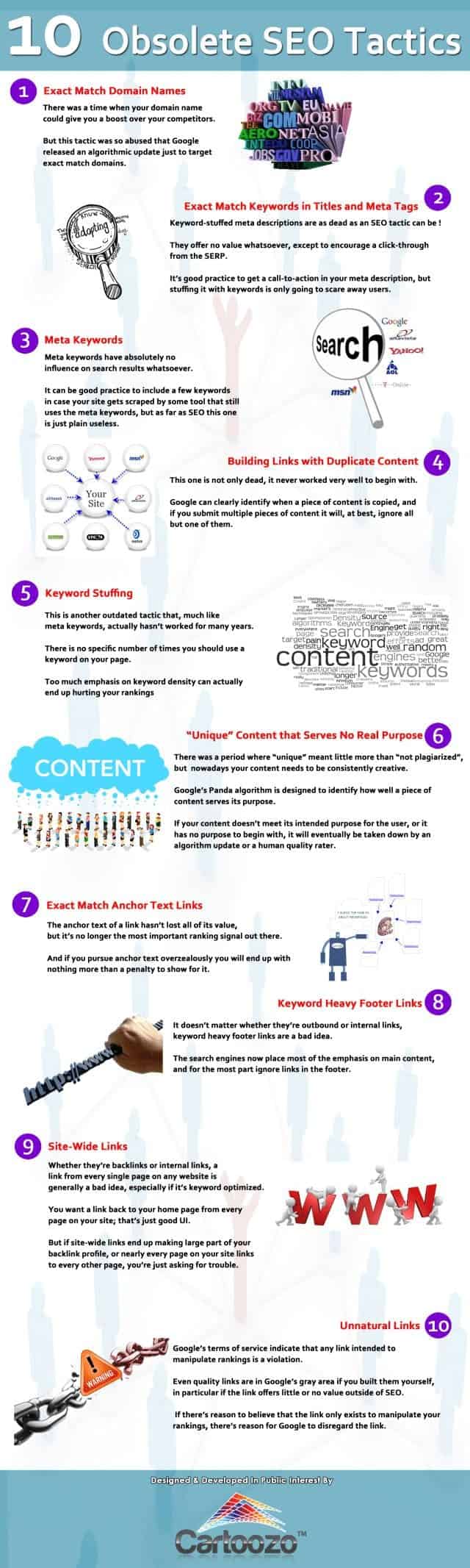
Cartoozo share 10 obsolete SEO tactics you should stop using in this infographic.
Here’s a quick summary:
- Exact match domain names
- Exact match keywords in titles and meta tags
- Meta keywords
- Building links with duplicate content
- Keyword stuffing
- “Unique” content that serves no real purpose
- Exact match anchor text links
- Keyword heavy footer links
- Site-wide links
- Unnatural links
Check out the infographic for more detail.
The world of search engine optimization (SEO) is ever-evolving, and tactics that once promised high rankings and increased traffic can quickly become obsolete. Worse yet, some practices that were once commonplace can now result in penalties from search engines, causing your site to plummet in rankings.
It’s crucial to stay updated on best practices and avoid outdated or harmful SEO strategies. Here are ten SEO tactics you should stop using immediately to ensure your website remains compliant with search engine guidelines and maintains a healthy ranking.
Exact Match Domain Names
Exact match domain names (EMDs) were once a powerful tool in the SEO arsenal. The concept is straightforward: by incorporating a keyword directly into your domain name, you could ostensibly improve your website’s visibility for that keyword.
For example, if a user searched for “best Italian restaurant New York,” a domain like “bestitalianrestaurantnewyork.com” would theoretically rank higher due to the exact match.
However, Google’s algorithm updates, particularly the EMD update in 2012, significantly devalued the importance of EMDs. This change was part of a broader effort to prioritize high-quality, relevant content over manipulative SEO tactics. While EMDs still hold some value, they are no longer the surefire ranking factor they once were.
Instead, search engines focus more on the overall quality, relevance, and authority of the content a site provides.
Why Exact Match Domain Names Are Less Effective Now
- Algorithm Changes: Google’s EMD update specifically targeted low-quality sites that relied solely on their domain name to rank. Sites with EMDs that also provided valuable content were less affected, but those that were thin on content and rich in keywords saw a decline in rankings.
- User Experience: Modern SEO places a significant emphasis on user experience. A domain name stuffed with keywords can seem spammy and less trustworthy to users. It’s more effective to have a memorable and brandable domain name that users can easily recall and associate with quality.
- Brand Building: EMDs often limit brand potential. For instance, a domain like “cheaplaptops.com” restricts the perception of your brand solely to cheap laptops. As your business evolves, you may want to offer a wider range of products or services that the domain name no longer accurately represents.
Effective Domain Strategies for Small Businesses
Given the reduced importance of EMDs, small businesses should focus on creating a strong brand presence through a well-thought-out domain name that aligns with their business goals and values. Here are some in-depth tips and guidance:
- Brandability: Choose a domain name that reflects your brand identity. It should be unique, easy to remember, and spell. A brandable domain can help establish trust and recognition with your audience. For example, “TechSavvy.com” is more brandable and memorable than “BestCheapTechLaptops.com”.
- Relevance: While exact match isn’t necessary, your domain should still be relevant to your business. A name that hints at what you do can help users understand your business at a glance. For instance, “GreenThumbGardens.com” for a gardening business is both brandable and relevant.
- Simplicity: Avoid complex and lengthy domain names. Simple and concise names are easier to remember and type. This reduces the likelihood of errors and improves user experience. For example, “PetCareHub.com” is straightforward and easy to type.
- Avoid Numbers and Hyphens: Numbers and hyphens can be confusing and are often associated with spammy websites. They can also be hard to communicate verbally. Stick to words and keep it clean. For example, “HealthyEats.com” is preferable to “Healthy-Eats-123.com”.
- Think Long-Term: Consider the future growth and diversification of your business. Choose a domain name that can grow with your business and doesn’t box you into a specific niche. For instance, “UrbanFoods.com” offers flexibility for expanding into various food-related products and services.
- Check for Trademarks and Social Media Availability: Before finalizing your domain name, ensure it’s not trademarked by another entity. Also, check the availability of the name on social media platforms to maintain consistency across your online presence. Tools like KnowEm can help with this process.
- Use Keywords Wisely: While EMDs are not as crucial, having a keyword in your domain can still be beneficial if it fits naturally and isn’t forced. For example, “OrganicHarvestMarket.com” uses relevant keywords but remains brandable and natural.
Building a Strong Online Presence Beyond the Domain Name
- High-Quality Content: Focus on creating valuable, engaging content that addresses the needs and interests of your audience. Quality content attracts backlinks, improves user engagement, and signals to search engines that your site is authoritative and relevant.
- User Experience: Ensure your website is user-friendly, with intuitive navigation, fast loading times, and mobile responsiveness. A positive user experience can lead to higher engagement and better rankings.
- Local SEO: For small businesses, local SEO is crucial. Optimize your site for local searches by including your business’s location in your content, meta tags, and even your domain name if appropriate. For example, “DenverTechRepair.com” is a good domain for a local tech repair shop.
- Social Proof and Reviews: Encourage satisfied customers to leave positive reviews on platforms like Google My Business, Yelp, and social media. Positive reviews build trust and can improve local SEO rankings.
- Social Media Engagement: Actively engage with your audience on social media. Share valuable content, respond to comments and messages, and build a community around your brand. Consistent branding across your website and social media channels reinforces your online presence.
- Analytics and Adaptation: Use tools like Google Analytics and Search Console to monitor your website’s performance. Analyze the data to understand what’s working and what’s not, and be ready to adapt your strategy accordingly.
Summary
While exact match domain names are not as influential in SEO as they once were, choosing the right domain name is still a critical decision for your business.
By focusing on brandability, relevance, and simplicity, you can create a strong foundation for your online presence. Coupled with high-quality content, a great user experience, and effective local SEO strategies, a well-chosen domain name can contribute significantly to your business’s success.
For small businesses, the key is to look beyond the quick wins and invest in long-term strategies that build trust, authority, and engagement. By doing so, you’ll not only avoid the pitfalls of outdated SEO tactics but also create a resilient and thriving online presence.
Exact Match Keywords in Titles and Meta Tags
In the early days of SEO, exact match keywords in titles and meta tags were a dominant strategy. For instance, if a business aimed to rank for “best Italian restaurant New York,” the optimal practice was to use this exact phrase in the title and meta description.
However, search engines like Google have evolved. They now prioritize user experience and content relevance over rigid keyword matching. The focus has shifted from exact matches to the overall context and quality of the content.
Why Exact Match Keywords Are Less Effective
- Algorithm Sophistication: Modern algorithms understand synonyms, related phrases, and context. They can infer that “top Italian eatery in NYC” is related to “best Italian restaurant New York.” This semantic understanding reduces the need for exact matches.
- User Intent: Search engines now emphasize user intent. They aim to deliver results that best answer the user’s query, which means content quality and relevance take precedence over exact keyword placement.
- Avoiding Penalties: Overusing exact match keywords can lead to keyword stuffing, a practice penalized by search engines. This can harm your rankings and reduce the credibility of your site.
Effective Strategies for Optimizing Titles and Meta Tags
For small businesses, crafting titles and meta tags that balance keyword relevance with natural, engaging language is key. Here’s how to do it:
- Prioritize Natural Language: Your titles and meta descriptions should read naturally and appeal to users. Instead of forcing exact match keywords, use variations and related terms that convey the same meaning.
- Incorporate Keywords Strategically: While exact matches are less critical, including keywords naturally within your titles and meta descriptions is still important. Focus on primary keywords and incorporate them in a way that makes sense contextually.
- Create Compelling Titles: Your title tag is often the first thing users see in search results. Make it compelling and clickable. Use power words, numbers, and emotional triggers to entice users.
- Optimize Meta Descriptions for Click-Through Rates (CTR): Meta descriptions, while not a direct ranking factor, influence click-through rates. A well-written meta description can increase the likelihood of users clicking on your link.
- Use Synonyms and Related Phrases: Diversify your keyword usage by including synonyms and related phrases. This helps capture a broader range of search queries and avoids repetitive language.
- Local SEO Optimization: For small businesses, especially those with a local presence, incorporating location-specific keywords can be highly effective. Ensure your titles and meta descriptions reflect your local relevance.
- Length Matters: Keep your title tags under 60 characters and meta descriptions under 160 characters. This ensures they are fully displayed in search results, providing a complete snapshot to users.
- Highlight Unique Selling Points (USPs): Emphasize what sets your business apart. Mention unique features, awards, or standout menu items to attract clicks.
- Use Structured Data: Implement structured data (schema markup) to enhance your search listings with rich snippets. This can improve visibility and click-through rates by providing additional information like ratings, reviews, and business details directly in search results.
- Test and Refine: Continuously monitor the performance of your titles and meta descriptions. Use tools like Google Search Console to track changes in click-through rates and rankings. A/B test different versions to see what resonates most with your audience.
Summary
Optimizing titles and meta tags goes beyond exact match keywords. It involves crafting compelling, relevant, and user-friendly tags that naturally incorporate keywords while prioritizing user intent and engagement.
For small businesses, this approach not only improves search engine visibility but also enhances the overall user experience, leading to higher click-through rates and better search performance.
By focusing on these strategies, small businesses can effectively optimize their titles and meta tags, providing a significant boost to their SEO efforts and helping them stand out in competitive search landscapes. Remember, the goal is to attract and engage users, providing them with the information and experience they are seeking.
Meta Keywords
Meta keywords were once a fundamental component of SEO. In the early days of search engines, webmasters used meta keywords to signal the relevant topics and search terms for their web pages. By including a list of keywords in the meta tag, they aimed to improve their chances of ranking for those terms.
However, as search engine algorithms evolved, the reliance on meta keywords diminished due to widespread abuse and keyword stuffing.
By the mid-2000s, major search engines like Google and Bing had largely stopped using meta keywords as a ranking factor. They shifted their focus to more reliable indicators of relevance and quality, such as content, user experience, and backlinks.
Today, meta keywords are considered obsolete, and continuing to use them can be seen as an outdated practice.
Why Meta Keywords Are No Longer Relevant
- Abuse and Manipulation: Meta keywords were frequently abused by spammers who stuffed them with irrelevant or excessive keywords to manipulate search rankings. This led to a decline in their usefulness as a reliable signal for search engines.
- Algorithm Advancements: Search engines have developed more sophisticated algorithms that analyze content contextually. They can understand the meaning and relevance of content without needing meta keywords as a crutch.
- Focus on Quality and User Experience: Modern SEO emphasizes high-quality content and a positive user experience. Search engines prioritize pages that provide valuable information and meet user intent over those that simply list relevant keywords.
What to Focus on Instead of Meta Keywords
For small businesses, the shift away from meta keywords means focusing on other, more effective SEO strategies. Here are some in-depth tips and guidance:
- High-Quality Content Creation
- Relevance: Ensure your content is highly relevant to your target audience. Conduct thorough keyword research to understand what your potential customers are searching for and create content that addresses their needs and questions.
- Depth and Detail: Provide comprehensive and detailed information. Longer, in-depth articles tend to perform better in search rankings because they offer more value to users.
- On-Page SEO Optimization
- Title Tags: Craft compelling and descriptive title tags that naturally incorporate primary keywords. Make sure they accurately reflect the content of the page and are enticing to users.
- Meta Descriptions: Write engaging meta descriptions that summarize the page content and include a call to action. While meta descriptions are not a direct ranking factor, they influence click-through rates (CTR).
- Header Tags (H1, H2, H3, etc.): Use header tags to structure your content logically. This helps both search engines and users understand the hierarchy and main points of your content.
- Keyword Integration
- Natural Usage: Integrate keywords naturally into your content. Avoid keyword stuffing and ensure that keywords fit seamlessly into the text. Use variations and related terms to provide a more comprehensive understanding of the topic.
- Semantic Keywords: Use semantic keywords and related phrases to cover a broader range of search queries. Tools like Google’s Keyword Planner and SEMrush can help identify these terms.
- User Experience (UX) and Engagement
- Mobile-Friendliness: Ensure your website is mobile-friendly. With the majority of searches now occurring on mobile devices, a responsive design is crucial.
- Page Load Speed: Optimize your website for fast loading times. Slow pages can frustrate users and lead to higher bounce rates.
- Engaging Multimedia: Incorporate images, videos, infographics, and other multimedia elements to make your content more engaging and easier to digest.
- Internal Linking
- Logical Structure: Use internal linking to create a logical site structure. This helps search engines crawl your site more efficiently and distributes link equity throughout your pages.
- Anchor Text: Use descriptive anchor text for internal links. This provides context to search engines about the linked page’s content.
- External Backlinks
- Quality Over Quantity: Focus on earning high-quality backlinks from authoritative and relevant websites. A few high-quality links can be more beneficial than numerous low-quality ones.
- Guest Posting and Outreach: Engage in guest posting and outreach efforts to build relationships with other sites in your industry. This can lead to valuable backlinks and increased exposure.
- Local SEO
- Google My Business: Optimize your Google My Business listing. Ensure that your business information is accurate and complete, and encourage satisfied customers to leave reviews.
- Local Keywords: Incorporate local keywords into your content and meta tags to capture local search traffic. For example, a bakery in Boston might use terms like “Boston bakery” or “best pastries in Boston.”
- Analytics and Continuous Improvement
- Monitor Performance: Use tools like Google Analytics and Google Search Console to monitor your website’s performance. Track metrics such as traffic, bounce rate, and conversion rates to identify areas for improvement.
- A/B Testing: Conduct A/B testing on different elements of your site, such as titles, meta descriptions, and calls to action, to determine what resonates best with your audience.
Summary
Meta keywords have long been rendered obsolete in the realm of SEO. For small businesses, this means shifting focus to more effective and modern SEO practices. By prioritizing high-quality content, optimizing on-page elements, enhancing user experience, and building a robust backlink profile, businesses can achieve sustainable growth and improved search engine rankings.
Embrace the latest SEO strategies, and always aim to provide value to your audience. This approach not only aligns with search engine algorithms but also builds trust and engagement with your customers, ultimately leading to long-term success.
Building Links with Duplicate Content
Duplicate content refers to blocks of content that are either identical or significantly similar across different websites or within the same site. In the past, some businesses used duplicate content to build links quickly, hoping to enhance their SEO rankings.
However, this practice is now recognized as problematic for several reasons:
- Search Engine Penalties: Search engines like Google strive to provide unique and valuable content to users. When they detect duplicate content, they often filter out duplicates from search results and may penalize sites that use this tactic excessively.
- Diluted Link Equity: When multiple pages have the same content, the link equity (or SEO value) can be diluted among those pages. This means no single page gets the full benefit of the links, reducing the overall SEO impact.
- User Experience: Duplicate content can confuse users and diminish the perceived value of your site. Visitors are less likely to return to a site that appears to offer repetitive or unoriginal content.
Why Original Content Matters
Creating unique, high-quality content is essential for building a robust SEO strategy. Original content helps establish your authority in your niche, attracts organic backlinks, and provides value to your audience.
Here’s how to build links effectively without resorting to duplicate content:
Strategies for Building Links with Original Content
- Create High-Quality, Shareable Content
- Blog Posts: Write in-depth blog posts on topics relevant to your industry. Focus on providing valuable insights, actionable tips, and comprehensive information that readers will find useful.
- Guides and Tutorials: Develop detailed guides and how-to tutorials. These types of content are highly shareable and can attract backlinks from other websites that find your resources helpful.
- Guest Blogging
- Identify Reputable Sites: Look for reputable websites in your industry that accept guest posts. Ensure they have a good domain authority and a relevant audience.
- Pitch Unique Ideas: When pitching a guest post, propose unique and valuable content ideas that haven’t been covered on the target site. Tailor your content to fit their audience while showcasing your expertise.
- Provide Value: Focus on creating content that provides genuine value to the readers of the host site. This not only increases the chances of your post being accepted but also encourages readers to visit your site for more information.
- Leverage Social Media and Influencer Outreach
- Share Your Content: Actively share your content on social media platforms to increase its visibility. Engaging with your audience and participating in relevant conversations can help attract more backlinks.
- Collaborate with Influencers: Partner with influencers in your industry to co-create content or have them share your content with their followers. Influencers can amplify your reach and attract high-quality backlinks.
- Develop Linkable Assets
- Infographics: Create visually appealing infographics that present data and insights in an easily digestible format. Infographics are highly shareable and often attract backlinks from sites that find them useful.
- Research Reports and Case Studies: Conduct original research or compile case studies that provide valuable data and insights. Publish these as downloadable assets on your site to attract backlinks from industry publications and blogs.
- Engage in Online Communities and Forums
- Participate in Discussions: Join online communities and forums related to your industry. Participate in discussions, answer questions, and provide valuable insights.
- Share Relevant Content: When appropriate, share links to your content that can help answer questions or provide additional information. Ensure that your contributions are helpful and not overly promotional.
- Offer Testimonials and Reviews
- Provide Testimonials: Offer testimonials for products or services you have used and genuinely appreciate. Many businesses will link back to your site as a courtesy for your testimonial.
- Review Products and Services: Write reviews of products and services in your industry on your blog. Reach out to the companies you review and let them know. They may share your review on their site, providing a backlink.
- Utilize Resource Pages
- Identify Resource Pages: Find resource pages on other websites that list valuable content and tools in your industry.
- Suggest Your Content: If you have high-quality content that fits the criteria of these resource pages, reach out to the site owner and suggest including your content. Be polite and explain how your content adds value to their resource list.
- Conduct Interviews and Expert Roundups
- Interview Industry Experts: Conduct interviews with industry experts and publish them on your blog. Experts are likely to share the interview with their audience, generating backlinks.
- Participate in Roundups: Join expert roundups where multiple experts contribute their insights on a specific topic. These roundups are often widely shared and can provide multiple backlinks.
- Repurpose Content
- Transform Existing Content: Repurpose your existing content into different formats, such as videos, podcasts, or slideshows. This not only extends the reach of your content but also creates opportunities for additional backlinks.
- Syndicate Content: Syndicate your high-quality content on reputable platforms like Medium or LinkedIn. Ensure that the syndicated content links back to the original post on your site.
Summary
Building links with duplicate content is a harmful SEO practice that can lead to penalties and diminished results.
For small businesses, focusing on creating original, high-quality content is key to building a robust and sustainable SEO strategy. By leveraging guest blogging, social media, linkable assets, and other effective tactics, businesses can attract valuable backlinks, enhance their online presence, and improve their search engine rankings.
Invest in creating content that provides genuine value to your audience, and build relationships within your industry to naturally attract backlinks. This approach not only aligns with modern SEO best practices but also helps establish your brand as a trusted authority in your field.
Keyword Stuffing
Keyword stuffing is the practice of overloading a webpage with keywords or phrases in an attempt to manipulate search engine rankings. This tactic involves repeating keywords excessively in the content, meta tags, and alt texts, often at the expense of readability and user experience.
Why Keyword Stuffing is Harmful
- Search Engine Penalties: Search engines like Google use sophisticated algorithms to detect keyword stuffing. Websites that engage in this practice risk penalties, which can significantly drop their rankings or even result in deindexing.
- Poor User Experience: Content filled with repetitive keywords is often unreadable and unengaging. Users are likely to leave the site quickly, increasing the bounce rate and signaling to search engines that the content is of low quality.
- Damage to Reputation: Keyword-stuffed content appears spammy and unprofessional, damaging the credibility and trustworthiness of your website and brand.
Effective Keyword Usage: Best Practices for Small Businesses
For small businesses, focusing on high-quality content and user experience is key to sustainable SEO success. Here’s how to effectively use keywords without resorting to stuffing:
Natural Integration of Keywords
- Write for Humans First: Prioritize readability and natural flow. Keywords should fit seamlessly into your content without appearing forced.
- Use Synonyms and Related Terms: Incorporate variations and synonyms to avoid repetition and provide a richer context.
Focus on Long-Tail Keywords
- Target Specific Phrases: Long-tail keywords are more specific and often less competitive, making them easier to rank for. They also better match user intent.
Optimize Key On-Page Elements
- Title Tags: Craft compelling titles that include your primary keyword naturally.
- Meta Descriptions: Write engaging meta descriptions that summarize the content and entice clicks, incorporating the keyword naturally.
- Header Tags: Use H1, H2, and H3 tags to structure your content and include keywords where relevant.
Enhance Content Quality
- Provide Value: Create content that addresses the needs and interests of your audience. High-quality, informative content is more likely to attract and retain visitors.
- Length and Depth: Longer, more comprehensive content tends to perform better in search rankings. Ensure your content thoroughly covers the topic.
Use Keywords in Alt Text for Images
- Descriptive Alt Text: Alt text helps search engines understand the content of images and can improve SEO. Use keywords naturally in the descriptions.
Internal and External Linking
- Internal Links: Use internal links to guide visitors to related content on your site, using descriptive anchor text.
- External Links: Link to reputable external sources that provide additional value and context.
Summary
Keyword stuffing is an outdated and harmful practice that can lead to search engine penalties and a poor user experience.
For small businesses, the focus should be on integrating keywords naturally into high-quality content that provides genuine value to users. By adopting these best practices, you can improve your search engine rankings, enhance user engagement, and build a credible online presence.
Invest in understanding your audience’s needs, and create content that addresses their questions and interests. This approach not only aligns with modern SEO best practices but also helps establish your business as a trusted authority in your field.
“Unique” Content that Serves No Real Purpose
Creating unique content has been a cornerstone of SEO strategies for years. However, not all unique content is valuable. Some businesses churn out content merely for the sake of having something different on their site, without considering its relevance or utility to their audience.
This approach can lead to several problems:
- Poor User Experience: Content that lacks purpose fails to engage or inform visitors, leading to high bounce rates and low time on page. Users quickly recognize when content is fluff and offers no real value.
- Wasted Resources: Producing content requires time, effort, and resources. Creating purposeless content means these resources are wasted on content that doesn’t drive results.
- Negative SEO Impact: Search engines aim to deliver the best possible results to users. Content that serves no real purpose can harm your SEO efforts as search engines recognize and devalue low-quality content.
Why Purposeful Content Matters
Purposeful content serves specific goals: educating, informing, entertaining, or solving a problem for your audience. This type of content enhances user experience, encourages engagement, and boosts SEO.
Here’s how to create content that truly matters:
Strategies for Creating Purposeful Content
- Understand Your Audience
- Research Your Audience: Use tools like Google Analytics, social media insights, and customer surveys to understand who your audience is, what they care about, and what problems they need solved.
- Develop Buyer Personas: Create detailed profiles of your ideal customers, including demographics, interests, pain points, and goals. This helps tailor your content to their specific needs.
- Identify Content Goals
- Define Clear Objectives: Determine what you want to achieve with your content. Goals might include driving traffic, increasing conversions, educating customers, or building brand awareness.
- Align Content with Business Goals: Ensure your content strategy aligns with your broader business objectives. Every piece of content should contribute to these goals.
- Focus on Quality Over Quantity
- Value-Driven Content: Prioritize creating fewer, high-quality pieces of content that provide real value to your audience over churning out lots of low-value content.
- Comprehensive and In-Depth: Develop content that thoroughly covers a topic, providing deep insights and actionable information.
- Provide Solutions and Answer Questions
- Solve Problems: Identify common problems your audience faces and create content that provides solutions. This could be through how-to guides, tutorials, or detailed articles.
- Answer Questions: Use tools like AnswerThePublic, Quora, and Google’s “People also ask” feature to find questions your audience is asking and create content that answers these questions.
- Leverage Data and Research
- Use Data to Inform Content: Incorporate data, statistics, and research to add credibility to your content and provide evidence-based information.
- Original Research: Conduct your own research or surveys to produce unique data that can be used in your content, making it more valuable and shareable.
- Engage with Visual and Interactive Content
- Visual Elements: Use images, infographics, videos, and other visual elements to enhance your content and make it more engaging.
- Interactive Content: Develop quizzes, calculators, interactive infographics, and other interactive content that engages users and provides value.
- Regularly Update Content
- Keep Content Fresh: Regularly update your content to ensure it remains relevant and accurate. This is particularly important for content that includes statistics or references to current events.
- Evergreen Content: Create content that remains relevant over time, but periodically review and refresh it to maintain its value.
- Promote and Distribute Content
- SEO Optimization: Optimize your content for search engines by including relevant keywords naturally, optimizing meta tags, and using proper header tags.
- Content Distribution: Share your content across multiple channels, including social media, email newsletters, and industry forums to reach a wider audience.
Summary
Creating “unique” content that serves no real purpose is a waste of resources and can harm your SEO efforts.
For small businesses, the focus should be on producing high-quality, purposeful content that provides real value to your audience. By understanding your audience, setting clear content goals, and prioritizing quality over quantity, you can create content that engages users, enhances your SEO, and supports your business objectives.
Invest in content that solves problems, answers questions, and provides valuable insights. This approach not only aligns with modern SEO best practices but also helps build a loyal audience and establishes your business as an authority in your industry.
Exact Match Anchor Text Links
Anchor text is the clickable text in a hyperlink. Exact match anchor text links occur when the anchor text precisely matches the target keyword or phrase you’re trying to rank for.
While this was a common practice in early SEO strategies, it has since become a risky tactic due to its association with manipulative link-building practices.
Why Exact Match Anchor Text is Risky
- Algorithm Penalties: Search engines like Google view overuse of exact match anchor text as a potential indicator of spammy link-building tactics. This can lead to penalties that negatively impact your rankings.
- Unnatural Link Profile: A high percentage of exact match anchor text links in your backlink profile appears unnatural and manipulative, signaling to search engines that the links may not have been earned organically.
- User Experience: Overly optimized anchor text can degrade the readability and user experience of your content. Users prefer natural, contextually relevant links that guide them to additional useful information.
Best Practices for Using Anchor Text
For small businesses, it’s crucial to use anchor text strategically and naturally. Here’s how to do it effectively:
Diversify Anchor Text
- Brand Anchors: Use your brand name as anchor text. This builds brand recognition and appears natural.
- Generic Anchors: Use generic phrases that fit naturally into the text, such as “click here,” “read more,” or “this article.”
- Partial Match Anchors: Use variations of your target keywords that fit naturally within the context.
- Naked URLs: Sometimes, simply using the URL as the anchor text is appropriate.
Contextual Relevance
- Natural Placement: Ensure that the anchor text fits naturally within the content. It should make sense to the reader and provide context about the linked page.
- Relevant Linking: Link to content that is directly relevant to the anchor text and adds value to the reader’s experience.
Use Descriptive Anchor Text
- Descriptive and Informative: Use anchor text that accurately describes what the user will find on the linked page. This improves user experience and helps search engines understand the content.
Balance Internal and External Links
- Internal Linking: Use internal links to guide visitors to other relevant content on your site. This helps with site navigation and distributes link equity throughout your site.
- External Linking: Link to authoritative external sources to provide additional context and build credibility.
Monitor and Adjust
- Analyze Link Profile: Use tools like Google Search Console, Ahrefs, or SEMrush to monitor your backlink profile and anchor text distribution. Ensure there’s a healthy mix of anchor text types.
- Disavow Toxic Links: If you identify spammy or toxic links pointing to your site, use Google’s disavow tool to prevent them from affecting your SEO.
Summary
Exact match anchor text links are a risky tactic that can lead to penalties and a poor user experience.
For small businesses, the key is to use a variety of anchor text types naturally and strategically. By diversifying anchor text, ensuring contextual relevance, using descriptive anchors, balancing internal and external links, and regularly monitoring your backlink profile, you can build a strong and sustainable SEO strategy.
Focus on creating high-quality, valuable content that naturally attracts backlinks and enhances user experience. This approach not only aligns with modern SEO best practices but also helps establish your business as a trusted authority in your industry.
Keyword Heavy Footer Links
Keyword heavy footer links refer to the practice of stuffing the footer of a website with numerous links that are rich in keywords.
These links are often aimed at manipulating search engine rankings by artificially inflating the relevance of certain pages for targeted keywords.
Why Keyword Heavy Footer Links are Problematic
- Search Engine Penalties: Search engines like Google can recognize keyword stuffing and manipulative link practices. Overloading your footer with keyword-rich links can lead to penalties, resulting in a drop in rankings or even removal from search engine indexes.
- Poor User Experience: Footers overloaded with links appear spammy and can confuse or frustrate users. A cluttered footer detracts from the overall user experience and makes navigation difficult.
- Diluted Link Equity: When too many links are packed into the footer, the value of each link is diminished. This can weaken the overall SEO benefit and spread link equity too thinly across many pages.
Best Practices for Using Footer Links
For small businesses, the focus should be on creating a clean, user-friendly footer that enhances navigation and supports SEO goals without resorting to keyword stuffing.
Here’s how to effectively use footer links:
Prioritize User Experience
- Simplify Navigation: Use the footer to enhance navigation, making it easy for users to find important pages like contact information, privacy policies, and key sections of your site.
- Logical Grouping: Group related links together logically. For instance, put all customer service links in one section and product-related links in another.
Use Descriptive Anchor Text
- Clear and Descriptive: Ensure that the anchor text is clear and descriptive, providing users with an accurate idea of what they’ll find on the linked page.
Limit the Number of Links
- Avoid Overloading: Keep the number of links in your footer to a reasonable amount. Focus on the most important and frequently accessed pages.
Focus on Relevant Internal Links
- Relevant Links: Link to pages that are relevant and important for your users, such as product categories, key services, and important policy pages.
Incorporate Branding and Contact Information
- Brand Information: Include essential information about your business, such as your logo, address, and a brief description.
- Contact Details: Provide clear contact information, including phone number, email, and links to social media profiles.
Use Footer Links for Local SEO
- Local Keywords: If you operate a local business, include location-specific keywords in a natural way to enhance local SEO.
Incorporate Legal and Compliance Links
- Legal Information: Include links to important legal documents and compliance information, such as terms of service, privacy policy, and cookie policy.
Summary
Keyword heavy footer links are an outdated and harmful practice that can lead to search engine penalties and a poor user experience.
For small businesses, the focus should be on creating a clean, user-friendly footer that enhances navigation and supports SEO goals without resorting to keyword stuffing. By prioritizing user experience, using descriptive anchor text, limiting the number of links, and focusing on relevant internal links, you can build a footer that not only supports your SEO efforts but also enhances the overall user experience.
Invest in creating a footer that provides genuine value to your users, guiding them to important pages and information while maintaining a clean and professional appearance. This approach not only aligns with modern SEO best practices but also helps build a trustworthy and user-friendly website.
Site-wide Links
Site-wide links are links that appear on every page of a website, typically in the header, footer, or sidebar. They are used for consistent navigation and to ensure important pages are easily accessible from anywhere on the site.
However, when overused or misused, site-wide links can pose SEO challenges and potentially lead to penalties.
Why Overuse of Site-Wide Links is Problematic
- Search Engine Penalties: Search engines may interpret an excessive number of site-wide links as an attempt to manipulate rankings, especially if they are keyword-rich and not relevant to every page. This can lead to penalties.
- Diluted Link Equity: When a large number of links are present on every page, the value or “link juice” passed from one page to another is diluted. This reduces the effectiveness of those links in improving the rankings of the targeted pages.
- User Experience Issues: Overloading headers, footers, or sidebars with numerous links can clutter the page and make navigation confusing for users, leading to a poor user experience.
Best Practices for Using Site-Wide Links
For small businesses, it’s crucial to use site-wide links judiciously to enhance navigation and support SEO goals without overloading pages with unnecessary links. Here’s how to do it effectively:
Use Site-Wide Links for Essential Navigation
- Primary Navigation Links: Include links to the most important pages in your primary navigation, such as Home, About Us, Services, Contact, and Blog. These links should be relevant and useful to users on every page.
Keep the Footer Clean and Functional
- Limit Footer Links: Use the footer for secondary but essential links, such as Privacy Policy, Terms of Service, and Sitemap. Include links to social media profiles and other important but less frequently accessed pages.
Avoid Overloading with Keyword-Rich Links
- Natural and Contextual: Ensure that any site-wide links are natural and contextually relevant. Avoid stuffing footers or sidebars with keyword-rich links intended solely for SEO purposes.
Use Descriptive Anchor Text
- Clear Descriptions: Anchor text should clearly describe what the user can expect from the linked page. This helps both users and search engines understand the relevance of the link.
Leverage Internal Linking Strategically
- Contextual Links: Use internal links within the content to guide users to related pages. These links should be contextually relevant and naturally integrated into the text.
Prioritize User Experience
- Intuitive Navigation: Design your navigation to be intuitive and user-friendly. Links should be easy to find and use, enhancing the overall user experience.
Monitor and Adjust
- Analyze Performance: Use tools like Google Analytics to monitor how users interact with your site-wide links. Adjust based on user behavior and feedback.
Summary
Overuse of site-wide links can harm your SEO efforts and degrade user experience.
For small businesses, the focus should be on creating a clean, intuitive navigation structure that enhances usability and supports SEO goals. By prioritizing essential navigation links, keeping footers functional and uncluttered, avoiding keyword stuffing, and using descriptive anchor text, you can ensure that your site-wide links are beneficial rather than detrimental.
Invest in understanding how your users interact with your site and continuously refine your link structure to improve both SEO performance and user satisfaction. This approach not only aligns with modern SEO best practices but also helps build a user-friendly and trustworthy website.
Unnatural Links
Unnatural links are backlinks that are acquired through manipulative practices rather than organic means. These include buying links, participating in link schemes, using automated tools to generate backlinks, or creating low-quality, spammy content solely for the purpose of obtaining links.
Unnatural links are often flagged by search engines as attempts to manipulate rankings and can result in severe penalties.
Why Unnatural Links are Problematic
- Search Engine Penalties: Search engines like Google have sophisticated algorithms that can detect unnatural link patterns. Sites found using unnatural links can face penalties, which can drastically reduce their search engine rankings or even lead to deindexing.
- Damage to Reputation: Engaging in practices that generate unnatural links can harm your reputation. Customers and industry peers may view your business as untrustworthy if they perceive your SEO tactics as dishonest.
- Waste of Resources: Investing in unnatural link-building practices often provides a poor return on investment. These tactics may yield short-term gains but typically result in long-term setbacks when penalties occur.
Best Practices for Building a Natural and Strong Backlink Profile
For small businesses, focusing on ethical and sustainable link-building practices is key to building a strong and enduring online presence. Here’s how to do it effectively:
Create High-Quality Content
- Valuable and Relevant: Produce content that is valuable and relevant to your audience. High-quality content naturally attracts backlinks because it provides information, insights, or entertainment that others want to share.
- Engaging Formats: Utilize various formats like blog posts, videos, infographics, and podcasts to engage different segments of your audience.
Develop Relationships within Your Industry
- Network with Influencers: Build relationships with influencers and thought leaders in your industry. Genuine connections can lead to natural mentions and backlinks from authoritative sites.
- Participate in Industry Forums and Communities: Engage in discussions on industry forums, social media groups, and communities. Provide valuable insights and share your expertise.
Guest Blogging and Outreach
- Write Guest Posts: Contribute guest posts to reputable websites and blogs in your industry. Ensure that your content is high-quality and provides value to the host site’s audience.
- Outreach for Backlinks: Reach out to website owners, bloggers, and journalists who might find your content useful. Politely ask if they would consider linking to your relevant content.
Utilize Social Media and Content Promotion
- Share Content on Social Media: Actively share your content on social media platforms to increase its visibility. Engaging content can attract shares and backlinks.
- Engage with Your Audience: Interact with your followers, respond to comments, and participate in discussions. Building a community around your content can lead to more organic shares and backlinks.
Leverage Local SEO and Community Involvement
- Optimize for Local SEO: Ensure your business is listed in local directories, and your content includes local keywords where relevant. Participate in local events and sponsor community activities.
- Create Local Content: Produce content that is relevant to your local audience. Highlight local events, news, and collaborations with other local businesses.
Monitor Your Backlink Profile
- Use SEO Tools: Utilize tools like Google Search Console, Ahrefs, and SEMrush to monitor your backlink profile. Identify and analyze the quality of your backlinks regularly.
- Disavow Toxic Links: If you identify spammy or toxic backlinks, use Google’s Disavow Tool to prevent them from harming your SEO.
Summary
Unnatural links can severely harm your SEO efforts and damage your online reputation.
For small businesses, building a strong and natural backlink profile is essential for sustainable growth. By focusing on creating high-quality content, developing genuine relationships, leveraging social media, and optimizing for local SEO, you can attract valuable backlinks that enhance your site’s authority and search engine rankings.
Regularly monitor your backlink profile to ensure its health and take proactive steps to disavow any harmful links. This approach not only aligns with modern SEO best practices but also helps build a trustworthy and credible online presence for your business.
Conclusion
SEO is a dynamic field that requires constant adaptation to stay ahead of algorithm updates and maintain a strong online presence. By avoiding outdated and harmful tactics such as exact match domain names, keyword stuffing, and unnatural links, you can ensure your website remains compliant with search engine guidelines and provides a positive user experience.
Focus on creating high-quality, valuable content and building genuine relationships within your industry to achieve long-term SEO success. Stay informed about the latest trends and best practices, and always prioritize the needs and interests of your audience.

Author:
Mark Ford