Are you struggling to keep up with Googles’ endless algorithm updates? Have they left you unsure about what you need to do in order to achieve good rankings?
If you’re embarking on an SEO strategy keeping up to date with updates and trends is essential. Something that works well can quickly turn black hat and land you with a penalty and lead to your site being removed from Googles index completely.
To help, the team at Search Engine Land have put together their updated periodic table of SEO factors below.
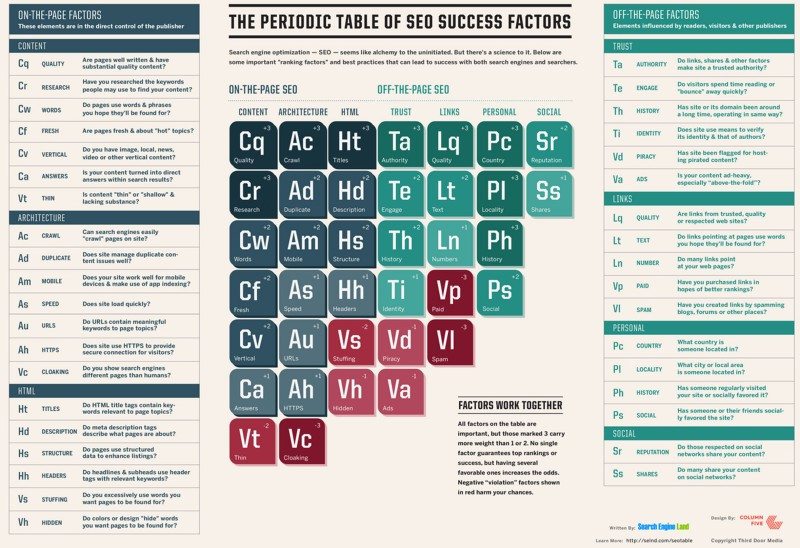
In the ever-evolving world of digital marketing, staying up-to-date with the latest SEO ranking factors is essential for any website owner or marketer. Search Engine Optimization (SEO) is a dynamic field, with search engines like Google constantly updating their algorithms to provide users with the best possible search results. In this blog post, we will delve into the SEO ranking factors that were relevant in 2015, providing you with valuable insights into how you can improve your site’s performance in search results.
The SEO Landscape in 2015
Before we dive into the specific ranking factors, let’s take a moment to understand The SEO Landscape in 2015. Back then, Google was the dominant search engine, accounting for over 90% of all global searches. It had already introduced major updates like Panda, Penguin, and Hummingbird in the preceding years, all aimed at improving search quality and penalizing low-quality content and manipulative tactics.
Mobile Optimization (Mobilegeddon)
In 2015, the significance of mobile optimization was becoming increasingly apparent. Google recognized the growing trend of users accessing websites via mobile devices, and as a result, they introduced what became known as “Mobilegeddon.” This algorithm update aimed to reward websites that were mobile-friendly with higher rankings in mobile search results.
To improve your site’s mobile optimization in 2015, you needed to:
- Responsive Design: Ensure your website was built with a responsive design, which adapts to different screen sizes and orientations.
- Mobile-Friendly Testing: Utilize Google’s Mobile-Friendly Test tool to check if your site met their mobile optimization criteria.
- Page Speed: Optimize page loading times, as slower sites tend to perform poorly on mobile devices.
- Usability: Make sure your site’s navigation and user interface were user-friendly on smaller screens.
Quality Content and Keywords
High-quality content has always been a crucial factor in SEO, and it was no different in 2015. Google’s algorithms were becoming more sophisticated at identifying relevant and valuable content for users. Here’s how you could improve your site’s content and keyword optimization:
- Keyword Research: Conduct thorough keyword research to identify the terms and phrases relevant to your niche. Use tools like Google Keyword Planner and Moz Keyword Explorer.
- Content Quality: Create informative, engaging, and original content that addressed the needs and interests of your target audience. Avoid duplicate content and keyword stuffing.
- Keyword Usage: Use keywords naturally in your content, including in titles, headings, and throughout the body. Focus on providing value rather than obsessing over keyword density.
- Long-Form Content: Longer, comprehensive articles often performed better in search results. Aim for in-depth content that thoroughly covers the topic.
- Freshness: Keep your content up-to-date and relevant. Regularly update and refresh older articles to maintain their search visibility.
Backlinks and Link Building
Backlinks, or inbound links from other websites to yours, continued to be a significant ranking factor in 2015. However, the quality and relevance of these links were becoming increasingly important. To improve your site’s backlink profile:
- Quality over Quantity: Focus on acquiring high-quality, authoritative backlinks from reputable websites within your niche.
- Natural Link Building: Avoid spammy link-building tactics like buying links or participating in link schemes. Instead, aim for natural, organic backlinks earned through valuable content.
- Anchor Text: Use varied anchor text when building backlinks to maintain a natural link profile. Avoid over-optimized anchor text.
- Diversity of Sources: Seek backlinks from a diverse range of sources, including blogs, news sites, forums, and social media.
- Competitor Analysis: Analyze your competitors’ backlink profiles to identify opportunities for acquiring similar links.
User Experience (UX) and Technical SEO
A seamless user experience was increasingly important in 2015. Google considered factors like page speed, mobile-friendliness, and overall site performance when ranking websites. To enhance your site’s UX and technical SEO:
- Page Speed: Optimize your site’s loading speed by compressing images, utilizing browser caching, and minimizing HTTP requests.
- Mobile Optimization: Ensure your site is responsive and mobile-friendly to cater to the growing number of mobile users.
- Secure Connection (HTTPS): Transition to HTTPS for a more secure and trustworthy browsing experience.
- Site Structure: Create a clear and logical site structure with easily navigable menus and internal linking.
- XML Sitemaps: Generate XML sitemaps to help search engines crawl and index your site more effectively.
Social Signals
Social signals, such as social media shares and engagement, were starting to gain importance as SEO ranking factors in 2015. While the direct impact of social signals on rankings was debated, there was evidence to suggest that content with high social engagement tended to perform better in search results.
To leverage social signals for SEO:
- Shareable Content: Create content that was shareable and resonated with your audience on social media platforms.
- Social Sharing Buttons: Include social sharing buttons on your website to make it easy for visitors to share your content.
- Engage on Social Media: Actively engage with your audience on social media, responding to comments and fostering a sense of community.
- Google+ (at the time): Since Google+ was still active in 2015, it was advisable to maintain a presence on this platform, as Google seemed to consider Google+ activity in rankings.
Local SEO
Local SEO was a growing trend in 2015, especially for businesses with physical locations. To improve your site’s visibility in local search results:
- Google My Business: Claim and optimize your Google My Business (GMB) listing with accurate business information, reviews, and photos.
- Local Citations: Ensure consistent NAP (Name, Address, Phone Number) information across online directories and listings.
- Local Content: Create localized content that addressed the specific needs and interests of your local audience.
- User Reviews: Encourage and manage user reviews on platforms like Google and Yelp, as positive reviews could influence local rankings.
Conclusion
In 2015, SEO was already a complex and dynamic field, and it has only continued to evolve since then. While many of the ranking factors discussed in this article remain relevant today, it’s essential to stay updated with the latest developments in SEO to maintain and improve your site’s performance in search results.
To succeed in SEO, remember these key takeaways from 2015:
- Prioritize mobile optimization to cater to the growing number of mobile users.
- Focus on high-quality content that provides real value to your audience.
- Build a strong backlink profile with high-quality, relevant links.
- Enhance user experience and technical SEO for better rankings.
- Leverage social media for increased visibility and engagement.
- If you have a physical location, invest in local SEO to reach local customers.
By staying informed and adapting to the ever-changing SEO landscape, you can ensure that your website continues to rank well and attract organic traffic in the years to come. SEO is a long-term game, and staying up-to-date is the key to success.

Author:
Mark Ford