
Are you struggling to grow your online business despite your best efforts? Want to know which common mistakes could be holding back your growth and profits?
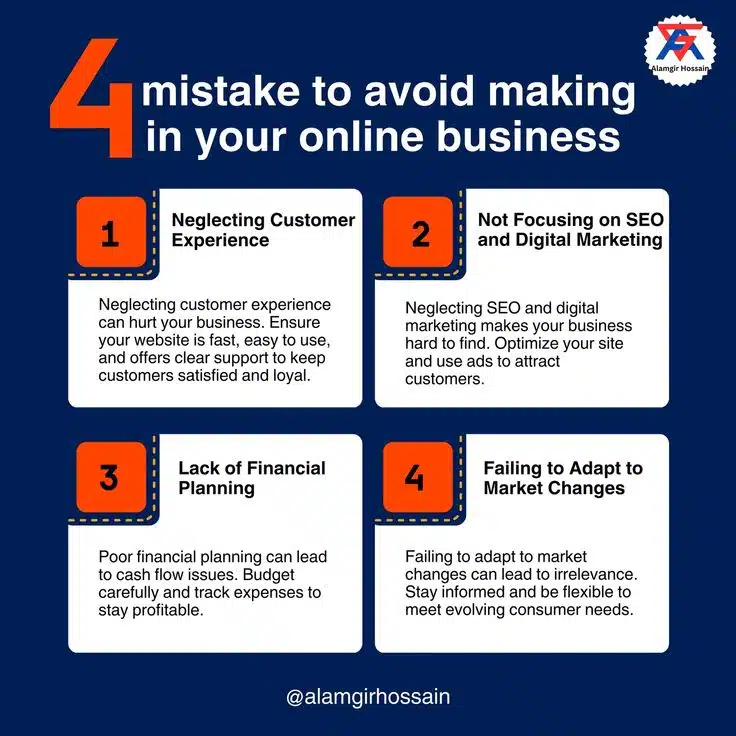
You’ll find some online basics in this infographic.
It breaks things down as follows:
- Neglecting Customer Experience
- Not Focusing on SEO and Digital Marketing
- Lack of Financial Planning
- Failing to Adapt to Market Changes
Check out the post below for more.
Building a successful online business isn’t just about launching a website and waiting for customers to show up. Growth and profitability demand careful planning, attention to customer needs, and agility in a fast-changing digital landscape.
Yet many businesses unintentionally sabotage their own success by making a few critical errors. In this post, we explore the top four mistakes holding businesses back—and how to avoid them.
Neglecting Customer Experience
Customer experience is the foundation of any successful online business. When your website is slow, confusing, or lacks support options, customers won’t stick around. A poor experience can damage your reputation and reduce repeat business. To grow consistently, your customer journey needs to be fast, friendly, and friction-free.
- Optimise your website speed
Users expect fast load times. Use tools like Google PageSpeed Insights to identify and fix delays caused by large images, poor hosting, or inefficient code. - Simplify navigation and layout
Make it easy for visitors to find what they need. Use clear menus, logical page structures, and consistent design to guide users through your site. - Offer responsive customer support
Add live chat, FAQs, or contact forms so visitors can get help when they need it. Fast responses build trust and reduce drop-off rates. - Make your website mobile-friendly
With most traffic now coming from smartphones, a mobile-optimised experience is essential. Use responsive design and test how your site works on different devices.
Not Focusing on SEO and Digital Marketing
No matter how good your products or services are, they won’t sell if people can’t find you. Many businesses overlook the importance of SEO and digital marketing, leaving their websites buried in search results. Visibility is key—without it, growth slows and profitability suffers.
- Invest in on-page SEO
Optimise your pages with relevant keywords, descriptive headings, and meta tags. Make sure every page has a clear focus and includes internal links. - Start a content marketing strategy
Publish helpful blog posts, guides, and videos that address your audience’s questions. Content builds trust and improves search engine rankings over time. - Use paid ads strategically
Platforms like Google Ads and Facebook Ads can drive targeted traffic quickly. Test different ad creatives and audiences to maximise ROI. - Track performance with analytics
Use Google Analytics or similar tools to monitor where your traffic comes from and how users behave. Data helps you refine your strategy for better results.
Lack of Financial Planning
A great product won’t save you from poor financial management. Many online businesses fall short because they don’t plan for cash flow, overspend on untracked expenses, or fail to forecast accurately. Without strong financial foundations, growth becomes unsustainable.
- Create a detailed budget
Break down monthly costs, including hosting, software, marketing, and staff. Knowing where your money goes allows for smarter decisions. - Track income and expenses regularly
Use accounting software like Xero or QuickBooks to stay on top of your finances. Regular reviews help you catch problems early. - Plan for seasonal fluctuations
Anticipate slow periods and high-demand spikes by reviewing past performance. Build a buffer into your budget to cover lean months. - Reinvest in high-ROI areas
Identify what’s working—be it ads, SEO, or email marketing—and double down. Reinvestment fuels scalable, long-term growth.
Failing to Adapt to Market Changes
The online world moves fast—and standing still can mean falling behind. Businesses that ignore emerging trends, evolving consumer behaviour, or new competitors often lose relevance. To stay profitable, you need to monitor change and be ready to pivot when needed.
- Monitor industry trends and tools
Keep up with changes in technology, platforms, and customer expectations. Subscribe to industry blogs, attend webinars, and follow thought leaders. - Stay close to your customers
Use surveys, reviews, and support queries to understand shifting needs. Listening to feedback can spark ideas for improvement or innovation. - Test and tweak regularly
Experiment with new products, services, or marketing channels. Run A/B tests on your website to refine your messaging and layout. - Embrace flexibility in your strategy
Be prepared to pivot if something isn’t working. Whether it’s pricing, positioning, or your product mix, adaptability keeps you competitive.
Final Thoughts
Success in the online world rarely comes from doing one big thing right—it comes from avoiding the most common missteps. When you overlook customer experience, ignore digital marketing, skip financial planning, or resist change, you create barriers to your own growth. But by correcting these issues, you open the door to a smoother, smarter, and far more profitable future.
Take the time to assess where your business stands on each of these four fronts. Are you offering an exceptional customer experience? Are you visible and active in your market? Do you have your finances under control? Are you ready for what’s next? The answers to these questions will determine not just your current success—but your future potential.

Author:
Mark Ford