Are you looking for ways to improve your online presence? Want to know how utilise the fine art of storytelling in your marketing strategy?
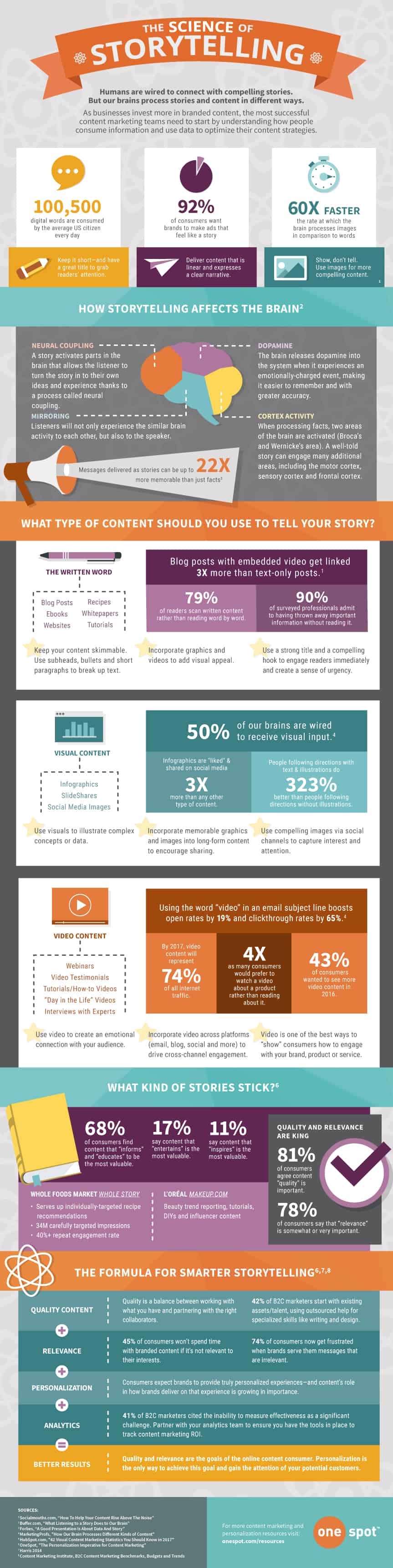
One Spot share the science of storytelling in this infographic.
Here’s a summary of what you’ll learn:
- How storytelling affects the brain
- The type of content you should use to tell your story
- The kind of stories that stick
- The formula for smarter storytelling
Check out the infographic for more detail.
In today’s highly competitive business landscape, capturing your audience’s attention is harder than ever. Yet, there is one tool that has consistently proven effective over millennia: storytelling. Stories have a unique power to connect with people on an emotional level, spark curiosity, and build trust. But storytelling is not just an art—it’s a science that has a profound impact on our brains, shaping our thoughts, actions, and decisions.
This blog post will break down the science of storytelling and how your business can leverage it to create more engaging content, build stronger relationships with customers, and ultimately drive growth.
How Storytelling Affects the Brain
For small businesses, the science of storytelling provides a powerful framework to engage potential customers and build lasting relationships. Understanding how storytelling affects the brain enables you to craft content that resonates deeply with your audience, ensuring your message is not only heard but remembered. Here’s a more in-depth look at how storytelling influences the brain, along with actionable tips to help small businesses harness this power effectively.
- Engages Multiple Brain Regions
As mentioned earlier, storytelling engages different regions of the brain. When your audience reads or listens to a well-told story, it doesn’t just process the words in a linear way—it lives the experience.
- Tip for Small Businesses: Use vivid, sensory-rich descriptions when crafting your stories. If you run a bakery, for example, don’t just tell customers that your cakes are delicious. Describe the rich, buttery aroma that fills the air when your pastries come out of the oven. Make your audience imagine the texture of the soft, freshly baked bread in their hands. By appealing to multiple senses, you create a more immersive experience, making your story more memorable and emotionally engaging.
- Triggers Emotional Responses
Emotion is central to decision-making. Research shows that when people are presented with emotional stimuli—such as a touching story or a heartfelt testimonial—their brains process information differently. Emotional stories activate the limbic system, which governs our emotional and behavioral responses.
- Tip for Small Businesses: Focus on crafting stories that trigger specific emotional reactions. Think about the core emotions you want to evoke in your audience. If you’re a family-run business, share stories that highlight warmth, togetherness, and community. If you offer a product designed to solve a frustrating problem, focus on the relief and satisfaction your customers feel after using it. By tailoring your storytelling to elicit strong emotions, you’ll form a deeper connection with your audience and inspire action.
- Guidance: Be careful not to manipulate emotions. Authentic emotional storytelling is key. Customers today are savvy, and they can detect when a brand is trying too hard to play on their feelings. Ensure your emotional stories align with your brand values and real experiences to maintain credibility and trust.
- Releases Oxytocin
Oxytocin, often called the “bonding hormone,” plays a crucial role in forming relationships. When you share a story that builds trust—especially one that features real people and authentic experiences—oxytocin levels in the audience’s brain increase. This hormone encourages empathy and fosters a sense of connection.
- Tip for Small Businesses: To stimulate the release of oxytocin, focus on stories that showcase trust, kindness, and collaboration. Share personal stories about the relationships you’ve built with suppliers, customers, or even within your team. For example, a local coffee shop might tell the story of its partnership with a local farmer, highlighting the care that goes into sourcing organic coffee beans. By showing your business as part of a larger, trustworthy community, you foster a sense of belonging and authenticity.
- Guidance: Use video content where possible. Research shows that visual storytelling, particularly through video, enhances the emotional impact of a story. Seeing faces, hearing voices, and witnessing genuine emotions can make the release of oxytocin even more pronounced.
- Improves Memory Retention
Dopamine is released in the brain when something captures our attention or creates emotional significance. This “reward” chemical not only makes us feel good but also helps encode memories more effectively. This is why we remember stories far better than facts or statistics alone.
- Tip for Small Businesses: Use storytelling to anchor key messages. If you’re running a promotion or launching a new product, wrap your announcement in a narrative. Instead of saying, “We have a 20% discount this week,” tell the story of how the discount came to be. Perhaps your founder is celebrating a personal milestone or the team recently reached a significant company achievement. By framing promotions and key messages within stories, customers are more likely to remember them.
- Guidance: Use metaphors and analogies in your stories to make abstract or complex ideas easier to understand. For example, if you’re a tech startup explaining a complicated software solution, relate it to something familiar, like comparing your software to a digital toolbox that helps customers “build” their business efficiently. Metaphors engage the brain’s associative areas, aiding memory retention.
- Promotes Neural Coupling
Neural coupling is the process by which the storyteller and listener’s brains synchronize. This phenomenon means that, as the storyteller, you are essentially “sharing” an experience with your audience. It’s like your audience is experiencing your story right alongside you.
- Tip for Small Businesses: Make your audience the hero of the story. Instead of always focusing on your business, shift the focus to your customers. Let your story be about how your product or service has transformed their lives or solved their problems. This customer-centric storytelling strengthens neural coupling because it makes the audience feel personally connected to the narrative.
- Guidance: Invite participation and interaction in your storytelling. Encourage customers to share their own stories through testimonials, social media posts, or user-generated content. When customers see themselves in your brand’s story, neural coupling is even more effective, fostering a sense of community and shared experience.
- Builds Empathy
Storytelling allows us to step into someone else’s shoes, even if only for a brief moment. This ability to create empathy is crucial for small businesses, as it enables you to show your audience that you understand their struggles and desires.
- Tip for Small Businesses: Share empathy-driven stories that reflect the challenges your audience faces. For example, if you run a fitness center, don’t just talk about getting in shape—tell the story of someone who struggled to balance work, family, and fitness but found a way to succeed with your help. Highlight the human side of the story, showing how your business addresses real-life issues your customers care about.
- Guidance: Avoid generic stories. The more specific and personal the story, the more likely it is to build empathy. Your audience needs to see that you understand their unique problems and are not just offering a one-size-fits-all solution.
Practical Guidance for Small Businesses on Crafting Stories
To truly take advantage of the brain’s response to storytelling, small businesses should consider the following storytelling strategies:
- Be Specific with Your Target Audience
Tailor your stories to resonate with the specific demographics and psychographics of your customers. Understand their pain points, desires, and values. If you’re a local business, your stories should emphasize community, support, and personal relationships, which are likely more relevant to your audience than broader, global narratives.
- Use Visual Storytelling
Incorporate visual elements such as images, graphics, and videos to enhance your storytelling. These elements activate even more areas of the brain, making your content more engaging. Small businesses can use platforms like Instagram, TikTok, and YouTube to share visual stories about their brand journey, customer experiences, or product development.
- Consistency is Key
Repetition helps reinforce memory. Consistently tell stories across your marketing channels that reinforce your brand values and message. Whether it’s through social media, newsletters, or your website, make sure your storytelling remains cohesive.
- Leverage Social Proof
Real customer stories, testimonials, and case studies are especially powerful. These not only engage the brain but also add credibility and trust. Encourage customers to share their experiences through online reviews, testimonials, or user-generated content that can be integrated into your storytelling.
- Keep it Simple and Authentic
Simplicity and authenticity often win over complex, highly produced narratives. In storytelling, less is often more. A heartfelt, straightforward story that speaks to your audience’s emotions and experiences will be more impactful than a complicated, jargon-filled message.
By understanding and applying these insights into how storytelling affects the brain, small businesses can create stories that captivate, engage, and ultimately convert their audience into loyal customers. Stories are not just marketing tools—they are pathways to building deeper, more meaningful relationships with your audience.
The Type of Content You Should Use to Tell Your Story
For small businesses, storytelling is not just about what you say—it’s about how you say it and through which mediums. By leveraging the right types of content, you can effectively communicate your brand’s story, build stronger customer relationships, and ultimately drive sales. Each form of content has its own strengths and is suited to different storytelling purposes. Here’s an in-depth guide for small businesses on how to use different types of content to tell your brand’s story effectively.
- Brand Stories
Your brand’s origin story is one of the most powerful narratives you can share, especially if you’re a small business. People love to know how companies started, the challenges they overcame, and what motivated the founders to launch the business. This story can humanize your brand and make it relatable to your audience.
- Tip for Small Businesses: Be transparent and personal. Share the personal motivations behind your business—whether it’s a passion project, a response to a gap in the market, or a mission to solve a problem you faced yourself. For example, if you run a family-owned restaurant, tell the story of how your grandmother’s recipes inspired the menu or how your community helped you get started.
- Guidance: Use your “About Us” page on your website to tell your brand story. Instead of filling it with generic company information, craft a compelling narrative about your journey, struggles, and vision. Add visuals like old photographs, behind-the-scenes videos, or even handwritten notes to bring authenticity to your story.
- Bonus Tip: Don’t forget to show your company values in your story. Highlight what matters most to your business, such as sustainability, community support, or customer care. When customers see shared values in your story, it builds a stronger connection.
- Customer Success Stories
Nothing sells your product or service better than a satisfied customer. Customer success stories act as powerful testimonials and provide social proof of your business’s effectiveness. These stories also show potential customers how they might benefit from your product or service by highlighting real-world results.
- Tip for Small Businesses: Feature real customers in your stories and make them the heroes. Share their journey from before they found your product or service to how their life or business improved after using it. Use a storytelling format: Set the stage, describe the conflict (the problem the customer was facing), present the solution (your product or service), and conclude with the positive outcome.
- Guidance: Gather stories from different types of customers to reach a wider audience. For instance, if you sell fitness equipment, feature success stories from different customer groups—busy parents, fitness enthusiasts, or older adults. This diversity allows you to show that your product works for various people with different needs.
- Bonus Tip: Use video testimonials whenever possible. Videos can capture emotion, tone, and personality much better than text alone. Encourage your customers to share their experiences in short, authentic video clips. You can use these clips on your website, social media, or in marketing emails.
- Case Studies
For businesses that work in more technical or service-driven industries, such as B2B companies, case studies can be invaluable. A case study takes a more structured and data-driven approach than a customer success story. It explores a specific problem your customer faced, how your business provided a solution, and what measurable results were achieved.
- Tip for Small Businesses: When writing a case study, make sure to include clear metrics and data that demonstrate the success of your solution. For example, if you’re a digital marketing agency, your case study should include specific numbers, such as how much you increased a client’s traffic, leads, or conversions.
- Guidance: Follow a proven structure when crafting your case study:
- Introduction: Provide background information about the client and the issue they were facing.
- Problem: Explain the problem or challenge in detail.
- Solution: Describe the solution you provided, focusing on how your product or service addressed the problem.
- Results: Present the outcomes, using metrics and data to prove the effectiveness of your solution.
- Conclusion: Summarize the overall success of the project and how your client benefited.
- Bonus Tip: Share case studies on your website’s blog, as downloadable PDFs, or even through email campaigns targeting potential customers in similar industries. Case studies can build credibility, especially when you’re trying to attract business clients who want to see proof before they invest in your product or service.
- Behind-the-Scenes Content
Customers today are more interested than ever in transparency and authenticity. Behind-the-scenes content offers your audience a sneak peek into the inner workings of your business, whether it’s how you create your products, the day-to-day operations of your team, or the decisions that drive your brand.
- Tip for Small Businesses: Use behind-the-scenes content to humanize your brand and build a sense of closeness with your audience. For example, if you’re a small business owner in the handmade goods space, take your customers on a journey from raw materials to the finished product. Show the craftsmanship, care, and time that goes into making each piece.
- Guidance: Behind-the-scenes content works well across various platforms:
- Instagram Stories or Reels: Share short, authentic clips that give a glimpse into your workspace or creative process.
- YouTube or Facebook videos: Create longer-form content that delves into your brand’s culture, team members, or production.
- Blog posts: Write about your company’s values, workplace culture, or the reasons behind important business decisions.
- Bonus Tip: Don’t be afraid to show imperfection. Authentic behind-the-scenes content isn’t about perfection; it’s about giving a real and raw look into your business. Show the challenges and triumphs that occur behind closed doors. This authenticity will help you build trust and loyalty with your audience.
- User-Generated Content (UGC)
User-generated content is a goldmine for small businesses. It refers to content created by your customers, such as photos, videos, reviews, or social media posts, where they share their experiences with your brand. UGC is incredibly effective because it comes from real customers, making it more trustworthy and authentic than brand-produced content.
- Tip for Small Businesses: Encourage customers to share their stories using branded hashtags on social media, or create campaigns where customers submit content for a chance to be featured on your website or social channels. For example, a small business selling skincare products might ask customers to post “before and after” photos, showcasing how the products improved their skin.
- Guidance: Always acknowledge and celebrate your customers’ contributions. When customers tag you or use your branded hashtag, engage with them by liking, commenting, or resharing their content. This makes your customers feel valued and increases the likelihood of them continuing to share.
- Bonus Tip: Feature user-generated content on your product pages. Photos and reviews from real customers can help build credibility and influence purchasing decisions. For example, an online clothing retailer can use UGC by showing pictures of customers wearing their clothes, adding an element of social proof.
- Blogs and Long-Form Content
Long-form content, such as blog posts, can be a great way to tell your story in more depth. Blogging allows you to share your expertise, insights, and the values that define your business. It’s an opportunity to educate your audience and demonstrate your industry knowledge while weaving storytelling into your content.
- Tip for Small Businesses: Use your blog to tell stories about your journey, share helpful tips, or discuss current trends in your industry. Storytelling can be used in educational content by including anecdotes or real-life examples to illustrate points. For example, if you run a home improvement business, you could write blog posts that tell the story of specific projects, including challenges you faced and how you overcame them.
- Guidance: Create a content calendar to ensure regular blog updates. Consistent storytelling through blog posts keeps your audience engaged and builds your brand over time. Consider mixing storytelling with informative or “how-to” content, which can attract search engine traffic while also providing value to your readers.
- Bonus Tip: Repurpose your blog content into different formats. A blog post can easily become a social media caption, an infographic, or even a podcast episode. Repurposing your content helps you reach a broader audience while maintaining a consistent brand narrative across platforms.
Practical Tips for Small Businesses to Effectively Use Storytelling Content
To maximize the impact of storytelling content, here are some additional best practices for small businesses:
- Leverage Social Media
Social media platforms, especially Instagram, TikTok, and Facebook, are perfect for sharing different types of storytelling content. Use these platforms to tell quick, engaging stories through posts, videos, and stories. Focus on short-form content like customer highlights, behind-the-scenes looks, or mini customer testimonials.
- Use Data-Backed Content
Incorporating data into storytelling content, especially with case studies or customer success stories, can help substantiate your claims. Potential customers, especially in B2B industries, want to see real results before they make decisions.
- Build a Content Library
Create a library of storytelling content that you can reuse and share over time. This could include testimonials, behind-the-scenes videos, customer stories, and more. Having a repository of storytelling assets will make it easier to keep your marketing fresh and engaging.
- Collaborate with Customers
Your customers are your best storytellers. By partnering with them to create content—whether through reviews, testimonials, or UGC—you build credibility and trust. Encourage and celebrate customer participation in your storytelling efforts.
By using these content types and strategies, small businesses can effectively tell their stories, build trust, and grow their brand in a competitive marketplace. Whether through blogs, social media, or video, every piece of content is an opportunity to tell a story that resonates with your audience.
The Kind of Stories That Stick
For small businesses, creating stories that stick with your audience is crucial to building lasting connections, brand recognition, and customer loyalty. While every story has the potential to resonate, some stories are more memorable than others. These are the kinds of stories that not only capture attention but also remain in the minds of your audience long after they’ve encountered them. By focusing on certain storytelling techniques and principles, you can craft narratives that leave a lasting impact. Here’s an in-depth guide for small businesses on how to create stories that truly stick.
- Use Relatable Characters
One of the most important aspects of a story that sticks is relatability. When your audience sees themselves in your characters, they’re more likely to connect emotionally with the story. Whether you’re telling a brand story or sharing customer testimonials, the key is to make your characters feel real and relevant to your target audience.
- Tip for Small Businesses: Make your customers the protagonists of your stories. Instead of centering your story entirely on your business or product, put the spotlight on the people who use it. Use real names, faces, and experiences. For example, if you’re a small fitness studio, tell the story of a local client who overcame personal challenges to reach their fitness goals with your help. By focusing on their journey, you’re making the story more relatable and human.
- Guidance: Develop customer personas based on your target audience. Use these personas to guide the creation of stories that speak directly to the struggles, dreams, and values of your audience. The more your audience can see themselves in your stories, the more likely the story is to stick with them.
- Bonus Tip: Use visual storytelling to enhance relatability. Photos and videos of real customers or employees can help bring your stories to life. Social media platforms like Instagram and Facebook are great places to share visual narratives featuring your characters.
- Tap Into Core Human Emotions
Stories that evoke strong emotions are the ones people remember. Whether it’s joy, sadness, fear, or hope, emotional storytelling helps to create a deeper, more meaningful connection with your audience. Studies show that people are more likely to remember stories that made them feel something.
- Tip for Small Businesses: Identify the key emotions you want your stories to evoke, and weave them into your narrative. For example, if your brand is about providing comfort or relief—like a small bed and breakfast—focus on the emotions of relaxation, escape, and personal care. If you sell products for new parents, your stories should center around feelings of love, protection, and nurturing.
- Guidance: Think about the emotional journey your audience is on when interacting with your brand. If you sell a product or service that solves a particular problem, focus on the emotional before-and-after of your customers. For example, before using your product, they might feel frustrated or anxious, but afterward, they experience relief, happiness, or empowerment.
- Bonus Tip: Use emotional triggers wisely. Small businesses often have an advantage here because they can come across as more authentic and personal than larger brands. Avoid using overly dramatic or manipulative tactics. Instead, focus on real emotions that come from genuine customer experiences or brand values.
- Create Conflict and Resolution
A good story often includes some kind of conflict or challenge followed by a resolution. The conflict is what hooks your audience—it creates tension and makes them curious to find out how the story will end. The resolution, meanwhile, provides satisfaction and often reinforces your business’s value proposition.
- Tip for Small Businesses: Showcase the challenges your customers face and how your business helps them overcome those challenges. For example, if you run a local bakery, your story could revolve around a customer who struggled to find gluten-free options but found delicious alternatives at your bakery. The conflict (difficulty finding gluten-free treats) is resolved by your business’s offerings, which creates a satisfying conclusion.
- Guidance: Be specific about the problem and solution. A story with a vague conflict doesn’t stick as well as one with clear stakes. Your audience should be able to understand exactly what the character in your story is up against and how your business was the turning point that led to success.
- Bonus Tip: Use the hero’s journey structure in your storytelling. In this classic narrative structure, the hero (your customer) embarks on a journey, faces a challenge (the conflict), and with the help of your business (the mentor or guide), they overcome the challenge and achieve success. This timeless structure resonates with people on a deep, psychological level and makes your story more memorable.
- Simplify and Clarify Your Message
One of the biggest challenges in storytelling is keeping the message clear and focused. Stories that stick are often simple and easy to understand. Overcomplicating your story with too much information or unrelated details can confuse your audience and dilute the message.
- Tip for Small Businesses: Keep your story concise and focused on one main idea. Every story you tell should have a clear takeaway or message. If your story is about how your eco-friendly products help the environment, stay focused on that theme rather than introducing too many other subplots or details. The simpler and more direct your story, the easier it is for your audience to grasp and remember.
- Guidance: Use language that is accessible and relatable. Avoid jargon or technical terms that might alienate your audience. If you’re telling the story of how your product works, explain it in terms that your audience can easily understand, even if they’re not experts in your field.
- Bonus Tip: Focus on a single emotional arc in each story. If you try to evoke too many different emotions at once, your audience might get confused about how to feel. Pick one central emotion and build your story around that.
- Make Your Story Relevant
Relevance is critical to making stories stick. Your audience needs to feel like the story matters to them personally, and that it’s not just a generic narrative that could apply to anyone. Relevant stories address your audience’s specific needs, desires, and challenges.
- Tip for Small Businesses: Tailor your stories to your audience’s context. For example, if you run a local clothing boutique, your stories should reflect the fashion preferences and lifestyle of your local community. Perhaps you can tell a story about how your store sources materials from local designers, making it relevant to people who care about supporting their community.
- Guidance: Segment your audience when possible. If your customer base is diverse, create different stories for different segments. For example, if you sell skincare products, you might tell one story for younger customers struggling with acne and another for older customers looking to reduce wrinkles. Each segment will find the stories more relevant because they speak directly to their concerns.
- Bonus Tip: Stay up-to-date with current events and trends that affect your audience. If there’s a timely issue or trend that your business can tie into, craft a story that aligns with that. For example, during environmentally focused events like Earth Day, tell stories about your business’s sustainability efforts.
- Incorporate Surprise or Uniqueness
Stories that contain an element of surprise or unexpected twist tend to stick in people’s minds. This could be an unusual plot twist, a surprising fact, or a unique perspective. The element of surprise triggers a stronger emotional response, which helps with memory retention.
- Tip for Small Businesses: Introduce a twist in your storytelling that catches your audience off guard. For instance, if your brand story involves how your business started, you might include a surprising challenge or coincidence that led to your success. This unexpected element will make your story more memorable and interesting.
- Guidance: Use surprise in moderation. A story that relies too heavily on shocking moments can come across as gimmicky. The key is to blend surprise with authenticity and keep it aligned with your overall message.
- Bonus Tip: Highlight what makes your business unique or unconventional. If you’re a small business with a distinctive offering, like handcrafting all your products or using a rare technique, make that the surprise in your story. This will differentiate you from competitors and make your story stand out.
- Incorporate Visual and Sensory Details
Stories that include vivid imagery or sensory details tend to stick better because they engage more of the brain. Describing specific sights, sounds, smells, and textures makes the story more immersive, which helps your audience to remember it.
- Tip for Small Businesses: Use sensory-rich descriptions to enhance your storytelling. For example, if you run a coffee shop, don’t just say, “We make great coffee.” Instead, describe the aroma of freshly roasted beans, the sound of coffee brewing, or the smooth texture of a perfectly crafted latte. These details bring the story to life and make it more engaging for your audience.
- Guidance: Pair your sensory storytelling with visual content whenever possible. Share photos, videos, or graphics that support the narrative. For example, you could create a short video that shows the step-by-step process of making your product, accompanied by descriptions of what customers might smell, feel, or hear at each stage.
- Bonus Tip: Create multi-sensory experiences through live events, product demonstrations, or in-store experiences. If your customers can experience your brand through multiple senses, they’re more likely to remember the story behind it.
Practical Tips for Small Businesses to Create Stories That Stick
Here are some additional tips to help small businesses ensure their stories remain memorable:
- Use Repetition
Repetition is a key factor in making stories stick. Retell important parts of your brand story across various platforms. Whether it’s through social media, email marketing, or in-person conversations, ensure that your key stories are consistently shared.
- Test and Iterate
Don’t be afraid to test different types of stories and see which ones resonate the most with your audience. Track engagement metrics like shares, comments, or sales conversions tied to specific stories, and use this data to refine your approach.
- Incorporate Storytelling Across All Marketing Channels
Consistency is crucial. Use the same storytelling principles in your website copy, email marketing, social media posts, and even packaging or in-store experiences. This helps reinforce your brand narrative, making it more likely to stick with your audience over time.
By focusing on these principles—relatability, emotion, conflict, simplicity, relevance, and surprise—small businesses can craft stories that resonate deeply with their audience and stick in their minds long after the first encounter.
The Formula for Smarter Storytelling
Smarter storytelling isn’t just about telling a good story; it’s about using storytelling strategically to drive results for your small business. The most successful brands use storytelling to create emotional connections, build loyalty, and inspire action, whether that’s a purchase, a referral, or simply building brand awareness. To achieve this, you need a systematic approach to storytelling that combines creativity with business objectives. In this section, we’ll explore the formula for smarter storytelling and provide practical tips for small businesses to create compelling narratives that drive real-world results.
- Know Your Audience Inside Out
The first step in any storytelling strategy is to thoroughly understand your target audience. Smarter storytelling is highly personalized and tailored to the specific needs, challenges, and desires of your customers. Without a deep understanding of your audience, your story may fall flat or fail to resonate.
- Tip for Small Businesses: Create detailed customer personas that go beyond demographics. Focus on psychographics, including their pain points, values, buying behavior, and emotional triggers. What are their goals? What keeps them up at night? By knowing what drives your customers, you can tailor your story to directly address their needs.
- Guidance: Use customer surveys, social media insights, and analytics to gather data about your audience. Pay attention to the type of content they engage with, what problems they discuss in forums or reviews, and what language they use. This data will help you craft stories that speak directly to your customers’ hearts and minds.
- Bonus Tip: Divide your audience into different segments based on shared characteristics or behaviors. This allows you to create multiple storylines that appeal to different segments of your audience. For example, if you’re a small business selling outdoor gear, you might tell one story for avid hikers and another for casual campers. Each group has different motivations, and your storytelling should reflect that.
- Start with a Clear Purpose
Every story you tell should have a specific purpose, whether it’s to inform, entertain, or inspire action. Smarter storytelling aligns with your business goals and moves your audience through the customer journey—from awareness to consideration to decision-making. The best stories aren’t just entertaining; they’re also strategic.
- Tip for Small Businesses: Identify the objective of each story before you start creating it. Are you trying to raise brand awareness? Increase sales of a particular product? Build trust with a skeptical audience? Clarifying the purpose will help you stay focused and ensure that your story aligns with your broader business objectives.
- Guidance: For each story, define a clear call-to-action (CTA). This might be asking the audience to visit your website, sign up for a newsletter, share the story with friends, or make a purchase. A story without a purpose or CTA may be enjoyable, but it won’t drive the results you need.
- Bonus Tip: Consider your sales funnel when crafting stories. At the top of the funnel, you might focus on broader brand stories that build awareness. In the middle, you can use customer success stories or product tutorials to address specific pain points. At the bottom, case studies or testimonials can nudge customers to make a final purchase.
- Leverage a Strong Narrative Structure
Even in marketing, structure matters. A well-organized story with a beginning, middle, and end is easier for your audience to follow and more likely to leave a lasting impression. Smarter storytelling follows a tried-and-true structure that creates an emotional arc, keeps the audience engaged, and delivers a satisfying conclusion.
- Tip for Small Businesses: Use the problem-solution-benefit framework. Start by identifying a problem or challenge that your customer is facing, introduce your business or product as the solution, and end with the benefits or outcomes that come from using your product. This straightforward structure is effective because it mirrors the customer’s own decision-making process.
- Guidance: A classic storytelling technique that works well for businesses is the “Hero’s Journey”. In this structure:
- The Hero (Your Customer): Introduce your customer as the central figure.
- The Challenge: Present a problem or obstacle they face.
- The Guide (Your Brand): Show how your product or service helps them overcome the challenge.
- The Transformation: End with a clear depiction of the customer’s success or transformation after using your product.
- Bonus Tip: Incorporate visual storytelling techniques, such as photos, videos, or infographics, to support your narrative. Visuals can make your story more engaging and help explain complex concepts more clearly. For example, if your small business sells tech gadgets, a video showing the product in action is often more effective than text alone.
- Be Authentic and Transparent
Today’s consumers are more skeptical than ever, and they can often spot a fake story from a mile away. Smarter storytelling requires authenticity—your stories should reflect the real values, mission, and operations of your business. Authenticity builds trust, which in turn strengthens customer loyalty.
- Tip for Small Businesses: Avoid over-polishing your stories. It’s okay if they aren’t perfect. In fact, stories that show vulnerability or challenges can be more relatable and compelling than stories that only focus on success. For example, if you’re a small business that faced challenges during the pandemic, sharing how you adapted and grew stronger can resonate with customers who value resilience and transparency.
- Guidance: Stay true to your brand voice and personality in all your storytelling efforts. If your brand is casual and friendly, your stories should reflect that tone. If you’re more formal and professional, ensure that your stories align with that voice. Consistency across platforms and content helps reinforce authenticity.
- Bonus Tip: Involve your audience in the storytelling process. User-generated content (UGC) can be incredibly powerful because it comes directly from your customers, making it more trustworthy. Encourage your customers to share their stories about how they use your products and feature them on your website or social media channels.
- Incorporate Data and Insights
While storytelling is often seen as an emotional or creative process, incorporating data can add credibility and reinforce your message. Data-driven stories can help sway customers who are more logical in their decision-making process, such as B2B buyers or tech-savvy consumers.
- Tip for Small Businesses: Include key metrics and statistics in your stories to demonstrate real-world results. For example, if you’re a local marketing agency, you might tell the story of how you helped a client increase website traffic by 150% through targeted campaigns. The data makes the story more convincing and highlights the tangible benefits of your service.
- Guidance: Use customer testimonials that include specific numbers or measurable results. Testimonials with quantified results—such as “I doubled my sales within six months” or “I lost 15 pounds in two months using this product”—are more persuasive and memorable than vague praise.
- Bonus Tip: Visualize your data whenever possible. Use charts, graphs, or infographics to present statistics and key figures in a visually engaging way. People tend to remember visuals better than numbers alone, so pairing your data with compelling visuals can make your story more impactful.
- Make Your Story Interactive
Engagement is key in today’s digital landscape, and smarter storytelling often involves making the audience a part of the narrative. By creating interactive or participatory elements, you can increase engagement, deepen the connection with your audience, and encourage them to take action.
- Tip for Small Businesses: Use social media polls, quizzes, or challenges to engage your audience in the storytelling process. For example, if you run a small coffee shop, you could create a poll asking customers to vote on their favorite coffee blend. Once the winning blend is chosen, share the story of how you developed that product, incorporating customer input into the narrative.
- Guidance: Use interactive elements on your website or in your email marketing campaigns. For instance, a quiz that helps customers find the perfect product for their needs can double as a storytelling tool, guiding them through different product options with a narrative that leads to a recommendation.
- Bonus Tip: Consider hosting live events, webinars, or Q&A sessions where your audience can interact with you in real-time. These events can be structured around storytelling, allowing you to present your brand narrative while responding to questions and comments from the audience. This two-way engagement makes your storytelling more dynamic and memorable.
- Measure and Refine Your Storytelling Efforts
The final element of smarter storytelling is measurement. In order to continually improve your storytelling efforts, you need to track how well your stories are performing. Are they resonating with your audience? Are they driving conversions? By analyzing the results, you can refine your approach to storytelling and make data-driven adjustments over time.
- Tip for Small Businesses: Track key performance indicators (KPIs) for your storytelling content, such as engagement rates, social shares, click-through rates, and conversions. If you notice certain types of stories are generating more engagement or sales, focus on creating more content in that style.
- Guidance: Use tools like Google Analytics, social media insights, and email marketing metrics to gather data on your storytelling efforts. For example, if you’re sharing stories through email, track open rates and click-through rates to see which types of stories resonate the most with your audience.
- Bonus Tip: Don’t be afraid to experiment with different formats and platforms. A story that works well as a blog post might also work as a podcast or a YouTube video. Test different formats to see what works best for your audience, and continually optimize your content based on performance data.
Practical Tips for Small Businesses to Implement Smarter Storytelling
- Create a Content Calendar: Plan your storytelling efforts by creating a content calendar that aligns with your business objectives. This ensures that your stories are strategically timed and consistent across platforms.
- Invest in Quality Visuals: Whether you’re telling stories through photos, videos, or infographics, invest in high-quality visuals that enhance your narrative.
- Collaborate with Influencers or Local Partners: Partner with local influencers or businesses to co-create stories that expand your reach and tap into new audiences.
By following these steps—understanding your audience, defining a clear purpose, structuring your narrative, and using data—you can create smarter, more effective stories that resonate deeply with your customers and drive business growth.
Conclusion
Storytelling isn’t just about entertainment; it’s about engaging your audience on a deeper level, creating connections, and influencing decisions. The science behind storytelling shows that it’s an incredibly effective tool for businesses to build trust, foster loyalty, and inspire action. By understanding how storytelling affects the brain, choosing the right content, crafting memorable stories, and following a proven storytelling formula, your business can harness the power of stories to stand out in today’s crowded market.
As you move forward with your marketing efforts, remember that stories are not just tools to promote your brand—they are bridges that connect you with your audience in meaningful, lasting ways.

Author:
Mark Ford

From Confusion to Clarity: How to Steer Your Marketing Away from These Frequent Errors
Are you struggling to make sense of your marketing strategy and wondering why your results aren’t matching your effort? Want to learn how to avoid the most common marketing mistakes and create a clear, focused plan that actually delivers results? […]